


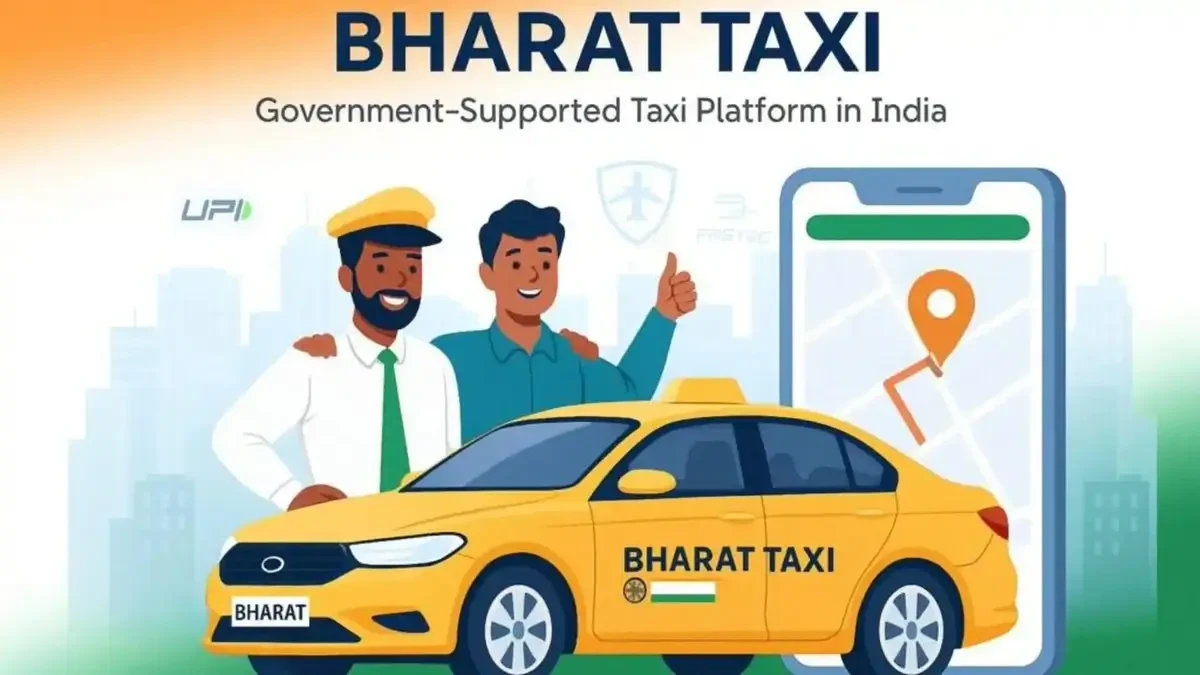
Bharat Taxi Launched: India's First Cooperative Ride-Hailing Platform With Zero Commission and No Surge Pricing
On February 5, 2026, India's ride-hailing industry witnessed a development that could fundamentally alter its competitive landscape. Bharat Taxi, the country's first cooperative-model ride-hailing platform, was officially launched by Union Home Minister Amit Shah in New Delhi. The platform operates under the tagline "Sarathi Hi Malik" — meaning "The Driver is the Owner" — a deliberate and pointed contrast to the gig economy model that has defined ride-hailing in India for the past decade.
What makes Bharat Taxi fundamentally different from Uber, Ola, or Rapido is not just its pricing or technology — it is its ownership structure. Built on the Amul cooperative model that transformed India's dairy industry, Bharat Taxi is owned collectively by its drivers through a cooperative framework backed by eight of India's most powerful cooperative institutions. This is not a venture capital-funded startup trying to undercut competitors temporarily — it is a structural reimagining of how ride-hailing can work.
The Cooperative Model: How It Works
To understand why Bharat Taxi matters, you need to understand the cooperative model and how it differs from the conventional venture capital-funded ride-hailing approach:
| Feature | Uber / Ola / Rapido | Bharat Taxi |
|---|---|---|
| Ownership | Private companies (VC/PE funded) | Cooperative (drivers are owners) |
| Commission | 25-30% of every fare | ZERO commission (Rs 30/day flat fee for cabs, Rs 18 for autos) |
| Surge Pricing | Yes (2x-5x during peak hours) | NEVER — guaranteed no surge pricing |
| Profit Distribution | To shareholders/investors | 80% to drivers, 20% to cooperative |
| Driver Insurance | Limited or none | Rs 10 lakh (Rs 5L accident + Rs 5L health) |
| Driver Status | Independent contractor (gig worker) | Cooperative member (owner-stakeholder) |
The most striking difference is the commission structure. On Uber and Ola, drivers typically lose 25-30% of every fare to the platform. On Bharat Taxi, drivers pay a flat fee of Rs 30 per day for cab drivers and Rs 18 per day for auto drivers — regardless of how many rides they complete or how much they earn. For a driver completing 15-20 rides per day earning Rs 2,000-3,000, this represents a saving of Rs 500-900 per day compared to traditional platforms.
The Amul Inspiration
The Amul cooperative model is one of India's greatest economic success stories. Founded in 1946, it transformed India from a milk-deficient country into the world's largest milk producer by organizing millions of small dairy farmers into a cooperative network where farmers — not middlemen — captured the majority of the value. Amul's annual turnover now exceeds Rs 72,000 crore ($8.5 billion).
Bharat Taxi explicitly models itself on this success. The chairman of Bharat Taxi is Jayen Mehta, the former Managing Director of Amul (GCMMF). His appointment is not symbolic — it is a deliberate choice to bring the operational expertise and cooperative governance philosophy that made Amul successful to the ride-hailing industry.
The Backing: Eight Cooperative Powerhouses
Bharat Taxi is not a scrappy startup working out of a garage. It is backed by eight of India's most established cooperative institutions, collectively representing hundreds of billions of rupees in assets and serving hundreds of millions of Indians:
| # | Institution | Full Name | Role |
|---|---|---|---|
| 1 | NCDC | National Cooperative Development Corporation | Primary promoter and regulatory support |
| 2 | IFFCO | Indian Farmers Fertiliser Cooperative | World's largest fertilizer cooperative — financial backing |
| 3 | Amul/GCMMF | Gujarat Cooperative Milk Marketing Federation | Operational model and governance framework |
| 4 | NABARD | National Bank for Agriculture and Rural Development | Financial infrastructure and rural reach |
| 5 | NDDB | National Dairy Development Board | Cooperative management expertise |
| 6 | KRIBHCO | Krishak Bharati Cooperative | Cooperative network and support |
| 7 | NAFED | National Agricultural Cooperative Marketing Federation | Marketing and distribution expertise |
| 8 | NCEL | National Cooperative Exports Limited | Operational and logistical support |
This institutional backing gives Bharat Taxi several structural advantages that no VC-funded startup can match: access to government infrastructure, established cooperative governance frameworks, massive existing member networks, and — critically — no pressure from venture capital investors to extract maximum profit at the expense of drivers.
Fare Structure: Transparent and Affordable
Bharat Taxi's fare structure is designed to be simple, transparent, and significantly cheaper than competitors — particularly during peak hours when surge pricing on other platforms can multiply fares by 2-5 times:
| Distance | Fare | Details |
|---|---|---|
| Up to 4 km | Rs 30 (minimum fare) | Base fare for short rides |
| 4-12 km | Rs 23/km | Standard city commute rate |
| Beyond 12 km | Rs 18/km | Reduced rate for longer distances |
| Surge Pricing | Rs 0 (NEVER) | No surge pricing at any time, guaranteed |
Fare Comparison: 10 km Ride During Peak Hours
To illustrate the real-world difference, consider a typical 10 km ride during evening peak hours (6-8 PM) in Delhi:
| Platform | Base Fare | Surge Multiplier | Final Fare (Peak) | Driver Keeps |
|---|---|---|---|---|
| Uber | ~Rs 200 | 1.5-2.5x | Rs 300-500 | Rs 210-350 (70%) |
| Ola | ~Rs 190 | 1.5-2.5x | Rs 285-475 | Rs 200-333 (70%) |
| Rapido | ~Rs 180 | 1.3-2x | Rs 234-360 | Rs 164-252 (70%) |
| Bharat Taxi | ~Rs 168 | 1x (NONE) | Rs 168 | ~Rs 166 (99%)* |
*After daily flat fee of Rs 30 amortized across ~15 rides = ~Rs 2/ride
During peak hours, a Bharat Taxi ride could cost passengers 40-70% less than the same ride on Uber or Ola, while the driver keeps nearly 100% of the fare.
Available Ride Types
Bharat Taxi offers a full range of vehicle categories to compete across all market segments:
- Auto: Three-wheeler auto-rickshaws for short urban trips
- Bike: Two-wheeler rides for quick, affordable point-to-point travel
- Economy Cab: Budget sedans (Wagon R, Alto, Swift class) for everyday commutes
- Priority Cab: Standard sedans (Dzire, Etios class) with priority matching
- Sedan: Premium sedans for comfortable travel
- XL: SUVs and larger vehicles for groups or luggage-heavy trips
Pilot Performance and Current Scale
Bharat Taxi conducted an extensive pilot program before the official launch, and the early numbers are promising:
| Metric | Number |
|---|---|
| Registered Drivers | 3-4 lakh (300,000-400,000) |
| Registered Passengers | 10 lakh (1 million) |
| Daily Rides | 10,000+ |
| Current Cities | Delhi-NCR + Gujarat |
| Airport Partnerships | 10 airports (via AAI partnership) |
| Metro Partnerships | 10 DMRC stations |
| Women Drivers (Sarathi Didi) | 150+ |
The partnership with the Airports Authority of India (AAI) to operate at 10 airports and with Delhi Metro Rail Corporation (DMRC) at 10 metro stations gives Bharat Taxi access to high-traffic, high-visibility locations that would take years for a private startup to negotiate.
Sarathi Didi: Women Drivers Initiative
Bharat Taxi has launched the "Sarathi Didi" program, specifically designed to recruit and support women drivers. Over 150 women drivers have been onboarded during the pilot phase. The program provides additional safety features, flexible scheduling, and community support for women entering the ride-hailing workforce. This is a significant initiative in a country where women represent less than 1% of ride-hailing drivers.
The Market Opportunity
India's ride-hailing market is enormous and growing rapidly:
| Market Metric | Value |
|---|---|
| India Taxi Market Size (2026) | $23.98 billion (Rs 2.02 lakh crore) |
| Projected Size (2031) | $34.87 billion (Rs 2.93 lakh crore) |
| CAGR | ~7.7% |
| Rapido Market Share | ~50% |
| Ola Market Share | ~30% |
| Uber Market Share | ~20% |
The current market is dominated by three players — Rapido (which has surged to approximately 50% market share largely through its auto and bike segments), Ola (which has been losing ground while focusing on its electric vehicle business), and Uber. None of these platforms use a cooperative model, and all take significant commissions from drivers.
Driver Benefits: Why Drivers Are Signing Up
The driver proposition is the core of Bharat Taxi's competitive advantage. Here is what drivers get:
- Zero Commission: Flat fee of Rs 30/day (cabs) or Rs 18/day (autos) instead of 25-30% per ride.
- 80/20 Profit Split: 80% of cooperative profits go back to drivers, 20% to the cooperative for operations and growth.
- Rs 10 Lakh Insurance: Rs 5 lakh accident insurance + Rs 5 lakh health insurance — provided by the cooperative at no additional cost to drivers.
- No Surge Pricing: Drivers earn consistent fares without the unpredictability of surge-dependent income.
- Ownership Stake: As cooperative members, drivers have voting rights and a say in platform governance — something impossible on Uber or Ola.
- No Algorithmic Penalties: Unlike Uber and Ola, where drivers face reduced ride allocation for rejecting rides or maintaining lower ratings, Bharat Taxi does not penalize drivers for selective ride acceptance.
Challenges and Risks
Despite its promising model, Bharat Taxi faces significant challenges:
- Technology Gap: Uber and Ola have spent years and billions of dollars building sophisticated matching algorithms, dynamic pricing engines, and route optimization systems. Bharat Taxi's technology platform, while functional, is less mature.
- Scale Challenge: 10,000 rides per day is tiny compared to Uber and Ola's millions of daily rides. Scaling to national coverage will require massive investment in driver acquisition, passenger adoption, and infrastructure.
- Passenger Habit: Indian consumers are deeply habituated to Uber and Ola. Switching to a new platform requires overcoming significant inertia, regardless of price advantages.
- Competitive Response: Uber and Ola will not sit idle. Expect aggressive promotional pricing, driver incentives, and marketing to counter Bharat Taxi's expansion.
- Cooperative Governance: Cooperative models require democratic decision-making, which can be slower and more complex than corporate governance. Maintaining efficiency while preserving cooperative principles will be an ongoing tension.
What This Means for Indian Consumers
For the average Indian ride-hailing user, Bharat Taxi's launch offers several potential benefits:
- Lower Fares: Particularly during peak hours, when surge pricing on Uber and Ola can make short rides prohibitively expensive.
- Price Predictability: No surge pricing means you always know what a ride will cost before booking.
- Better Driver Experience: Drivers who keep more of their earnings are likely to be more satisfied, more professional, and less likely to cancel rides.
- Competition Benefits: Even if you never use Bharat Taxi, its existence may force Uber and Ola to reduce commissions and moderate surge pricing to retain drivers and passengers.
Conclusion
Bharat Taxi's launch represents the most significant structural challenge to India's ride-hailing duopoly in years. The cooperative model — zero commission, no surge pricing, driver ownership, institutional backing — addresses the fundamental complaints of both drivers and passengers about existing platforms. Whether it can scale from its current Delhi-NCR and Gujarat operations to a national platform remains the critical question.
The Amul model proved that cooperatives can compete with and even outperform corporate giants in India. Whether the same approach can work in the technology-intensive, capital-hungry ride-hailing industry is an experiment worth watching closely. For Indian consumers frustrated with surge pricing and for drivers tired of losing 25-30% of every fare to a platform, Bharat Taxi offers something that has been missing from the ride-hailing market: a genuine alternative built on a fundamentally different economic model.


Comments (0)
Be the first to comment!