


முக்கிய விஷயங்கள்
- Indian cloud and data-centre firms like Yotta have committed to multi-billion-dollar Nvidia GPU orders, but their actual revenues are nowhere close to that scale.
- Much of the funding story involves parent-group balance sheets, bank debt, and the government's IndiaAI Mission compute subsidy, not pure business cash flow.
- This mirrors a bigger global worry — Nvidia, OpenAI, Oracle, and cloud players are all funding each other in a loop, and nobody fully knows where the real money starts.
- If AI demand in India doesn't catch up fast enough, someone is left holding very expensive, fast-depreciating hardware.
- For now, Indian startups benefit from cheaper GPU access — but the bill for all this is parked somewhere, waiting.
What just happened?
Over the last few months, a bunch of Indian data-centre and cloud companies have made some eye-popping announcements. Yotta — the Hiranandani Group-backed data-centre player — talked about massive Nvidia GPU clusters running into thousands of chips. Jio, Tata Communications, CtrlS, E2E Networks, and a few others have made similar noises, each trying to out-announce the other.
On paper, this looks great. India finally building its own AI compute muscle instead of renting it from US hyperscalers. Government officials love quoting these numbers at conferences.
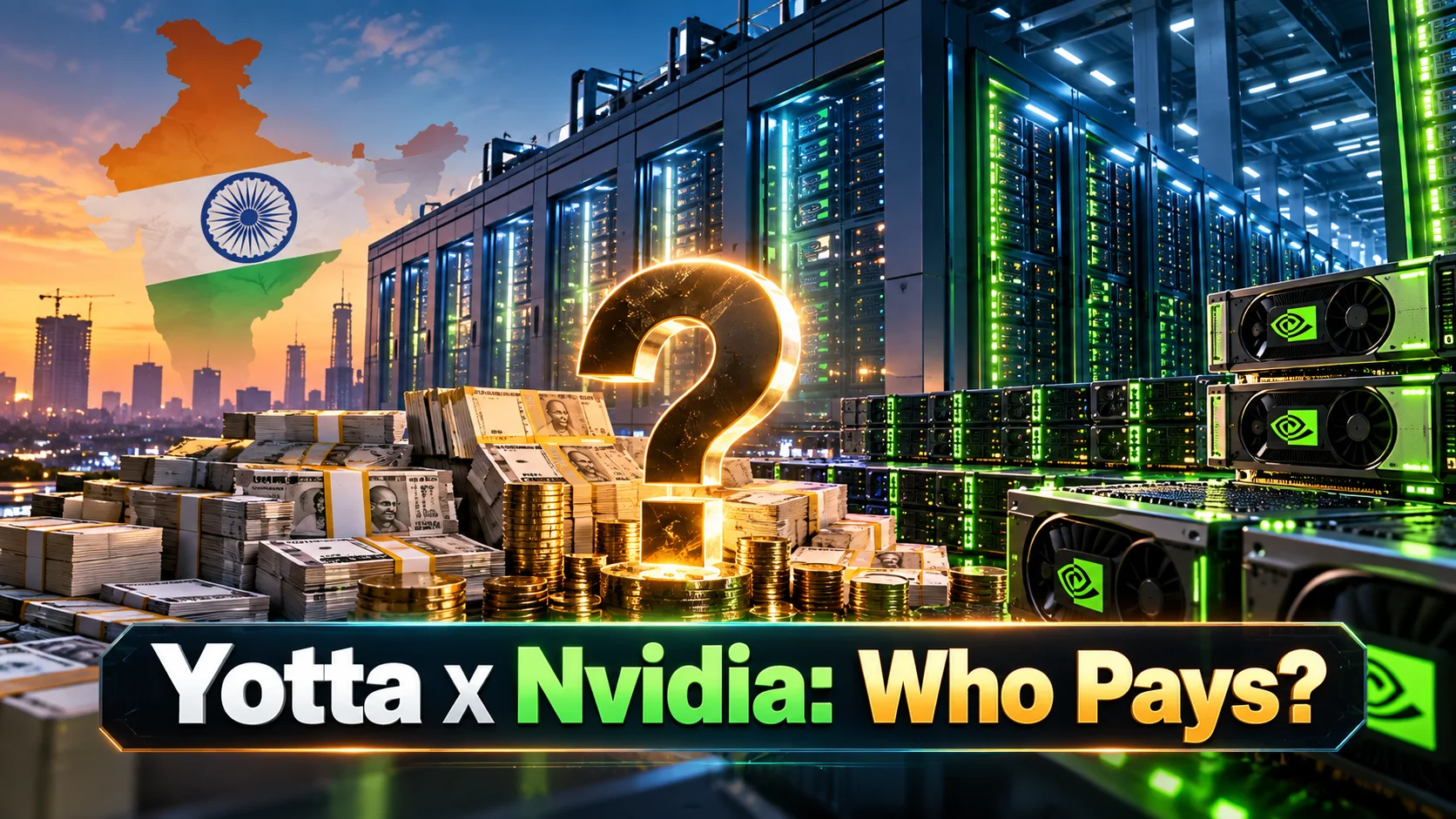
But here's the question nobody answers in the press release: a single high-end Nvidia GPU cluster at this scale can run into hundreds of crores, sometimes thousands of crores, depending on the chip generation and scale. These companies aren't exactly posting revenues that match that kind of spend. So who's actually footing the bill?
How does this actually work?
Let's break down where this money could realistically be coming from, because it's rarely just one source.
First — parent group money. Yotta isn't a standalone startup burning VC cash. It sits inside the Hiranandani Group, which has deep pockets from real estate. That's a classic Indian business move — use the cash-generating legacy business to fund the shiny new-age bet. Reliance does the same with Jio, funding telecom and cloud ambitions off the back of its oil-to-chemicals cash machine.
Second — debt. GPUs, unlike buildings, are financeable assets. Banks and NBFCs are increasingly comfortable lending against data-centre infrastructure, especially when there's a long-term customer contract backing it. Nvidia itself, and its financing partners globally, have been known to help structure these deals so the buyer doesn't need to pay full price upfront.
Third, and this is India-specific — the government's IndiaAI Mission. The scheme was set up specifically to bring down the cost of GPU access for Indian startups and researchers, empanelling private players like Yotta, Jio, Tata, and others to build and rent out compute at subsidised rates. Part of the capex risk for these companies gets softened because the government is effectively guaranteeing a chunk of future demand and, in some structures, offering viability support.
Fourth — and this is the part that should make you a little uneasy — customer pre-commitments. Some of these orders are backed by long-term contracts from large enterprises or even other cloud resellers who've promised to rent capacity once it's built. That's fine when the promised demand actually shows up. It's not fine when it doesn't.
Now zoom out globally, because India's version of this story is a smaller cousin of something much bigger happening with Nvidia, OpenAI, Oracle, Microsoft, and CoreWeave. Nvidia invests in AI companies. Those companies turn around and spend that money buying Nvidia chips, often routed through cloud providers who themselves borrowed to build data centres. Money goes round in a circle, and everyone's revenue numbers start looking inflated because the same dollar is effectively being counted multiple times across different balance sheets. Analysts have been flagging this as a circular financing problem for a while now. India's GPU order story has shades of the same pattern, just at a much smaller scale.
What changes for people in India?
For Indian AI startups and researchers, this is genuinely good news in the short term. Cheaper, local GPU access means you're not stuck paying in dollars to rent compute from a US cloud provider, dealing with currency risk and export-control headaches. If you're building an AI product in India today, renting GPU hours from a local provider at subsidised rates is a real cost advantage.
For the companies themselves — Yotta, Jio Cloud, Tata, CtrlS — this is a bet. A reasonable one, if India's AI usage genuinely scales the way everyone expects it to over the next few years. A risky one, if enterprise AI adoption in India stays slower than the hype suggests, which, let's be honest, has happened before with cloud and data-centre cycles in this country.
For taxpayers, there's an indirect angle too. If the IndiaAI Mission's compute subsidy is propping up demand for these GPU clusters, public money is quietly derisking a private infrastructure bet. That's not necessarily bad policy — plenty of countries subsidise strategic tech infrastructure — but it does mean the real exposure isn't just sitting with Yotta's shareholders.
What should you do now?
If you're a founder evaluating GPU providers in India, don't just chase the cheapest hourly rate. Ask who's actually backing the infrastructure, how it's financed, and what happens to your workloads if that provider hits a cash crunch midway. Cheap compute that disappears in eighteen months is worse than slightly pricier compute that's stable.
If you're just a curious reader following India's AI infrastructure story, keep one number in your head: GPU chips depreciate fast, usually written off over three to five years because newer, faster chips keep arriving. That clock starts ticking the moment the chips land in the data centre, whether or not customers show up to rent them. The multi-billion-dollar order announcements are the easy part. The next two to three years, when these companies actually need to show utilisation and returns on that spend, is where the real story plays out.
What should we actually watch for next?
Here's the honest limitation in this whole story — Indian data-centre companies aren't listed, which means there's no quarterly filing where Yotta or CtrlS has to show you utilisation rates, debt servicing, or how much of that Nvidia order is actually paid versus financed. Jio Platforms discloses some numbers because it sits under a listed parent, but even there, the GPU-specific capex and returns get buried inside a much bigger telecom and retail balance sheet. Compare that to Nvidia's own US customers like CoreWeave or Oracle, who at least have to explain backlog versus booked revenue to public shareholders every quarter. In India, we're mostly reading press releases and trusting the math works out.
The thing to track over the next few quarters is utilisation, not announcements. A GPU cluster sitting idle at 20-30% usage is a very different business than one running at 70-80% with paying customers queued up. IndiaAI Mission's empanelment terms reportedly tie subsidised pricing to actual demand commitments, so if enterprise and startup usage doesn't scale the way the pitch decks assume, either the government ends up extending more support, or these companies quietly write down assets faster than planned. Keep an eye on whether any of these firms start talking about "right-sizing" their GPU fleet — that's usually the polite corporate phrase for admitting the order was bigger than the demand.
There's also a India-specific angle worth watching — rupee depreciation against the dollar. Nvidia chips are priced in dollars, debt raised against them may carry dollar-linked terms depending on the lender, but the revenue these Indian firms earn renting out GPU hours comes in rupees. That currency mismatch is exactly the kind of risk that looks fine on a good year and turns painful the moment the rupee slides or global chip prices move. None of this means the India GPU buildout is a bad idea — the country genuinely needs local AI infrastructure. It just means the next real update on this story won't come from a press release announcing more chips. It'll come from someone quietly explaining why the last batch isn't fully rented out yet.





Comments (0)
Be the first to comment!