


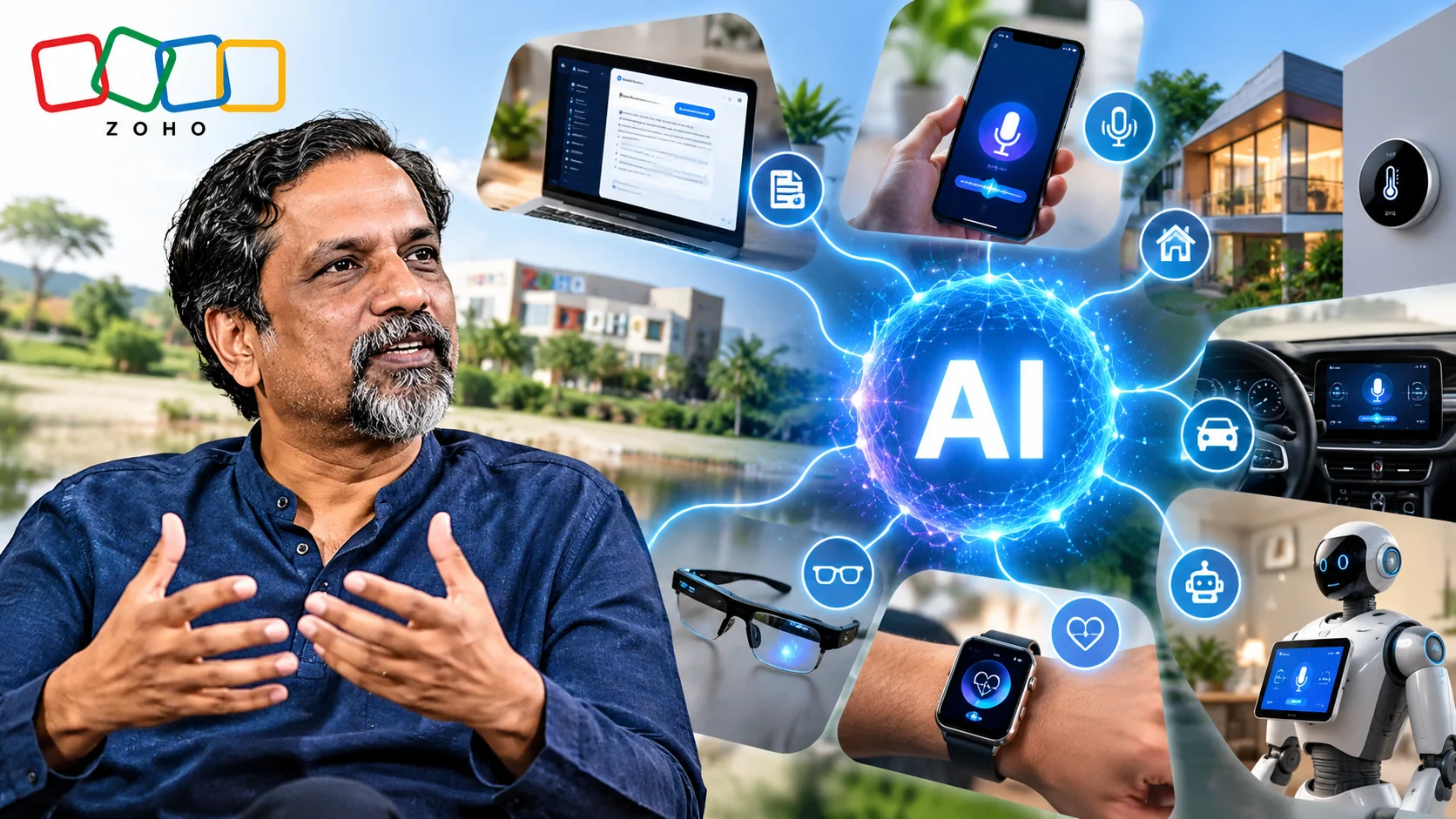
- Zoho chief Sridhar Vembu argues that the next real leap in AI is transforming how we interact with software, turning AI into the user interface itself.
- Instead of chasing sci-fi concepts of single super-brains, the future belongs to ubiquitous intelligence running quietly inside daily business workflows.
- For Indian businesses and regional language users, invisible AI interfaces mean eliminating complicated menus, dashboards, and ERP training curves.
- Software companies that build simple, task-specific smart workflows will outlast hype-driven chatbot wrappers.
What just happened?
Every tech podcast and Silicon Valley investor seems obsessed with one phrase right now: super intelligence. We keep hearing about massive data centres, trillion-parameter systems, and computers that might outthink humans on everything. Even global political leaders have started branding AI through that lens.
Zoho founder Sridhar Vembu has a completely different take. Speaking on the direction of enterprise technology, he pointed out that AI will feel less like a mysterious super-brain and more like ubiquitous intelligence. In plain words: AI is becoming the new user interface (UI).
Think about how we use computers today. You open an app, search through five dropdown menus, click six tabs, fill out forms, and download an Excel sheet. Vembu is betting that this entire layer of buttons and clicks is about to disappear.
Instead of logging into a separate chatbot window to ask questions, the smart engine will simply live inside every screen, tool, and button you already touch. That is a massive shift in how enterprise software gets built.
How does this actually work?
To understand what ubiquitous intelligence means, look at how software design evolved over the last thirty years. In the nineties, you typed text commands into MS-DOS. Then came the mouse and desktop windows. After that, smartphones gave us touchscreens and icons.
Each step made computing simpler because the interface got closer to human intent. The next jump is getting rid of the clutter altogether.
Let us take an everyday office example. Suppose an accounts manager needs to reconcile monthly vendor invoices against bank statements. Right now, they open an accounting app like Zoho Books or Tally, pull up bank statements, verify GST numbers one by one, and manually flag discrepancies.
With AI functioning as the UI, you do not navigate through seven menus. You simply type or speak your goal: 'Reconcile vendor invoices from last week and show me any GST number mismatches.' The system understands the intent, pulls the records, runs the cross-check, and gives you the exact exceptions to review.
You never had to learn where the reconciliation tab was hidden. You did not have to master a complex dashboard. The intelligence did the heavy lifting behind the curtain while presenting only the final decision to you.
This is why Vembu calls it ubiquitous. It is not sitting on a high pedestal as an all-knowing entity. It is quietly humming inside payroll, CRM, inventory, customer support, and email.
What changes for people in India?
This approach solves one of the biggest friction points in India: the enterprise software barrier. Millions of micro, small, and medium businesses run our economy. From a textile distributor in Tiruppur to an auto-parts supplier in Pune, most business owners avoid complex ERP software simply because the interfaces are too confusing.
When software requires weeks of employee training and English-heavy navigation, small firms stick to paper ledgers or basic messaging apps. But when AI acts as an intuitive interface that understands voice, regional languages, and context, everything changes.
Imagine a shop owner speaking in Tamil or Hindi to generate a formal GST e-way bill or check outstanding distributor balances. They do not need to understand database schemas or software navigation. The software adapts to how normal people talk, not the other way around.
There is also an economic reality here. Running giant, centralised mega-models costs enormous sums in compute and cloud bills. For practical everyday tasks, Indian businesses do not need a model that writes poetry about Mars. They need fast, lightweight models that do invoice matching, stock tracking, and ticket routing accurately at minimal cost.
Zoho's bet is that practical, cost-effective models embedded inside domain-specific workflows will create far more real-world value than bloated cloud experiments.
What should you do now?
If you run a business or work in product development, this shift requires rethinking how you look at tech upgrades.
First, stop treating AI as a separate experiment. If your team is still jumping back and forth between your core software and a third-party chatbot tab to copy-paste data, you are using the old model. Look for platforms that integrate intelligence directly into the screens where work happens.
Second, if you build apps or manage software products, simplify your interfaces. Strip away unnecessary forms, redundant settings, and complicated navigation paths. Design workflows around user intent rather than deep nested menus.
Finally, do not get blinded by the hype around giant super-brains. The tools that will actually save you money and time are the quiet ones that automate your routine daily headaches without making a scene.
Where could this approach run into trouble?
The promise of invisible interfaces sounds great on paper, but getting it right in production comes with genuine challenges. For one, enterprise software cannot afford hallucinations when dealing with core financial ledgers or GST filings. When a system automates a critical action based on plain English or regional voice prompts, accuracy has to be absolute. If an accounts team approves incorrect line items due to ambiguous phrasing, fixing the compliance fallout with tax authorities creates major administrative headaches.
Data privacy and cloud costs present another tricky hurdle for homegrown Indian businesses. Running continuous smart background checks across millions of daily transactions requires efficient, low-latency infrastructure rather than routing sensitive company data to expensive foreign servers. Business owners also need clear audit trails showing why an automated system took a specific decision. Without clear transparency and rock-solid guardrails, managers will naturally hesitate to hand over critical operational controls to invisible background intelligence.




Comments (0)
Be the first to comment!