


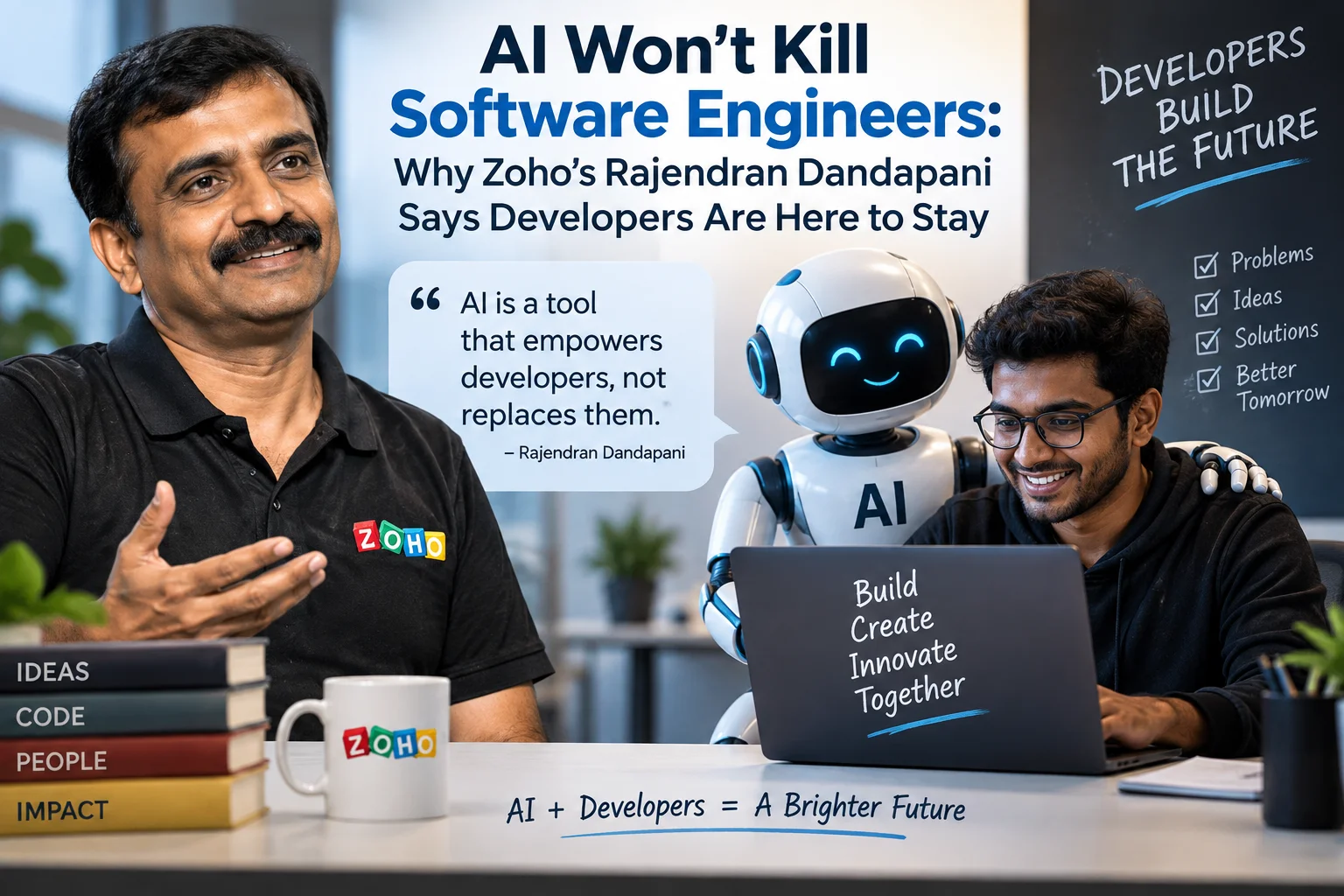
- Zoho Corporation Director Rajendran Dandapani tackled the rising panic around AI taking over developer jobs at DevSparks in Chennai.
- He clarified that while AI tools write code faster every day, writing raw syntax was never the real core of software engineering.
- The developer role is pivoting around three critical pillars: deciding what to build, directing AI models, and judging the quality of machine output.
- For Indian engineers, memorizing syntax is no longer enough; mastering system architecture, business domain logic, and code auditing is the way forward.
What did Rajendran Dandapani actually say at DevSparks Chennai?
Step outside any tech park in Chennai, Bengaluru, or Hyderabad around tea time, and you will hear engineers sharing the exact same worry. If AI models can spit out clean React components, write complex SQL queries, and scaffold backend APIs in a few seconds, what is left for human coders?
Rajendran Dandapani, Director at Zoho Corporation, gave a refreshing reality check during his talk at the DevSparks event in Chennai. Channeling Mark Twain's iconic quote, he told the packed hall of developers that reports of their impending demise are greatly exaggerated.
His core argument went straight to the heart of the confusion. For years, people treated software engineering as the act of typing syntax into an editor. Dandapani pointed out that typing was only ever the mechanical layer. The true job has always been problem solving, system design, and building things that humans actually want to use.
While AI will gladly take over the mechanical task of generating lines of code, deciding why a feature exists and making sure it works under pressure still falls squarely on human shoulders.
Why is typing code no longer the main job?
Think about building a house in your hometown. An architect does not spend all day lifting bricks or mixing sand and cement. The architect figures out the layout, checks if the soil can support a two-story structure, and ensures the drainage lines will not back up during the monsoon.
Dandapani broken down the future of software engineering into three clear, everyday responsibilities that no AI can handle on its own.
First, deciding what to build. Machines do not run businesses and they do not live in the real world. An AI has no intuitive sense of why a small grocery shop owner in Tiruchirappalli wants an instant audio chime for a five-rupee UPI payment instead of an interactive web dashboard. Spotting actual user pain, talking to customers, and translating messy real-world demands into software requirements remains entirely human work.
Second, directing the AI. Getting usable, production-ready code out of an automated tool is an engineering discipline by itself. If you feed vague prompts into a model, you get bloated, broken code in return. Developers must know how to slice a monolithic system into modular micro-tasks, feed the right database schemas, specify security boundaries, and steer the tool step by step.
Third, judging the output. This is where deep technical skill matters most. AI code often looks completely elegant at first glance while hiding silent memory leaks, race conditions, or massive security loopholes. A developer has to step up as an uncompromising code auditor, inspecting every line to verify whether it will scale gracefully when ten thousand users hit the server simultaneously on a festival sale day.
What does this mean for developers across India?
For over two decades, the Indian IT ecosystem ran on a predictable assembly line. Companies recruited fresh engineering graduates by the thousands, gave them three months of basic training, and put them on repetitive ticket maintenance, routine bug fixing, and boilerplate scripting.
That specific assembly line is disappearing rapidly. If an engineer's only skill is memorizing syntax rules or copy-pasting code snippets from online forums, automated tools will replace that workflow without breaking a sweat.
Yet, this shift creates unprecedented leverage for developers who understand real-world systems. In the past, launching a full-fledged SaaS product or a localized logistics tool needed a ten-person development team and months of funding. Today, a team of two sharp engineers in Madurai or Kochi can prototype, build, and deploy the same product in a couple of weeks by using AI tools for boilerplate grunt work.
The barrier to building things has dropped to nearly zero. The bottleneck is no longer how fast someone types code, but how well they understand the problem they are solving.
What kind of real-world use cases prove this point?
Consider an engineer building an offline-first billing app for rural distributors who deal with unstable mobile networks. An AI can quickly generate a local SQLite database schema or build a sync worker in Kotlin. What the AI cannot do is anticipate what happens when a delivery driver drives through a tunnel with zero signal, collects three cash payments, and reconnects to the network while another clerk edits the exact same inventory sheet in the warehouse.
Handling that sync conflict, designing the fallback logic, and ensuring financial records match down to the exact paisa requires human judgment. The developer designs the fail-safe architecture, directs the AI to write the specific synchronization handlers, and rigorously tests edge cases that the model never thought about.
The same pattern applies to fintech security. When integrating payment gateways or building fraud detection pipelines, a machine can write the boilerplate webhook listeners. But verifying that the endpoint cannot be tricked by replay attacks or race conditions requires a human engineer who understands network packets and security fundamentals inside out.
How should you change the way you work today?
If you are an engineering student, an early-career programmer, or a senior lead managing a team, spending energy on doomsday panicking gets you nowhere. The sensible move is to overhaul your daily workflow.
Stop treating AI like an enemy and stop treating it like a magic black box. Treat it like a super-fast junior intern who has read every textbook in the world but has zero common sense. Hand it tedious tasks like creating boilerplate interfaces, writing unit test cases, or formatting JSON structures, but never deploy its work without inspecting every single line.
Go back to core computer science fundamentals. Spend your weekends understanding database query planners, distributed caching, network protocols, memory management, and application security. The sharper your fundamentals, the faster you will spot dangerous mistakes in machine-generated code.
Most of all, build deep domain understanding. Learn how supply chains operate, how RBI guidelines shape payment flows, or how customer retention works in consumer apps. When you become the person who truly understands the problem, steering AI to build the right software becomes your biggest competitive advantage.




Comments (0)
Be the first to comment!