


Key Takeaways
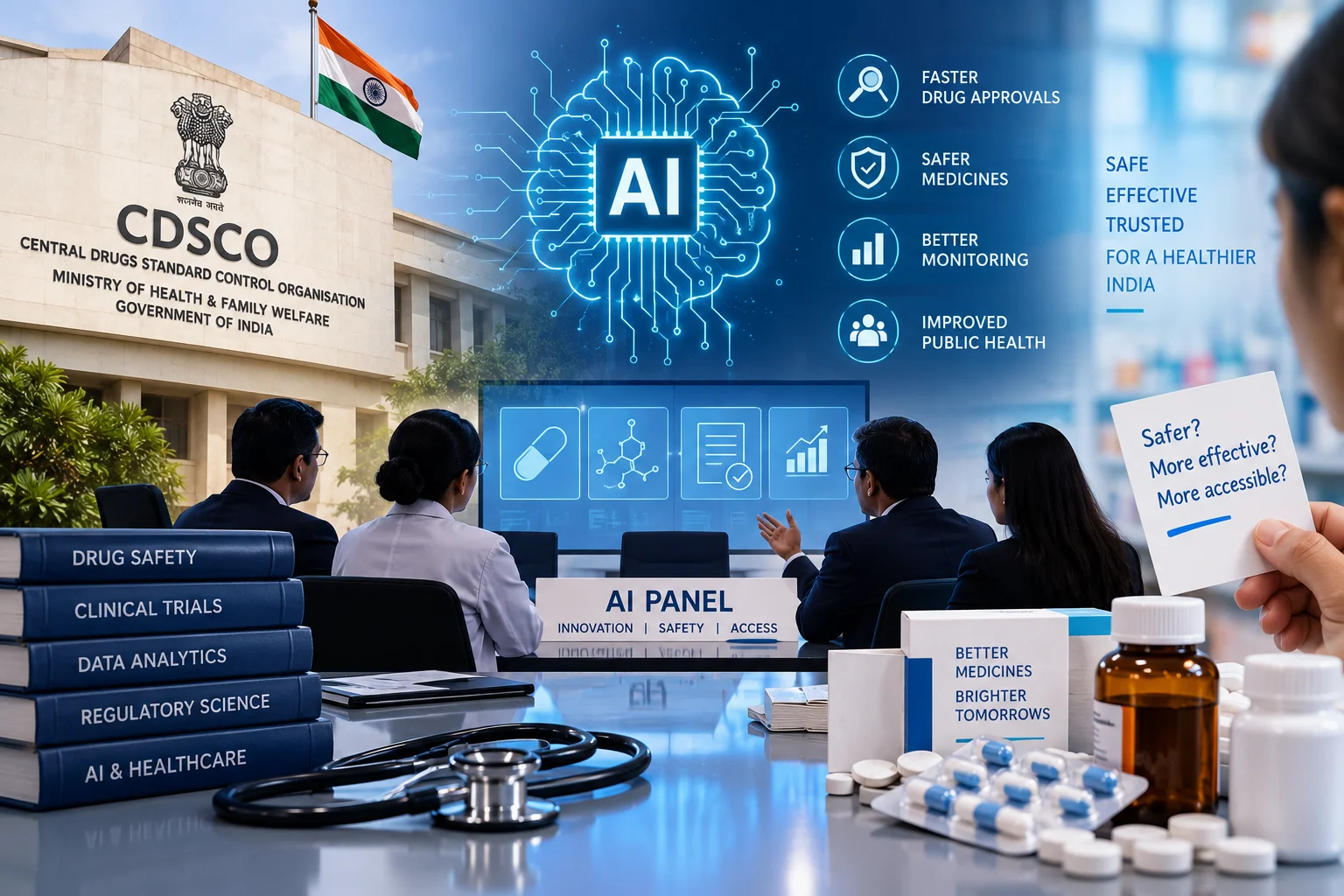
- India's apex drug regulator, the Central Drugs Standard Control Organisation (CDSCO), has formed a specialized expert committee on Artificial Intelligence.
- Head of the drug regulatory body DCGI Rajeev Raghuvanshi confirmed the panel will study how AI models are evaluated, approved, and regulated across drug discovery and clinical processes.
- The move comes as pharma companies shift from years of trial-and-error chemistry to computer models that design molecules in days.
- Crucial questions around algorithmic bias, South Asian genetic datasets, liability for AI mistakes, and data privacy remain to be ironed out.
What just happened at India's drug regulator?
Imagine walking into an Apollo Pharmacy or ordering your regular prescriptions on Tata 1mg, knowing the core molecule was mapped out by an algorithm running on a cloud server rather than scientists spending a decade mixing test tubes. That is not science fiction anymore. AI systems are already predicting how proteins fold, spotting drug candidates, and cutting clinical research cycles across the globe.
India's drug authorities have decided it is time to step in. The Central Drugs Standard Control Organisation (CDSCO) has constituted a dedicated expert committee focused on Artificial Intelligence. Drugs Controller General of India (DCGI) Rajeev Raghuvanshi stated that this new panel will examine how AI can be evaluated, approved, and systematically regulated throughout the drug discovery cycle.
For decades, Indian drug laws under the Drugs and Cosmetics Act were written entirely for physical chemistry, factory inspections, animal testing, and multi-phase human clinical trials. Software was treated as simple administrative tooling. Now that deep learning algorithms are actually inventing molecular structures, the regulator needs a brand-new playbook.
How does AI change the drug discovery game?
Traditional drug development is painfully slow and brutally expensive. Typically, a pharmaceutical lab screens ten thousand chemical compounds over five to eight years just to identify one viable drug candidate. After that come animal tests, safety checks, and three distinct phases of human trials. Most molecules fail somewhere along the way, burning hundreds of millions of rupees in the process.
AI completely changes this timeline. Machine learning models can analyze billions of chemical combinations in a matter of hours. They simulate how a synthetic molecule will bind to a virus, bacteria, or tumor cell long before a chemist touches physical chemicals. Instead of guessing in the dark, researchers get high-probability candidates delivered directly to their screens.
That speed is incredible, but it creates a massive challenge for regulators. When a pharmaceutical firm applies for clinical trial approvals, inspectors review physical lab data, chemical synthesis logs, and purity reports. With an AI model, the reasoning often sits inside a deep neural network that even the software developers cannot fully explain. If an algorithm claims Molecule A is completely safe and Molecule B is toxic, CDSCO needs verifiable proof of why that prediction is trustworthy.
Why does this matter so much for India?
India is often called the pharmacy of the world because our manufacturing hubs supply affordable generic medicines to over 200 countries. But when it comes to discovering brand-new, patented molecules from scratch, Indian pharma has traditionally taken a back seat. Original drug discovery requires massive capital, something only giant global conglomerates could historically afford.
AI dramatically lowers that financial barrier. Biotech startups and mid-sized pharma teams in hubs like Hyderabad, Bengaluru, and Pune can now design novel therapeutic candidates on relatively modest computing budgets. If the regulatory path is clear and predictable, India could shift from being purely a generic medicine manufacturer to a global powerhouse for original drug design.
There is also an urgent demographic angle. Most global medical AI models are trained on datasets from Western hospitals and clinical trials. South Asian genetic profiles, dietary habits, environmental factors, and disease prevalence patterns differ significantly from populations in Europe or North America. A diabetes or oncology drug candidate optimized purely on Western data might behave unpredictably in Indian patients. CDSCO's oversight ensures that algorithms tested and cleared for our hospitals are validated against local population data.
What are the big questions that remain unanswered?
While forming the expert committee is a welcome step, several difficult questions are on the table. First is the black box problem. Drug regulators need deterministic safety data. If an AI makes a critical prediction about drug safety, what standard of explainability will CDSCO demand from biotech startups before granting clinical trial clearance?
Second is the question of legal accountability. If an AI-designed drug causes unforeseen side effects during clinical trials, who carries the legal liability? Is it the pharmaceutical company sponsoring the trial, the contract research lab running the synthesis, or the software company that developed the algorithm? Indian law has yet to define liability frameworks for generative biological tools.
Third is the protection of patient data. AI models require massive amounts of health records, genomic sequences, and diagnostic scans for training. With India's Digital Personal Data Protection rules in play, how will pharma companies source and anonymize Indian health data without violating privacy rights or creating unauthorized data pipelines?
Finally, there is the patent dilemma. Under current intellectual property laws in India, only natural human persons can be named as inventors. If an algorithm autonomously generates a novel molecular compound, how will the Indian Patent Office and CDSCO handle the ownership and market exclusivity rights?
What should healthtech startups and pharma teams do now?
If you run a healthtech startup, develop diagnostic software, or manage computational biology workflows, you should not wait for the final policy document to land. Start auditing your validation pipelines today. Make sure your datasets are cleanly documented, your training methodologies are reproducible, and your data sourcing complies with Indian privacy standards.
For doctors, hospitals, and clinic chains integrating AI diagnostics—from automated chest X-ray screening to diabetic retinopathy detection—keep a close eye on CDSCO circulars. The lines between pure drug discovery tools and clinical diagnostic AI often overlap, and standard operating procedures will soon become mandatory.
For the average patient booking tests on Practo or buying medicines at the corner chemist, this development is a reassuring sign. As algorithms play a larger role in modern healthcare, having the national drug regulator actively setting guardrails means faster access to breakthrough treatments without compromising personal safety.



Comments (0)
Be the first to comment!