


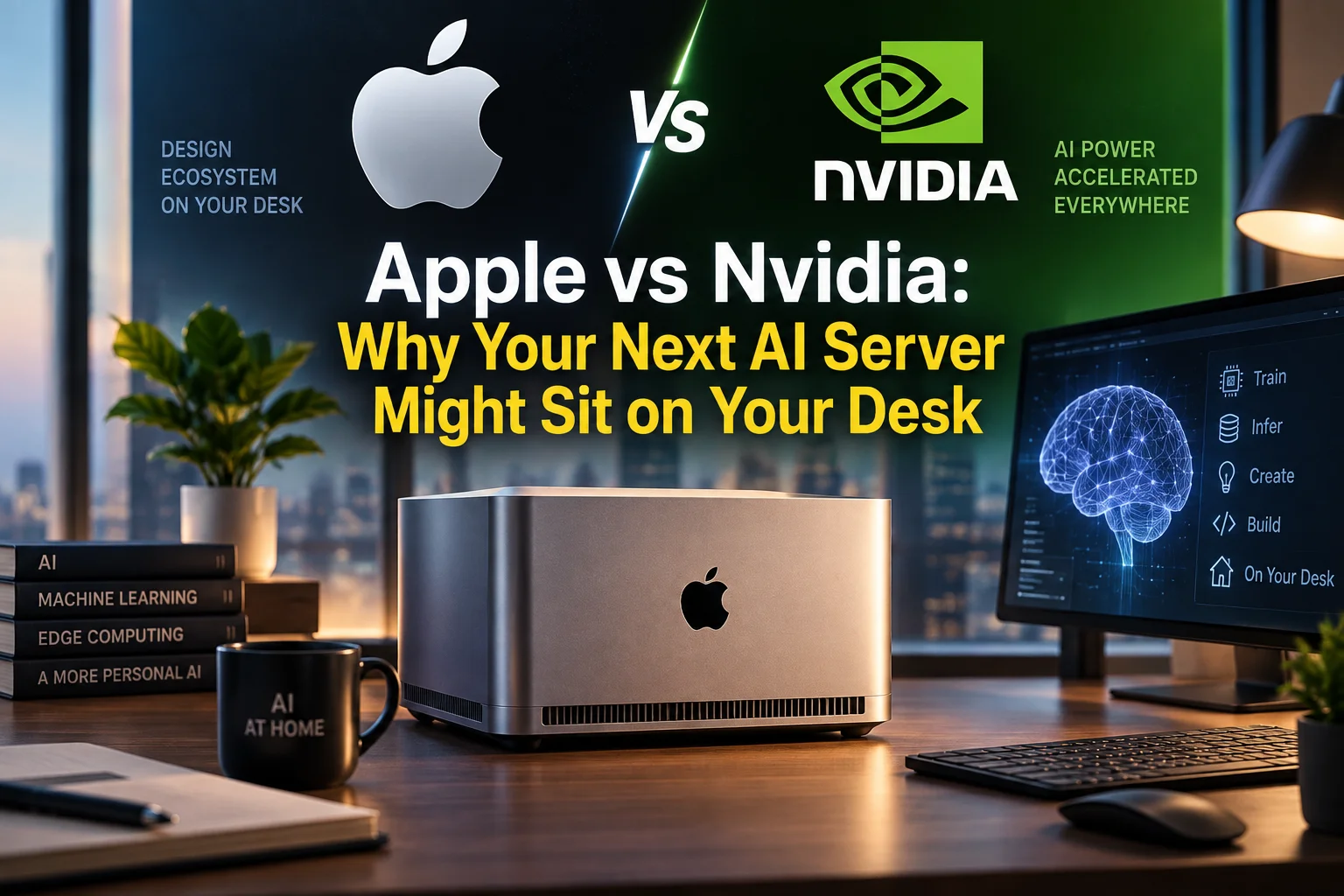
- Apple is pushing upgraded Mac Minis and top-spec Mac Studios—scaling near $20,000—as dedicated local AI powerhouses for developers.
- The strategy lets engineering teams run large models directly on their desks, dodging heavy monthly cloud bills from Nvidia and Microsoft.
- Microsoft and PC makers are preparing a direct counter-attack with Nvidia-powered AI desktops at an upcoming San Francisco event.
- For Indian tech teams and startups, investing in high-memory desktop hardware is turning into a smart shield against soaring API token costs and data privacy headaches.
What just happened to developer hardware?
If you run an engineering team or build software today, you know the quiet shock of opening your monthly cloud bill. Running modern artificial intelligence models on remote GPU clusters eats through company funds at terrifying speed. Every test query, every fine-tuning batch, and every customer prompt adds another charge to the company card.
Apple is stepping directly into this financial pain point. The company is positioning its upgraded Mac Minis and monster Mac Studio setups as dedicated local AI stations. While top-tier configurations of these machines can touch nearly $20,000, they pack enough muscle to run massive AI models right on your office desk without pinging a remote server.
This move puts Apple on an open collision course with Nvidia and traditional PC manufacturers. Microsoft is hosting a dedicated Windows hardware event in San Francisco next month, where new desktop rigs built alongside Nvidia silicon will take center stage. The tech rivalry has moved past building flashy consumer chatbots—it is now about who makes running heavy models cheap enough for everyday engineers.
Why does unified memory change the math?
To see why a compact desktop can challenge server-rack hardware, look at how regular computers handle memory. A standard PC keeps system RAM for the main processor and separate VRAM on the graphics card. If your graphics card has only 16GB or 24GB of VRAM, you hit an absolute wall when trying to load a massive open-source model with tens of billions of parameters.
Apple Silicon handles this differently through its unified memory architecture. The CPU, GPU, and Neural Engine all tap into one giant pool of high-speed memory on the same chip package. When you configure a high-end Mac with 128GB or 192GB of unified memory, almost that entire block becomes available to hold a giant model in active memory.
Nvidia still completely controls the world of massive data-center training. Nobody expects a desktop Mac to replace an industrial server farm training foundation models from scratch. But for inference—actually loading a model, querying it, building automated agents, and testing code thousands of times a day—running locally at zero marginal cost per prompt changes the entire equation.
Traditional PC makers working with Microsoft and Nvidia are not sitting still. Their upcoming desktop systems aim to bundle dedicated AI tensor processing and higher memory bandwidth directly into Windows workstations, setting up a fierce fight for developer desks.
What changes for Indian startups and developers?
Consider a five-person product team working out of Bengaluru, Pune, or Hyderabad. Spending ₹3 Lakh to ₹6 Lakh every single month on rented cloud GPU instances burns through seed funding in no time. A one-time purchase of a high-spec Mac Studio or a dedicated Nvidia workstation costs between ₹5 Lakh and ₹16 Lakh upfront, but it pays for itself within two or three quarters.
There is also the critical issue of data privacy and local compliance. Indian fintech, legal, and healthcare developers handle sensitive customer information, PAN numbers, and private database logs. Sending that information over an API to an overseas cloud server creates serious compliance headaches under Indian data protection standards.
When you run an open-weights model locally on your office table, sensitive customer records never leave your physical room. You never have to worry about sudden broadband drops, API rate limits, or international cloud downtime during peak product shipping hours. For independent Indian developers building custom internal workflows, local hardware offers total independence from ongoing monthly subscriptions.
Which real-world tasks run better on your desk?
Local desktop AI is not just a theoretical experiment—it handles specific everyday workloads far better than metered cloud endpoints.
First, local document intelligence and internal search. If your company wants an AI agent to index thousands of confidential internal PDFs, Slack conversations, and proprietary codebases, doing that through a paid cloud API gets expensive and risky. A high-memory desktop handles continuous embeddings and retrieval-augmented generation entirely offline.
Second, rapid prototyping and agentic loops. Modern AI agents often run 20 to 50 internal background prompts just to solve one complex software bug. Doing that on paid commercial APIs can run up hundreds of dollars in hours. On a local Mac Studio or Nvidia workstation, those loops cost nothing more than the electricity running to your wall socket.
Third, lightweight fine-tuning. Engineering teams can adapt open-weights models to specific Indian regional contexts, local tax rules, or company-specific jargon using local memory without setting up complex multi-GPU cloud instances.
How should you plan your hardware budget?
Do not run out and swipe your credit card for a ₹15 Lakh workstation just because the spec sheet looks staggering. Your daily workflow should decide where your money goes.
If you are an indie developer tinkering with standard 7-billion or 8-billion parameter models, an entry-level Mac Mini or a mid-range PC with a standard Nvidia RTX card will handle everyday tasks without breaking a sweat. You do not need top-of-the-line studio hardware just to learn or build basic apps.
If you run a product team spending thousands of dollars each month on API bills, sit down and audit your numbers. Calculate your total cloud spend over the past six months. If a major chunk of your bill goes toward internal testing, batch data extraction, or running open models, investing in dedicated local desktop hardware could slash your monthly cash burn drastically.
Watch the upcoming Windows and Nvidia announcements in San Francisco next month before placing large hardware orders. The race between Apple Silicon and Nvidia-powered PC desktops is pushing both camps to deliver higher memory and better performance per rupee, which is great news for developers building the next wave of software.






Comments (0)
Be the first to comment!