


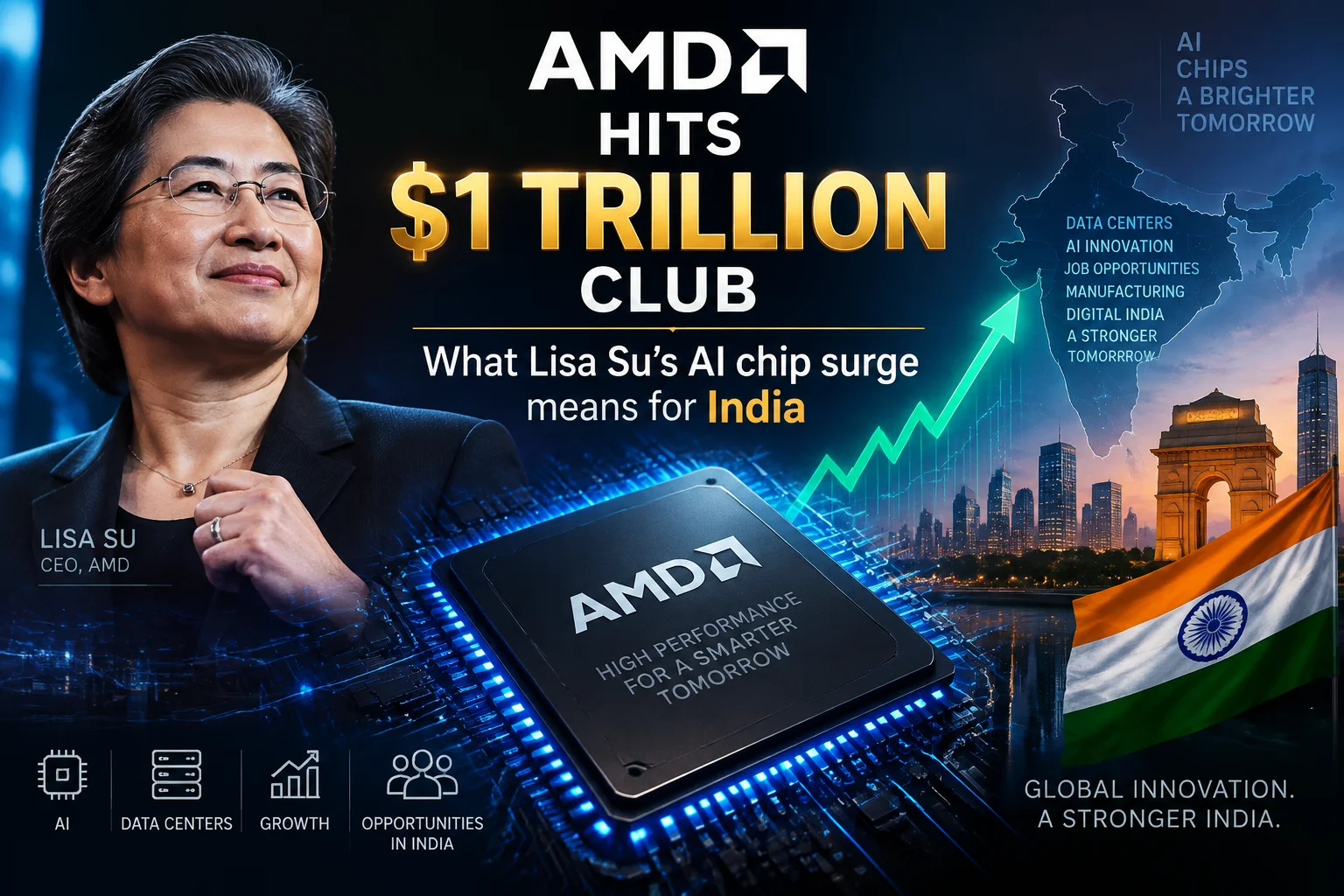
- The $1T Milestone: AMD officially joined the $1 trillion market cap club this Monday, powered by explosive demand for its AI computing chips.
- Breaking the Monopoly: Hyperscalers and cloud giants are aggressively adopting AMD's Instinct accelerators to break their total reliance on Nvidia.
- India Cloud Impact: A two-horse race in AI silicon means lower compute rental costs for Indian AI startups building on local data centres in Chennai, Mumbai, and Noida.
- Consumer Upside: Massive enterprise profits give AMD deeper pockets to push aggressive pricing on consumer Ryzen CPUs and laptop chips on Flipkart and Amazon India.
What just happened?
Remember when AMD was seen as the plucky budget alternative you bought only when your pocket could not stretch for an Intel chip? Those days belong to a museum.
This Monday, Advanced Micro Devices crossed the $1 trillion valuation threshold on global markets. In Indian currency terms, that is roughly ₹83 lakh crore—a figure so massive it dwarfs the combined market value of several frontline Nifty 50 companies. With this leap, AMD enters an ultra-exclusive club of chipmakers alongside Nvidia and TSMC who control the actual computing brains of the modern world.
The catalyst behind this explosive run is simple: artificial intelligence computing. Over the past couple of years, big tech companies poured billions into buying every graphics processing unit (GPU) they could get their hands on. While Nvidia ran away with the early lead, AMD quietly built out its enterprise hardware lineup, and global cloud operators have started backing it with open checkbooks.
How does this actually work?
To understand why investors pushed AMD past the trillion-dollar line, you have to look at what powers modern AI apps. When you talk to ChatGPT or ask an Indian voice AI bot to book an IRCTC train ticket, your phone is not doing the hard thinking. Massive server racks packed with specialized chips inside air-conditioned datacentres are crunching billions of mathematical parameters every second.
For years, Nvidia held a near-monopoly on this infrastructure because of CUDA, its proprietary software layer that developers used to code AI models. If you wanted to run large models, you had to buy their chips and pay whatever price tag was slapped on the box.
AMD cracked this wall using a two-pronged strategy. First, it launched beefy hardware like its Instinct MI series AI accelerators, packing massive memory bandwidth to handle giant models without stuttering. Second, it invested heavily in ROCm, an open-source software platform that lets developers port their PyTorch and TensorFlow models over without rewriting their code from scratch.
Tech giants like Microsoft, Meta, and Google realized that depending on a single chip supplier was dangerous for their margins. By adopting AMD's AI hardware across their server farms, they created genuine competition—and AMD captured huge market share in record time.
What changes for people in India?
Wall Street stock rallies often feel distant when you are sipping chai at a local stall in T. Nagar or Koramangala. But this specific shift in chip power will hit Indian tech users and businesses in three practical ways.
First, look at Indian datacentres. Companies like Yotta, Jio, Airtel Nxtra, and Tata Communications are pouring thousands of crores into expanding AI server capacity in Mumbai, Bengaluru, and Hyderabad. When Nvidia was the only real game in town, setting up high-performance compute clusters cost an absolute fortune. With AMD aggressively competing for every server rack, cloud rental rates for local developers and startups become far more affordable.
Second, this directly helps Indian AI builders. If you run a startup in Bengaluru building Indic language voice agents for UPI payments, your single biggest monthly expense is GPU server rental. Cheaper compute instances mean Indian founders can train regional models—Tamil, Telugu, Hindi, Bengali—without burning through their entire seed round in three months.
Third, there is a consumer spin-off. Enterprise AI hardware delivers massive profit margins. Lisa Su's team can now channel those profits into aggressive research and development for mainstream PC components. That translates into faster, more power-efficient Ryzen processors and Radeon graphics cards landing on Indian e-commerce shelves at competitive prices during festival sales.
What should you do now?
If you are an engineer, developer, or college student stepping into machine learning in 2026, do not lock your entire skillset to one vendor's proprietary tools. Spend time testing open frameworks like PyTorch and Triton on AMD's ROCm stack. Hardware-agnostic engineers are already commanding better salaries because companies want teams that can deploy models on whatever silicon offers the best price-to-performance ratio.
If you run a tech business or manage cloud infrastructure, audit your current server bills. Check whether your cloud provider offers AMD-powered AI instances. Switching inference workloads from proprietary setups to open accelerator instances can cut operational compute costs by 20 to 30 percent without sacrificing speed.
And if you are simply a PC enthusiast or gamer planning an upgrade this year, keep your eyes on mid-range laptop and desktop launches. Competition at the top always forces better pricing down to the consumer market, and the chip wars are finally heating up in our favour.





Comments (0)
Be the first to comment!