


முக்கிய விஷயங்கள்
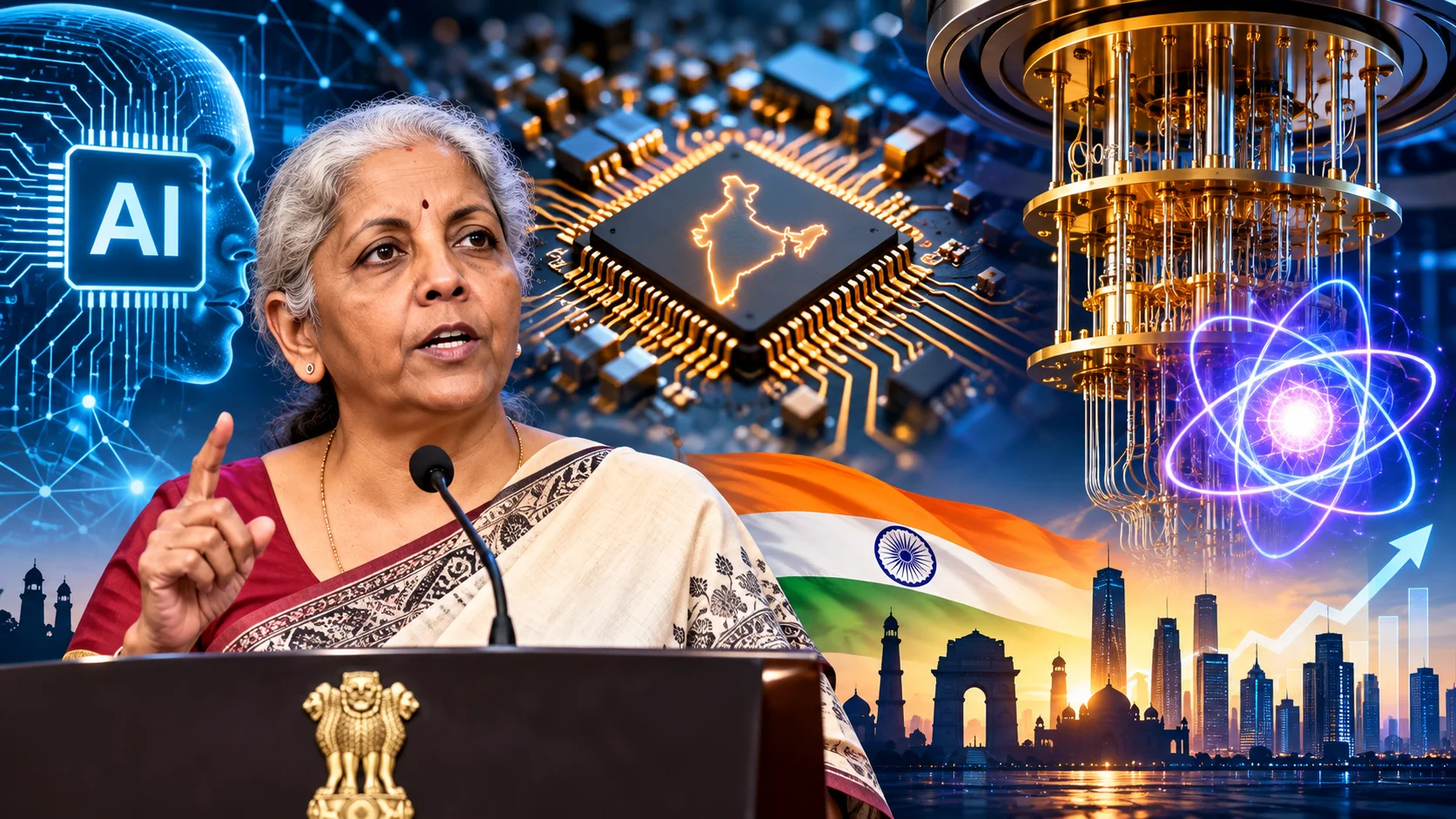
- Finance Minister Nirmala Sitharaman called AI, semiconductors and quantum tech India’s next major frontier at an IIT Madras Alumni Association fireside chat.
- The core message: India must move faster on hardware, skills and the institutional setup — not just software apps.
- Chips decide phone price, AI speed and data-centre power; quantum is the long game for secure computing and research.
- For students and workers, this points to chip design, AI engineering, fab support roles and deep-tech research paths.
- Policy talk only works if fabs, labs, talent pipelines and patient capital all move together.
What just happened?
Picture this. You’re on a Chennai local, scrolling news between stations, and the Finance Minister is talking chips and quantum — not just budgets and tax slabs.
At a fireside chat organised by the IIT Madras Alumni Association, Nirmala Sitharaman put three words on the table: AI, semiconductors and quantum tech. She framed them as the next major frontier for India.
The point wasn’t a slogan. It was a warning wrapped as ambition. India has to speed up the hard stuff — hardware, skills and the institutional ecosystem — if it wants to use these technologies, not only consume them.
That lands differently in 2026. Everyone already uses AI tools. UPI runs on invisible backend muscle. Jio and Airtel fight on network speed. But the real bottleneck is deeper: who builds the chips, who trains the models at scale, and who owns the labs that can chase quantum breakthroughs.
How does this actually work?
Let’s keep it simple. AI is the brain. Semiconductors are the body. Quantum is the experimental next body that could rewrite the rules later.
AI, அதாவது software that learns patterns and does tasks — writing, coding help, fraud checks, factory quality control. You meet it in ChatGPT-style apps, phone cameras, bank risk models and logistics routing at places like Flipkart’s backend world.
But AI doesn’t float in the air. It runs on chips. GPUs and specialised accelerators train big Models. Everyday Phone chips run the lighter versions. Data-centre Server farms burn power and money to keep all this alive.
Semiconductors are those chips. Design is one game. Manufacturing is another. Packaging and testing sit in between. India has been louder on design talent and assembly plans; full-scale advanced fabs are still the mountain climb.
Quantum tech is different. Think of it as computing and sensing that use quantum physics tricks — not your normal 0 and 1 only. Practical, mass-market quantum laptops are not landing next week. What matters now is research capacity, secure communications experiments, and not missing the decade while others lock IP and talent.
Sitharaman’s triad makes sense as a stack. Without chips, AI stays rented from someone else’s cloud. Without skills, fabs and labs become empty buildings. Without institutions — standards, funding routes, university-industry links, procurement that trusts local deep tech — the whole thing stalls at PowerPoint.
What changes for people in India?
First, the phone in your pocket. Better local chip strategy doesn’t mean a magic cheaper Phone tomorrow morning. It means, over years, more control on availability, pricing shocks, and custom silicon for India-scale use cases — payments, language AI, offline-first apps.
Second, jobs. The shiny titles get Instagram reels: AI engineer, prompt wizard, growth hacker. The quieter demand will sit in chip design verification, embedded systems, thermal and power engineering, fab technician roles, data-centre operations, and security for AI systems.
Third, startups. Pure app clones face brutal competition. Deep-tech teams that touch silicon, model efficiency, quantum-safe security, or industry AI for factories and hospitals will hunt longer capital and patient policy support. That’s harder than a consumer App launch. It’s also where the frontier talk becomes real.
Fourth, colleges. IIT Madras hosting the chat is not a random backdrop. Premier campuses already push semiconductor and AI research. The gap is the middle layer — state universities, polytechnics, ITI-level skilling — so a student in Coimbatore or Kochi can enter the chain without only dreaming of one entrance exam.
Fifth, daily digital life. UPI, GPay, bank apps, IRCTC peak traffic — all of this leans on reliable infrastructure. AI fraud detection, chip-level security, and future-proof cryptography sound abstract until a scam wave or outage hits your balance check at 9 pm.
One more thing people feel indirectly: electricity and water for data centres and fabs. Big hardware dreams come with local resource politics. Towns near big projects will ask about jobs and about strain. That debate belongs in the same conversation as “frontier tech.”
What should you do now?
If you’re a student, don’t freeze chasing one hyped label. Build a base: math comfort, coding discipline, electronics fundamentals if chips excite you, and clear writing so you can explain a system. Pick a lane — ML engineering, VLSI design, embedded, cybersecurity — and do small public projects. Certificates without projects age fast.
If you’re working in IT services, treat AI as a tool in your workflow, not a movie villain. Learn how models fail, how data leaks, how cost per inference works. Companies will pay for people who ship reliable systems, not just demo screenshots.
If you’re a founder, map your product to the stack. Are you renting all intelligence from foreign APIs with thin wrappers? Fine for a pilot. Weak as a long-term moat. Can you specialise for Indian languages, Bharat-cost devices, offline modes, or industrial constraints? That’s closer to the frontier the minister flagged.
If you’re a parent watching the news panic about “quantum,” breathe. Guide kids toward curiosity and labs, not fear. Robotics kits, open hardware boards, science fairs — boring in a good way — beat random viral AI anxiety.
If you’re just a user, keep doing the basic hygiene: app permissions, UPI PIN secrecy, software Update discipline. Frontier tech doesn’t erase old scams; sometimes it supercharges them.
Policy watchers should track follow-through: semiconductor incentives execution, AI compute access for startups and colleges, quantum mission milestones, and whether procurement actually buys Indian deep tech when it works. Speeches open doors. Purchase orders and lab grants keep them open.
India’s software story was real. The next chapter is heavier — literally silicon-heavy — and slower. Sitharaman’s line at the IIT Madras alumni chat is a signal flare. The race is about hardware muscle, skilled hands, and institutions that don’t blink after one budget cycle.
You’ll feel it first not as a press headline, but as who gets hired, which electives fill up, how expensive AI features become on your Phone plan, and whether Indian teams ship serious tech or keep assembling other people’s stacks.




Comments (0)
Be the first to comment!