


Key Takeaways
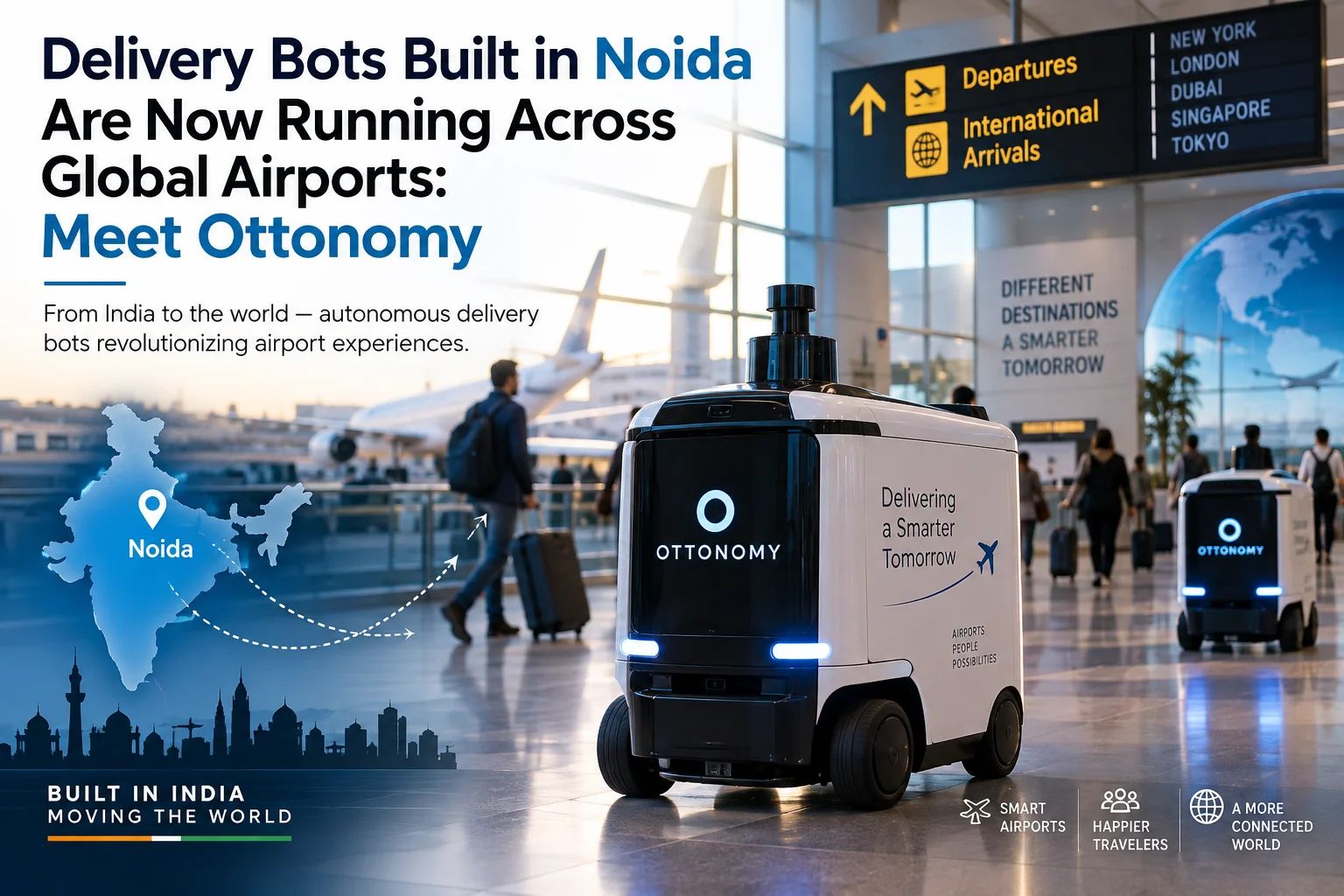
- Deeptech startup Ottonomy is deploying autonomous delivery robots across airports, malls, and outdoor campuses worldwide.
- While headquartered in Sunnyvale, the core engineering and manufacturing line runs out of Noida, Uttar Pradesh.
- Unlike standard delivery bots that rely purely on GPS, Ottonomy built a navigation stack that transitions smoothly between indoor corridors and outdoor parking lots.
- Global rollouts now cover North America, Europe, the Middle East, and key pilot zones across India.
What just happened?
Imagine sitting at an airport boarding gate at 6 AM. Your flight is in forty minutes, your coffee craving is peaking, but the nearest cafe is three terminals away. You place an order on your phone, and ten minutes later, a boxy four-wheeled machine quietly rolls up beside your chair, pops open its secure hatch, and serves your steaming cup. No delivery rider running through security checkpoints. No getting lost near baggage claim.
This sounds like a scene from an experimental tech demo in Tokyo. But the hardware doing this right now across multiple continents is manufactured right here in Noida.
Deeptech startup Ottonomy, founded by Ritukar Vijay and his team, has taken autonomous ground logistics from sci-fi pilots straight onto busy terminal floors. Headquartered in Sunnyvale, California, with its primary manufacturing and engineering base in Noida, the company has put its autonomous fleet into commercial action across North America, Europe, the Middle East, and India. While everyone spent the last three years obsessing over software chatbots, Ottonomy quietly cracked one of the toughest problems in physical tech: building a robot that does not get confused the moment it steps out of an elevator.
How does this actually work?
Making a robot move on flat ground is easy. Engineering a robot to navigate a bustling airport terminal packed with screaming toddlers, moving luggage trolleys, sliding glass doors, and patchy Wi-Fi signals is a completely different ballgame.
Most outdoor delivery robots you see on US college campuses rely heavily on GPS. That works fine on an open sidewalk. But the second a robot enters a covered parking lot, an underground logistics hub, or a massive airport terminal, GPS signals drop to zero. Traditional indoor robots, on the other hand, rely on magnetic strips on the floor or pre-mapped ceiling tags. If you alter the store layout or change a gate number, they get stuck.
Ottonomy tackled this with a contextual navigation engine. Their primary robot, dubbed the Ottobot, uses an array of 3D LiDAR sensors, visual cameras, and proprietary mapping software. Instead of panicking when GPS drops, it switches dynamically between indoor mapping and outdoor sensor streams. It understands structural landmarks, detects pedestrians moving in unpredictable directions, and reroutes itself around temporary barriers like cleaning carts or construction boards without human intervention.
Security is another clever bit. When a customer orders something, the compartment stays locked using digital authorization. Once the bot reaches your exact pin or table, you scan a QR code or tap your phone to unlock only your specific compartment. Multiple orders can sit in segregated temperature-controlled bays inside the same bot, meaning one trip handles multiple drops.
What changes for people in India?
India is usually celebrated for writing code for Silicon Valley apps, while deeptech hardware manufacturing gets shipped off to Shenzhen or Taiwan. Ottonomy flips that script on its head. The entire industrial design, assembly, testing, and hardware refinement happen inside their facility in Noida.
That matters for several reasons. First, building complex robotic hardware locally creates a specialized supply chain. Sensors, motor controllers, precision chassis fabrication, and embedded system testing all happen under domestic engineering teams. That drops the capital expenditure significantly compared to purely Western robotics firms.
Second, think about the immediate use cases within our own borders. Indian airports in Bengaluru, Mumbai, and Delhi are expanding into massive aerotropolises where walking from check-in to your gate takes twenty minutes. Large tech parks in Hyderabad and Chennai, sprawling hospital campuses, and 100-acre university grounds face constant internal logistics friction. Having small, safe autonomous vehicles handle intra-campus courier movement, medical sample transfers, and food drops takes immense pressure off support staff.
While full-scale sidewalk delivery across chaotic Indian streets might still face obvious challenges with open potholes and crowded footpaths, controlled environments are an entirely different story. Gated townships, SEZ tech corridors, luxury resorts, and high-traffic transit hubs are prime territory for this rollout.
What should you do now?
If you run facilities, logistics, or retail operations across large campuses, it is time to look beyond manual runners. Automated internal transit is no longer an experimental line item for five years down the road. It is already cutting last-mile delivery costs and turnaround times in live commercial hubs globally.
For engineers, developers, and robotics students in India, keep a close eye on hardware-plus-AI deeptech. The era of building simple consumer wrapper apps is giving way to serious physical engineering. Building robots that can perceive, decide, and act in messy real-world spaces is where the next massive wave of technical value is being created.
Next time you spot a friendly wheeled pod rolling across an airport lounge or an office park concourse, take a closer look at the build plate. The tech powering the future of global logistics might just have been built down the road in Uttar Pradesh.



Comments (0)
Be the first to comment!