


முக்கிய விஷயங்கள்
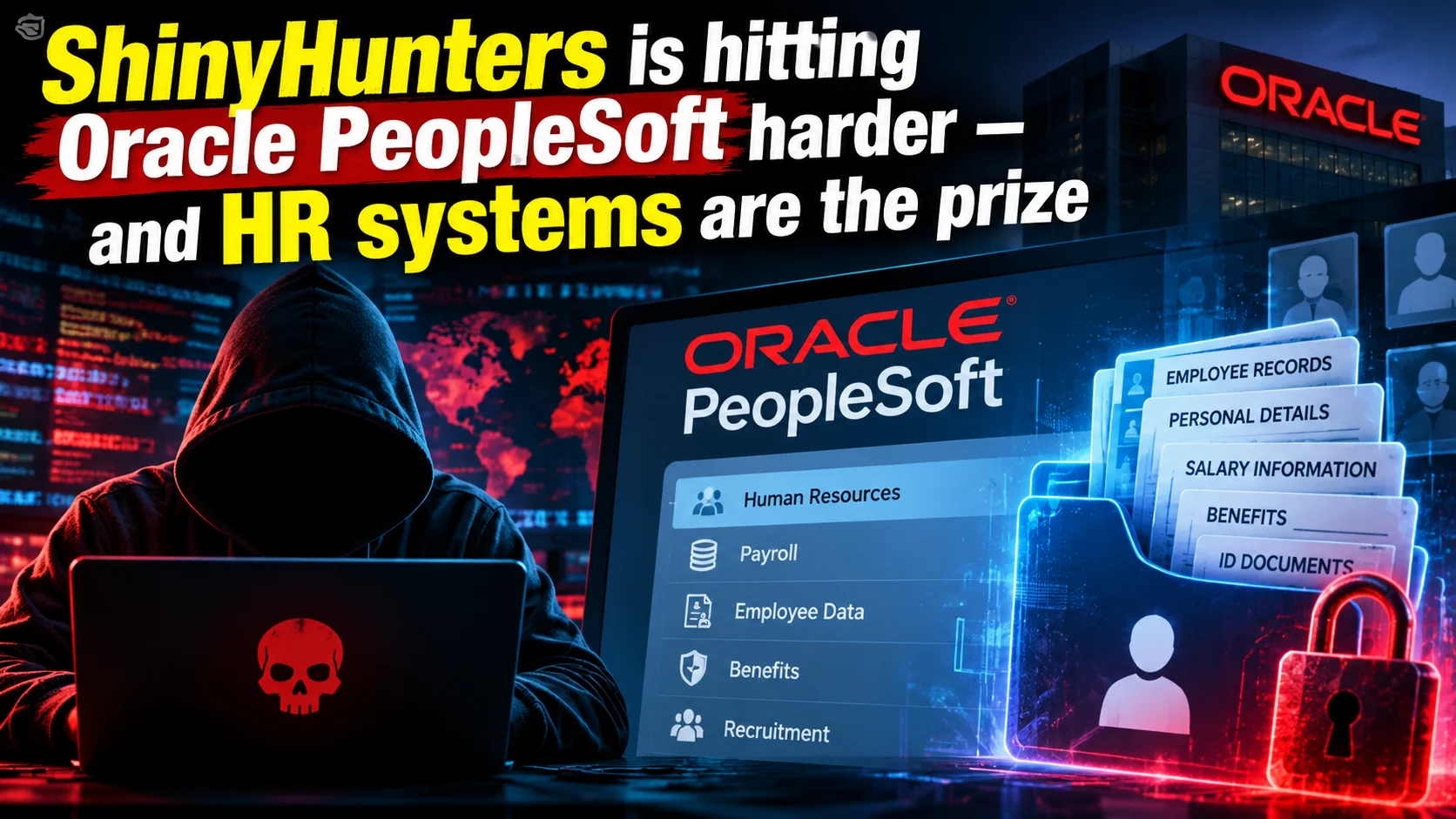
- Google-linked threat intel says ShinyHunters has expanded attacks aimed at Oracle PeopleSoft environments.
- PeopleSoft sits under HR, payroll, and other core office systems — so a breach is not just IT noise.
- Even big, well-funded organisations are in the blast radius; size alone is not a shield.
- Indian firms, campuses, and shared-service centres that still run PeopleSoft should treat Login, VPN, and admin access as high-risk surfaces right now.
- Staff-side moves matter: MFA, odd password-reset mails, and “urgent HR link” messages deserve a second look before you click.
What just happened?
You open your laptop on a Monday, punch in leave on the company portal, and move on. That portal is often PeopleSoft or something talking to it. Google’s threat side is now flagging that the ShinyHunters crew has stretched its attacks further into Oracle’s PeopleSoft world.
This is not a random website defacement story. PeopleSoft is the quiet machine behind hiring files, salary runs, bank account fields for reimbursements, and manager approvals. When a group known for data theft leans harder on that stack, the alarm is about employee records and business continuity, not just a flashy homepage.
ShinyHunters has a long track record of going after large stores of personal and corporate data and pushing stolen sets into underground markets. The new signal is scope: more pressure on PeopleSoft-facing setups, and a pattern that keeps shifting instead of freezing on one old trick.
That evolving bit is what should worry security teams. A fixed attack is easier to patch against. A moving one means last quarter’s “we are fine” memo may already be stale.
How does this actually work?
Think of PeopleSoft as a big office filing cabinet with a web door. Staff hit a Login page. HR teams hit admin screens. Sometimes partners or outsourced payroll teams get limited access. Attackers do not need to “hack Oracle the company” in a movie sense. They need a weak door into your instance.
In plain terms, campaigns like this usually hunt for exposed portals, forgotten test servers, weak remote access, stolen passwords, or phishing that tricks someone with real rights. Once inside, the goal is bulk data — employee IDs, contact details, sometimes bank-linked fields used for salary — and a quiet exit before logs scream.
ShinyHunters-style crews are patient about packaging that data. They care about volume and resale value. HR systems are juicy because the fields are structured and complete. Name, email, employee number, department, phone — that is a ready-made kit for follow-on fraud and spear phishing.
Google’s warning, as framed in public reporting around this wave, is less “one magic bug everyone must fear today” and more “this actor set is actively expanding how it goes after PeopleSoft estates.” That distinction matters. You still patch. You still lock down the edge. But you also assume the playbook will change week to week.
PeopleSoft deployments are often old, heavily customised, and tied to payroll calendars. Teams hesitate to restart or upgrade mid-cycle. Attackers know that hesitation. They lean on the gap between “critical system” and “we will touch it next maintenance window.”
Another real-world path: session theft and account takeover after a staff member clicks a fake SSO or password-reset mail. No exotic zero-day required. Just one tired manager on a phone network approving a leave request and a lookalike tab open beside it.
What changes for people in India?
India runs a huge amount of global HR and finance work from shared-service centres. Many of those centres sit on Oracle stacks, including PeopleSoft, or on tools that sync with it. A breach in a parent company’s PeopleSoft can spill into processes handled from Bengaluru, Hyderabad, Pune, or Chennai even when the “main” server is abroad.
Local enterprises and universities still use PeopleSoft for campus HR and payroll in places. If you are an employee, the first pain you feel is rarely a technical advisory. It is a weird SMS about salary, a fake IT call asking you to “confirm your employee ID,” or a phishing mail that copies your real HR subject lines.
Indian banking rails make the fraud path faster. UPI handles and GPay-style flows mean stolen personal details get weaponised into social-engineering scripts: “HR here, your reimbursement failed, re-enter UPI on this link.” The link is the attack. The PeopleSoft breach was only the research phase.
Well-resourced institutions are not magically safe. Big logos still run legacy portals, still give vendors remote access, still have contractors with broad rights. The Google-linked warning is partly about that discomfort — money and headcount do not equal a locked HR system.
For job seekers and ex-employees, old profiles matter too. Data sitting in “inactive” status can still leak. If you left a firm years ago and still get hyper-personal spam using internal project names, treat that as a signal, not a coincidence.
Regulators and boards in India already stare hard at personal data events. A PeopleSoft incident is not only an IT ticket; it can become a compliance and trust problem with staff unions, customers, and partners who share workforce data across entities.
What should you do now?
If you run IT or security: map every public URL that touches PeopleSoft, SSO, or VPN paths into it. Kill test and forgotten instances. Enforce MFA on admin and HR roles without exceptions for “VIP” accounts. Review who can export reports in bulk.
Watch auth logs for odd geolocation, sudden report downloads, and new devices on privileged accounts. Rotate credentials for service accounts that have been static for years. If a vendor needs access, time-box it and log it like a visitor badge, not a permanent key.
Patch on the vendor’s guidance and your change window — but do not wait for a perfect weekend if exposure is clear. Network controls that keep the PeopleSoft admin plane off the open internet buy you time even when application fixes lag.
If you are regular staff: slow down on HR-looking mails. Real payroll teams rarely ask you to “validate salary account on this new link” under panic timers. Use the official App or bookmark, not the button inside a forwarded message. Turn on MFA everywhere your company allows it.
On your phone, separate work Login from random Chrome tabs when you can. A single stolen session cookie can be enough. If your firm uses a password manager, use it — reused passwords from a personal shopping site should never open the HR door.
If something already feels off — salary mail you did not trigger, Login alerts at odd hours — call IT on a known number, not the number in the suspicious SMS. In India, also watch UPI collect requests that name your employer or employee ID. Decline first, verify second.
Companies should brief HR and finance teams in plain language. They are the human API into these systems. One rushed click from a payroll ops desk can undo a year of firewall diagrams.
None of this needs panic. It needs boring hygiene done this week, not after the underground forum post shows up with your org’s watermark still on the PDF.
Questions you are already asking
Is this only an Oracle cloud problem? No. PeopleSoft shows up in on-prem and hosted setups. The risk follows the deployment you actually run, not the marketing slide.
Does a famous brand name protect you? Public reporting around this wave is a reminder that it does not. Resourcing helps only when it is aimed at the real Login paths and admin rights, not the press release.
Should small Indian teams care if they “only” integrate with a parent PeopleSoft? Yes. Integrations and shared credentials extend the blast radius. Treat partner SSO as part of your own surface.




Comments (0)
Be the first to comment!