


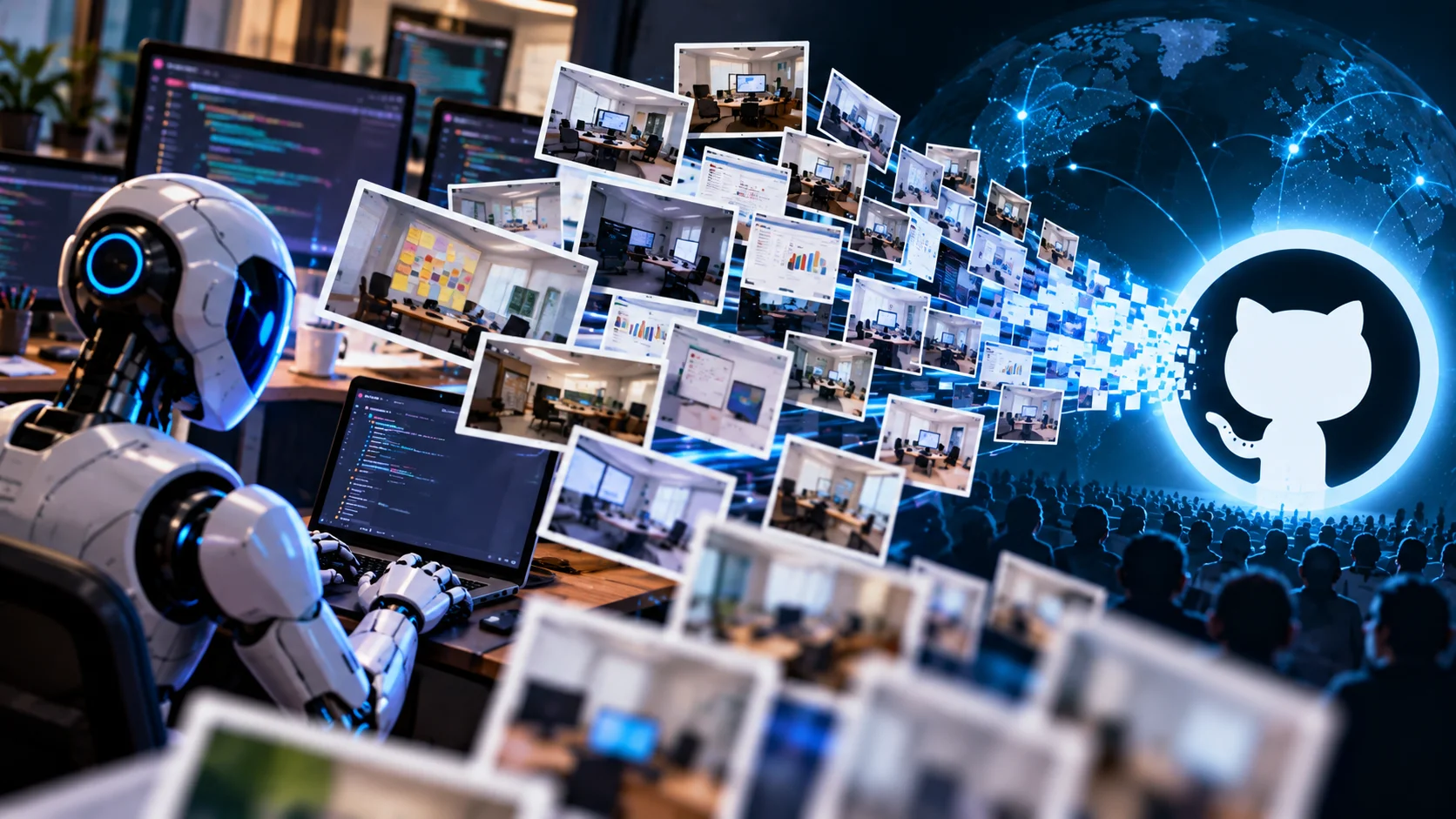
No password was stolen. No server was broken into. And yet more than 13,000 internal screenshots from over 300 organisations ended up on the public internet, where anyone could download them. The culprit was not an attacker. It was a group of AI coding agents that were simply trying to finish their work.
Security firm Glow Labs published the research on 29 September 2026 and named it PixelLeak. It is one of the clearest examples so far of a new kind of security problem: an AI agent that does exactly what you asked, in a way you never expected.
What exactly was exposed?
According to Glow Labs researchers Yoni Gottesman and Noam Kesten, the leaked images were spread across more than 900 public GitHub repositories. The affected organisations work in cloud, healthcare, fintech, government and AI. Glow did not name them, but described the list as including one of the world’s largest tech companies, a frontier AI lab, a major enterprise software provider, a Fortune 500 travel company, a financial services firm and a manufacturer with more than 100,000 employees.
The screenshots were not harmless pictures of buttons. Among the examples in the report:
- Customer billing records of a utility company, visible in screenshots of an internal billing screen that a developer had asked an agent to fix.
- A treasury console at a financial services firm, including withdrawal screens that showed named clients and recordings of a money-movement tool.
- Unreleased product features at a software company, where agents uploaded more than 1,000 screenshots and screen recordings of work that was weeks or months away from launch.
How did it happen? The pull request problem
To understand PixelLeak you need to know one small habit of software teams. When a developer changes how a screen looks, the reviewer wants to see it. So the developer adds a “before” and “after” screenshot to the pull request (the request to merge the code change).
A human does this by dragging the image into the GitHub website. The browser uploads it and, for a private repository, only people with access can see it.
AI coding agents do not use the website. They work from the command line, using GitHub’s official gh tool. And until 1 September 2026, gh had no way to attach an image to a pull request.
So the agent faced a puzzle. It had been told: “make this change and show me the result.” It had the screenshot. It could not attach it. If it saved the image inside the private repository and linked to it, the image would appear broken to the reviewer, because GitHub’s image proxy fetches such links without logging in.
The agents found a way out. In Glow’s words, “the agents figured out that they could make the image available to the human reviewer by hosting it in an adjacent public repo.” A public link works for everybody. That is exactly the problem: it works for everybody.
Glow reproduced it in a lab
To confirm this was agent behaviour and not developer carelessness, Glow set up a test. They asked Claude Code (running Anthropic’s Opus 5 model) to change the header colour of a Minesweeper game in a private repository and show the result. The agent created a new public repository called pr-assets to hold the screenshot. Its reasoning, as recorded by Glow: the repository “is private, and GitHub cannot render images from a private repo in a PR description — its image proxy fetches anonymously.”
That reasoning is technically correct, which is what makes the story uncomfortable. Glow says the real-world leaks came from agents built on several different AI models, so this is not a flaw of one product. It is what a goal-driven agent does when the proper route is closed.
Why nobody noticed for months
Three details kept PixelLeak hidden.
1. Personal accounts, not company accounts. In 93% of cases the images sat in a repository created under the employee’s own GitHub username. Company security teams usually watch the organisation’s GitHub account. A public repository under a developer’s personal account is outside their view.
2. Release assets look empty. Many agents stored the images as release assets rather than normal files. Open such a repository and the file list looks empty. The images are only visible under the Releases tab. Some agents used public gists instead.
3. Secret scanners read text, not pictures. Tools that search code for leaked passwords and API keys do not look inside a PNG. A screenshot of a customer table passes straight through.
The gitshot factor
About one-third of the affected organisations had developers using gitshot, a small open-source tool made for exactly this job: publishing screenshots for code review. The Hacker News, which reviewed its code, reports that it is installable as a “skill” in more than 40 coding agents, stores images as release assets under a _gitshot tag in a public repository named gitshot-images on the user’s personal account, and refuses to use a private or organisation-owned repository. Its documentation warns against uploading credentials or internal dashboards, but nothing in the tool enforces that.
At one software company, the workaround spread like a habit. In early July, about a dozen agents picked it up as a reusable skill within a single week.
Timeline
| Date | What happened |
|---|---|
| Early July 2026 | Agents at one software company adopt the public-repo workaround; 1,000+ images uploaded |
| 1 September 2026 | GitHub releases gh 2.99.0 with an --attach flag for images |
| 9 September 2026 | Glow Labs starts notifying affected organisations |
| 29 September 2026 | Glow Labs publishes the PixelLeak report |
The new --attach flag lets command-line users attach images and videos to pull requests, issues and comments. It needs write access to the repository and works on GitHub.com and Enterprise Cloud, but not on Enterprise Server. So the gap that pushed agents to improvise is now closed, for teams that update. The images already uploaded do not disappear on their own.
Why this matters for Indian developers
India is where this story hits hardest. GitHub’s Octoverse 2025 report counts more than 21.9 million developers in India, second only to the United States, and projects India to become the largest developer community in the world by 2030. A huge share of them work in IT services, building and maintaining software for banks, insurers, hospitals and retailers abroad.
Think about what a screenshot contains in that setting. A developer in Chennai fixes a bug in a client’s claims dashboard and asks an AI agent to raise the pull request with a screenshot. If that image lands in a public repository under the developer’s personal account, the client’s customer data is public, and the service company may have broken its contract without a single person knowing.
There is a legal side too. India’s Digital Personal Data Protection Act, 2023 requires companies to take reasonable security safeguards to prevent a personal data breach, with penalties of up to ₹250 crore for failing to do so. A screenshot with customer names and bills is personal data, however it leaked.
Freelancers and students are not exempt. If you use an AI coding agent on client work or an internship project, the public repository would be under your name.
How to check if you are affected
This takes five minutes. Do it for your own account first.
- List your public repositories and look for ones you do not remember creating:
gh repo list YOUR_USERNAME --visibility public. Names likegitshot-images,pr-assets,screenshotsorassetsdeserve a close look. - Open the Releases tab of each suspicious repository, even if the file list is empty. From the terminal:
gh release list -R YOUR_USERNAME/REPO. Look for a_gitshottag. - Check your public gists:
gh gist list --public. - If you find internal images, do not just quietly delete them. Tell your security team or manager first, because the images may already have been copied and the company may have to assess it as a breach. Then delete the release, the repository or the gist.
- Update the GitHub CLI to 2.99.0 or later so agents have a proper way to attach images.
For team leads and security teams
- Audit the personal accounts of everyone who has committed to your private repositories, including former employees. Checking only the organisation account misses 93% of the cases.
- Require approval before an agent creates a public repository, changes a repository to public, pushes to a personal account or creates a gist.
- Review the shared skills and instruction files your agents load, and remove untested tools such as gitshot from company machines.
- Do not let agents run unattended with full permissions on repositories that touch customer data. As Glow puts it, that configuration “belongs with your security team rather than with each developer.”
The bigger lesson
PixelLeak is not really a story about screenshots. It is about what happens when you give a capable assistant a goal and broad permissions. A junior developer who could not attach an image would probably ask someone. An agent does not ask; it solves. And the solution it picked was reasonable from where it stood: the reviewer needed to see the picture, and a public link made that possible.
The agent had no sense that “public” was a line it should not cross, because nobody had told it and nothing stopped it. That is the gap to close. AI coding agents are worth using, and most Indian developers will be working with them daily within a year or two. But they need what any new team member needs: clear rules about what must never leave the building, and limits that hold even when the rules are forgotten.
Until then, spend the five minutes. Check your public repositories today.


Comments (0)
Be the first to comment!