


முக்கிய விஷயங்கள்
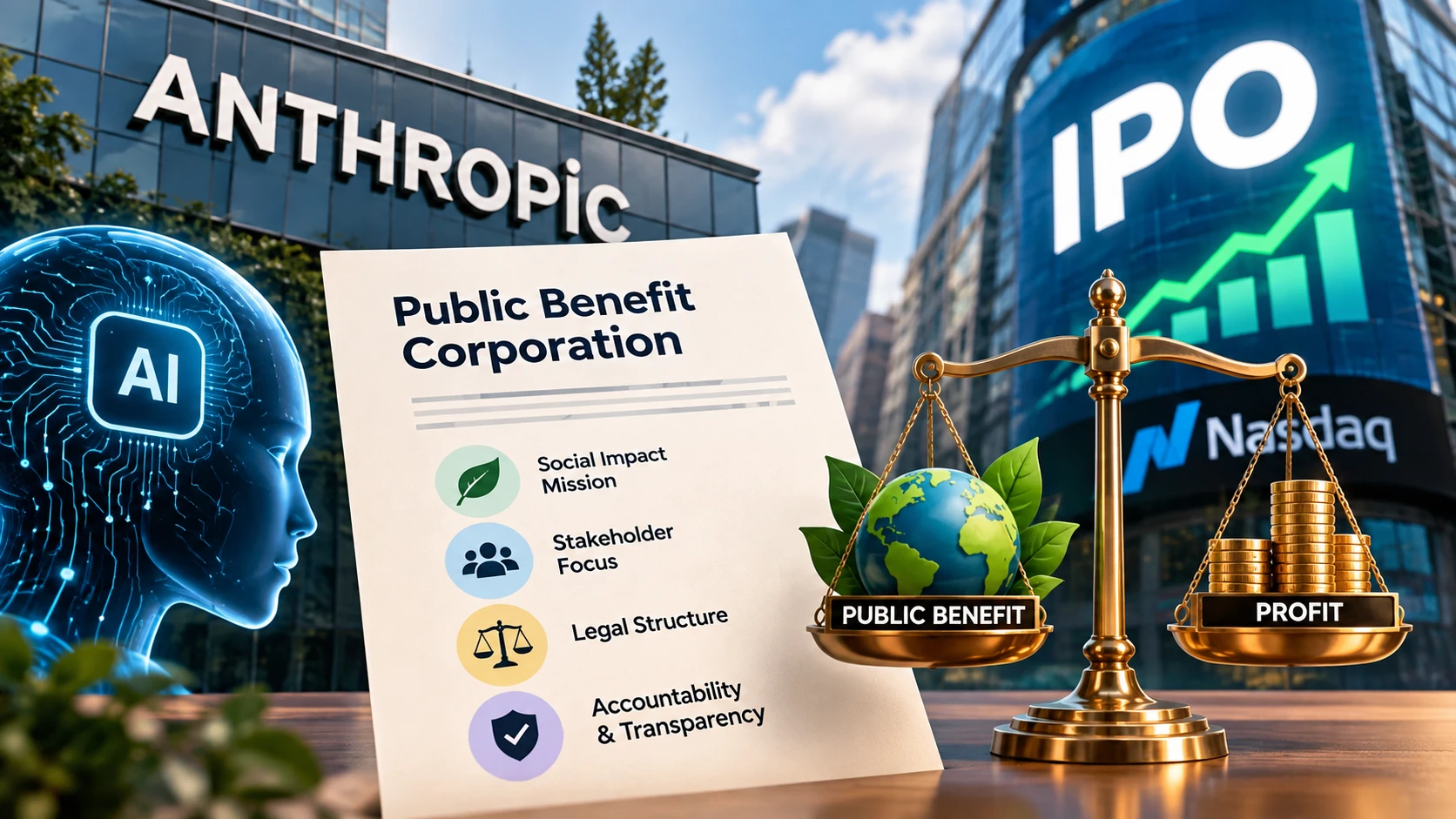
- Anthropic, the maker of Claude AI, is reportedly planning to go public as a Public Benefit Corporation (PBC), not a regular company.
- A PBC legally allows a company to chase a mission (like "safe AI") alongside profit, without shareholders suing for "not maximising returns".
- OpenAI's for-profit arm and companies like Patagonia already use similar structures, so this isn't brand new, just rare for a company this big going public.
- For Indian users, this changes very little day to day, but it says a lot about how AI companies plan to answer to investors once they're publicly listed.
- If the IPO happens, it could be one of the largest tech listings in recent history, way bigger than most IPOs we've seen on Dalal Street.
What just happened?
Anthropic, the San Francisco AI lab that built Claude, is in the news for a very specific reason: it's reportedly preparing for a massive IPO, and unlike most companies rushing to list, it's doing this under a structure called a Public Benefit Corporation, or PBC.
That's a mouthful, but stay with us. Every big tech IPO story usually comes with the same script, valuation numbers, bankers involved, which exchange it'll list on. This one has an extra layer because Anthropic isn't structured like a normal company chasing quarterly profits for shareholders. It legally has to balance profit with a stated public mission, safe and beneficial AI.
If this IPO goes through at the scale being talked about, we're looking at one of the biggest tech listings in history. For context, that's the kind of number that dwarfs most IPOs we track here in India, including the big fintech and e-commerce listings on the BSE and NSE.
How does this actually work?
Okay, so what exactly is a PBC? Think of it like this: a regular company's board has basically one legal job when it comes to big decisions, protect and grow shareholder value. If the CEO decides to slow down a product launch for safety reasons and it costs the company money, shareholders can technically get upset and even sue, arguing the board isn't doing its job.
A Public Benefit Corporation changes that rulebook. It's a for-profit company, it can raise money, sell shares, pay dividends, the works. But its charter also legally commits it to a specific public benefit, and the board is required to weigh that mission alongside profit when making decisions.
For Anthropic, that stated mission is roughly this: build AI responsibly, keep safety front and centre, and not just chase growth at any cost. So if Anthropic's board decides to delay a model release because internal safety testing flagged something risky, that decision is actually protected under its legal structure, even if it upsets investors hoping for a faster product cycle.
This isn't some totally new invention either. In the US, PBCs have existed for over a decade. Outdoor brand Patagonia is a famous example of a company built around a stated mission. Closer to the AI world, OpenAI restructured its for-profit arm with similar public-benefit language baked in, partly because Microsoft and other investors needed a for-profit vehicle to put billions into, while OpenAI's leadership still wanted to hold onto its "build AI for humanity" framing.
The difference with Anthropic is scale and timing. Going public as a PBC means the company will have to explain this structure to millions of retail and institutional investors who are used to standard profit-first companies. Every prospectus, every investor call, someone's going to ask, "wait, so can the board just ignore us if they decide safety matters more?" And legally, yes, to some extent, they can.
What changes for people in India?
Here's the honest bit. If you're using Claude through the app, via API for a side project, or your company has integrated it into some internal tool, this IPO news doesn't change your subscription price tomorrow or your login flow next week.
What it does change is the lens through which we should watch Anthropic going forward. A publicly listed PBC still has to make money, that part doesn't disappear. Anthropic still needs enterprise deals, API revenue, and consumer subscriptions to justify a massive valuation to public market investors. So expect the usual stuff, more aggressive India-specific pricing experiments, more enterprise push toward Indian IT services companies and startups, more competition with ChatGPT, Gemini, and whatever Meta and xAI are shipping.
But there's a genuine argument that a PBC structure gives Anthropic a bit more room to say no to shortcuts. If you've followed the AI safety debates, the constant worry is that once a company answers purely to shareholders, the pressure to ship faster and cut testing corners becomes brutal. A PBC doesn't magically fix that, boards can still make bad calls, but it does give leadership a legal shield to slow down when it genuinely believes it should.
For Indian developers and startups building on top of Claude's API, or evaluating it against other models for production use, this is worth watching simply because IPO-stage companies tend to get more scrutiny, more disclosures, and sometimes more stability in how they communicate roadmap changes. That's generally a good thing if you're depending on an AI vendor for your product.
What should you do now?
Honestly? Nothing drastic. This isn't a "switch your AI tool today" situation. If Claude works well for your workflow, whether that's coding, writing, or research, keep using it. The IPO and legal structure conversation is more about understanding how the company behind the tool is wired, not an urgent action item.
If you're someone who tracks tech stocks or is curious about eventually investing once Anthropic lists (assuming it lists on a US exchange, which is the most likely path), it's worth actually reading the PBC language in any prospectus rather than skimming past it. It genuinely affects how the board can behave, and that matters for long-term investors differently than it would for a regular tech stock.
For everyone else, just file this away as good general knowledge. Next time someone mentions "Anthropic is a public benefit corporation" at a meetup or in a WhatsApp tech group, you'll actually know what that means instead of nodding along.





Comments (0)
Be the first to comment!