


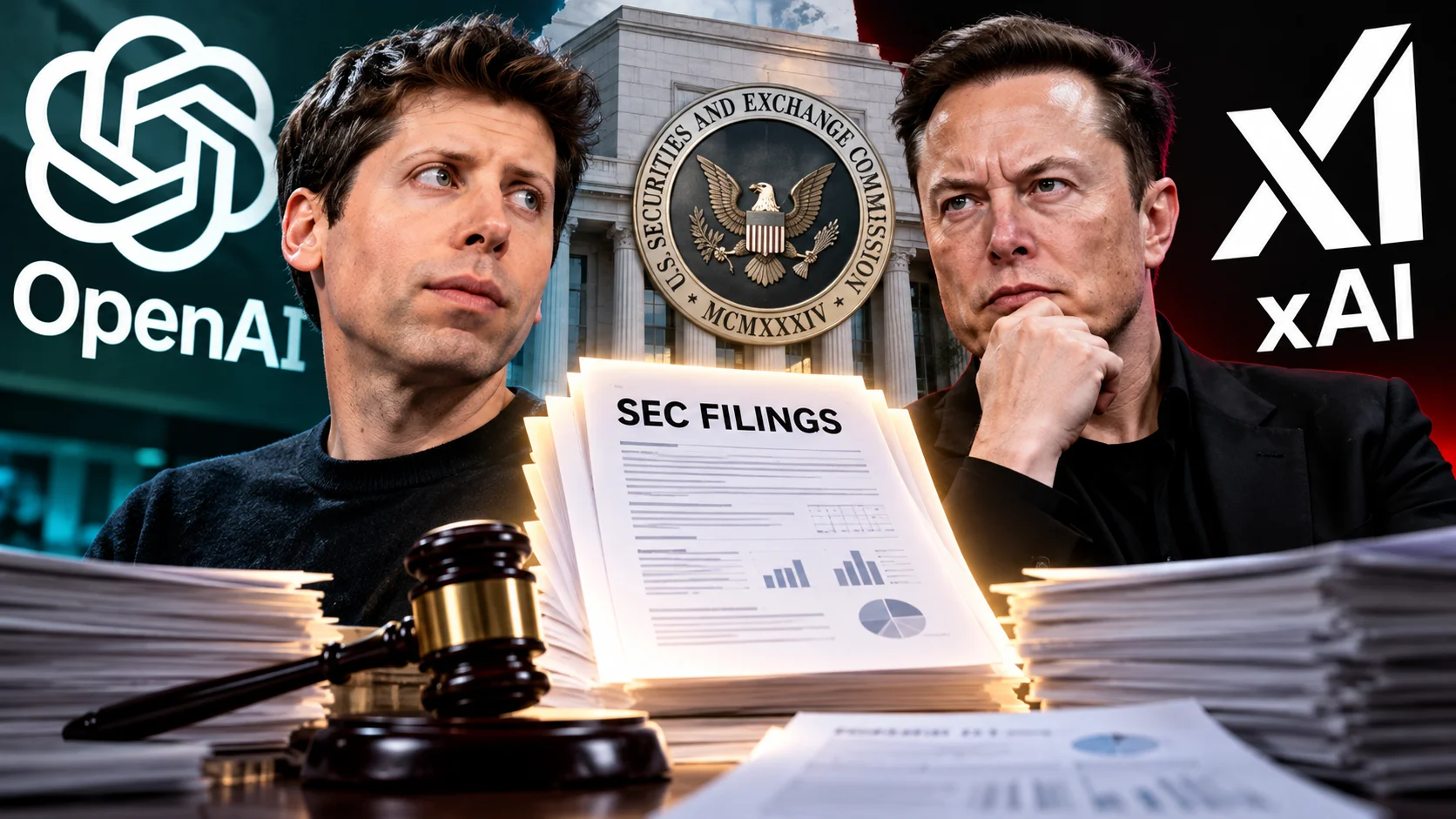
- OpenAI asked a Texas federal judge to throw out Elon Musk's xAI antitrust lawsuit before it reaches a trial.
- OpenAI argues that xAI's own SEC filings disprove any monopoly claims by showcasing billions raised and massive compute deployed in record time.
- Under antitrust law, xAI must prove real market suppression, which clashes directly with its own public fundraising and rapid product rollout records.
- For Indian developers and software founders, this corporate clash keeps token prices dropping and prevents any single provider from gatekeeping frontier AI.
What just triggered this Texas courtroom fight?
The long-running rivalry between Elon Musk and Sam Altman has spilled into a Texas federal courtroom with high legal stakes. Musk's AI company, xAI, filed an antitrust lawsuit accusing OpenAI of unfair trade practices, cornering early investor backing, and attempting to monopolize the generative AI sector.
OpenAI did not just issue a routine denial. The ChatGPT creator formally asked the federal judge to toss out the entire lawsuit before it ever reaches discovery or a jury trial.
The counter-strategy is sharp. OpenAI is using Musk's own regulatory disclosures against him. In legal filings presented to the court, OpenAI pointed straight at public SEC filings and investor documents submitted by xAI. Those filings paint a picture of a red-hot challenger startup that raised billions of dollars, purchased tens of thousands of top-end data center GPUs, and rolled out frontier models at record speed.
OpenAI's argument to the judge is straightforward: How can you claim OpenAI operates an impenetrable monopoly that chokes out competition when your own official paperwork brags about historic capital inflows and swift market entry?
How is OpenAI turning Musk's own paperwork against him?
To understand why this move hurts xAI's legal standing, you have to look at how antitrust claims work. In the United States, being a dominant market player is not illegal on its own. Building a wildly popular service that millions of people pay for every month is completely standard business.
To win an antitrust claim, xAI has to prove two difficult points: first, that OpenAI possesses genuine monopoly power in a clearly defined AI market, and second, that it used exclusionary, anti-competitive tactics to block viable rivals from entering.
Think of it like opening a modern coffee shop right across the street from a famous corner outlet in Chennai. If you raise ₹50 crore from eager investors, install top-tier brewing equipment, recruit experienced baristas, and draw long queues of customers every morning, you cannot walk into court the next month and claim the older shop made it impossible for you to enter the market.
That is the exact pressure point OpenAI targeted. Regulatory filings around xAI funding rounds show the startup drawing massive capital from top venture funds, setting up huge supercomputer clusters, and shipping models like Grok directly to millions of active users on X.
By highlighting these public filings, OpenAI wants the court to acknowledge that capital, compute, and developer attention are circulating freely across the sector. With billions flowing into xAI, Anthropic, Google, and open-weight models, convincing a federal judge that one company holds an iron grip on the whole industry is a steep climb.
Why does a US court clash matter to Indian developers and startups?
You might ask why an aggressive dispute in a Texas federal court matters to someone running an engineering team in Bengaluru or building an e-commerce automation tool in Coimbatore. The answer touches developer budgets, API pricing, and platform independence.
Right now, thousands of Indian SaaS startups, tech consultancies, and independent builders depend on frontier AI APIs to power their everyday products. If any single entity had an unchallenged monopoly over foundational models, Indian developers would face steep subscription fees in rupees, rigid platform rules, and zero pricing leverage.
This aggressive legal tussle shows just how fierce the rivalry remains among AI providers. Because xAI, OpenAI, Google, and Anthropic are battling head-to-head for market share, they keep lowering per-token API costs and expanding context windows for every single rupee spent.
For consumer users paying monthly subscriptions through UPI or credit cards for ChatGPT Plus or Grok, this competition drives rapid feature rollouts. When these tech heavyweights feel sustained legal and commercial heat, they have to keep shipping faster responses, smarter reasoning models, and better multimodal tools just to protect their user base.
How should Indian engineering teams play this AI price war?
If you build software, manage tech stacks, or run digital workflows, this legal clash offers one big practical lesson: never lock your product into a single model vendor.
Engineering teams across India are already designing model-agnostic backends. By using open-source abstraction layers like LiteLLM or LangChain, developers can route customer queries between OpenAI, Grok, Claude, or self-hosted open models with a quick configuration update.
Review your monthly inference bills regularly. Benchmark competing models for specific tasks, whether that involves regional language translation for Indian users, customer support automation, or complex code generation. Because each frontier lab wants to undercut rivals, switching providers or using hybrid routing can cut your operational costs significantly.
As the Texas court weighs OpenAI's motion to dismiss, do not expect the tension between Altman and Musk to disappear. For builders, founders, and everyday tech users, this intense rivalry guarantees that generative AI tools will remain competitive, accessible, and fast-moving.






Comments (0)
Be the first to comment!