


முக்கிய விஷயங்கள்
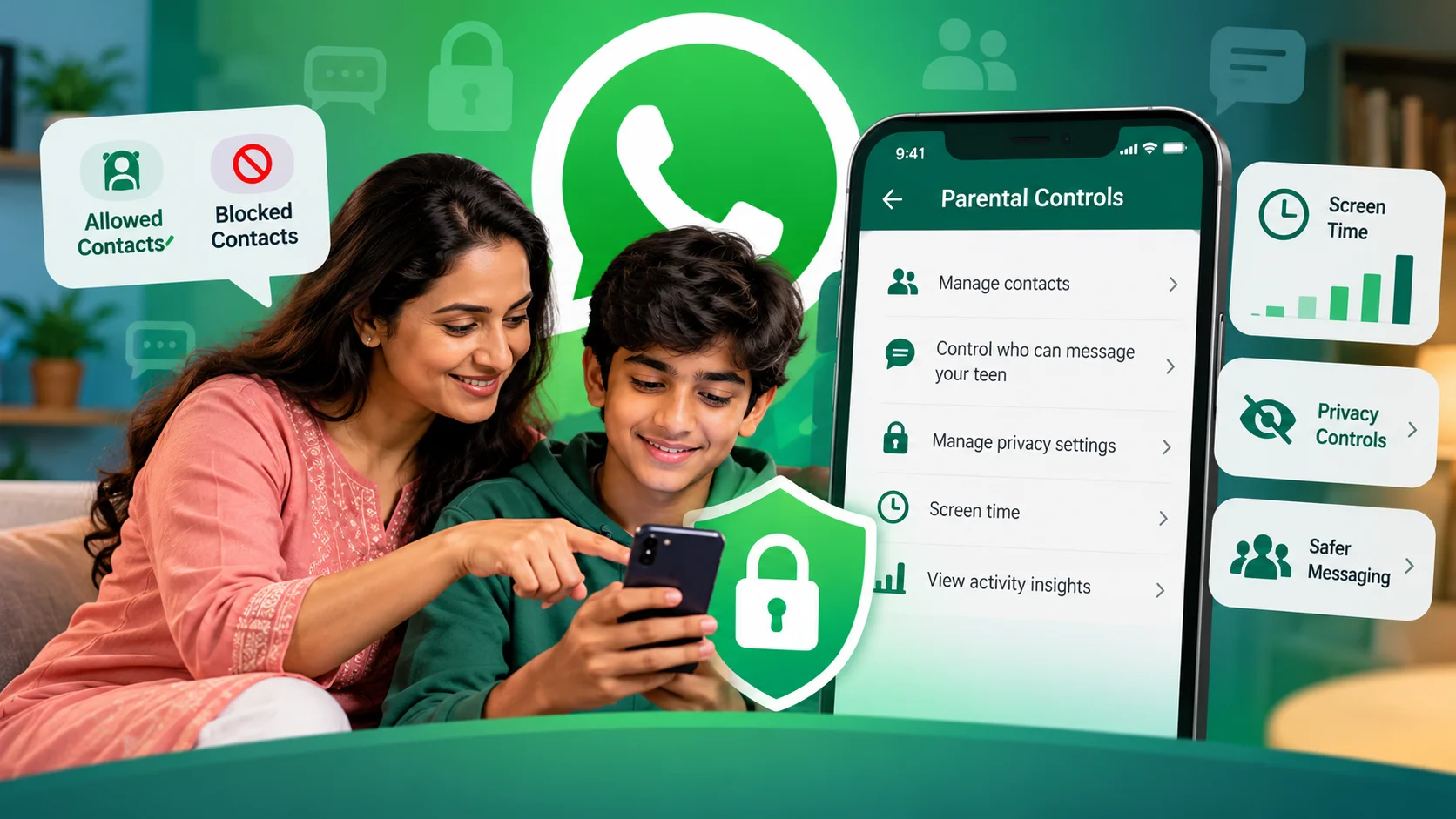
- WhatsApp is rolling out parental controls globally for pre-teen and teen accounts linked to a family's phones.
- Parents can manage who pre-teens add as contacts and which groups they join.
- For teens, parents get a say in privacy settings, Meta AI access, Status, and Channels.
- This links to Meta's wider push for teen accounts across Instagram and Facebook too.
- Rollout is global and gradual, so don't panic if your family doesn't see it on day one.
What just happened?
Picture this. Your eleven-year-old has a phone, mostly for school groups and talking to grandma. But WhatsApp doesn't really know that. Until now, once a number was verified, the kid had the same WhatsApp as everyone else, full contacts, full groups, full everything.
That's changing. WhatsApp has started rolling out parental controls aimed squarely at pre-teen and teen accounts, and it's going out worldwide, not as a one-country pilot. The idea is simple on paper, give parents a dashboard-style way to set limits without snooping through every single chat.
For pre-teens, the controls are about who they can even talk to. Parents can have a say in which contacts get added and which groups the child can join. Basically, it's less about reading messages and more about closing the door before a random number ends up in your kid's chat list.
For teens, the controls go a notch further. Parents can adjust privacy settings, control access to Meta AI inside WhatsApp, and manage whether Status updates and Channels are visible or usable. That's a meaningful jump because Meta AI and Channels are newer features that a lot of parents don't even know exist on their teenager's phone.
How does this actually work?
Here's the part that actually matters, the mechanic behind it. WhatsApp is building this on top of family-linked accounts, similar to how Instagram and Facebook already run their teen account systems under the Meta umbrella.
Think of it like a permission layer sitting on top of the regular app. The teen or pre-teen still uses WhatsApp like normal, send messages, join groups, watch Status. But certain toggles are now visible to a linked parent account too.
For a pre-teen profile, that layer is stricter. Adding a new contact or joining a group can require a parent to be aware of it or approve it, depending on how the setting is configured. It's closer to a training-wheels version of WhatsApp.
For a teen profile, the layer is more about visibility and limits rather than full gatekeeping. A parent can see and adjust whether Meta AI is switched on, whether Status is public or restricted, and whether Channels, which are WhatsApp's broadcast-style follow feature, are accessible at all.
Important point here, this is not WhatsApp reading your teenager's private chats. End-to-end encryption on actual conversations isn't what's being touched. This is strictly account-level settings, contacts, groups, AI access, and content features like Status and Channels.
What changes for people in India?
India is WhatsApp's biggest market by user count, so whatever rolls out globally eventually lands hard here too. A huge chunk of Indian households hand down an old phone to a kid around age 10-12, with a new SIM, and WhatsApp becomes their first real social app before Instagram or anything else.
Up until now, Indian parents mostly managed this the old-fashioned way, checking the phone directly, sitting next to the kid, or just hoping for the best. These parental controls give an actual in-app option instead of relying purely on trust and spot checks.
It also matters because of how group culture works in India specifically. School class groups, tuition groups, society groups, cricket match groups, kids end up in dozens of WhatsApp groups fast. A pre-teen control that limits random group joins could genuinely cut down on spam links and unwanted contacts landing in a child's chat list.
The Meta AI angle is worth watching too. Meta AI has been pushed hard inside WhatsApp in India over the last year, sitting right in the chat list for many users. A lot of parents don't realise their teenager can just open a chat with Meta AI and ask it anything, with no real filter they're aware of. Having a toggle for that access is a genuinely useful addition, not just a checkbox feature.
One thing to flag honestly, rollout for big global features rarely hits every Indian user on day one. Expect this to appear gradually through an app update over the coming weeks rather than showing up for everyone simultaneously.
What should you do now?
If you're a parent of a pre-teen or teen with WhatsApp, don't wait for a notification to explain things. Update the app first, since features like this only show up on the latest version.
Once it's live, link accounts if the option appears for your family's phones. Then actually sit down and set the Meta AI, Status, and Channels toggles together with your teenager rather than silently switching things off. It lands a lot better and avoids the usual phone-snatching argument.
For pre-teens, go through the contact and group settings once. It takes five minutes and genuinely reduces the chance of a forwarded link or random number creeping into their chats.
If you don't see any of this yet, that's normal. Just keep the app updated and check back in a few weeks since Meta tends to expand these rollouts region by region.
What won't this fix, honestly?
Here's the catch nobody at Meta's press desk will spell out for you. Every single one of these controls depends on WhatsApp actually knowing a user is a pre-teen or teen in the first place. Right now there's no Aadhaar check, no school ID upload, nothing that genuinely verifies age the way, say, a bank KYC does. A twelve-year-old who enters a birth year that makes them eighteen on signup simply slides past the entire system, parental controls and all. So this is less a lock and more a speed bump for kids who aren't actively trying to dodge it.
There's also the sibling-phone problem that's very real in Indian households. A lot of younger kids don't even have their own number, they're using an older sibling's or a parent's second SIM with their own WhatsApp login. If that account was never set up as a teen or pre-teen profile to begin with, none of these new toggles kick in automatically. Parents will need to actively go in and convert or link the account, which means the people who'd benefit most, less tech-aware parents, are the ones least likely to discover this feature exists.
And one more thing worth flagging. Group admins who aren't the parent can still add a pre-teen to a group in some configurations, depending on that group's own privacy settings, so the contact-and-group control isn't an absolute wall either. What's worth watching next is whether WhatsApp eventually ties this to some form of India-specific age signal, similar to how OTT platforms and some apps have started experimenting with lighter verification. Until that happens, treat this update as a genuinely useful add-on sitting on top of, not instead of, an actual conversation with your kid about who's in their group chats.


Comments (0)
Be the first to comment!