


முக்கிய விஷயங்கள்
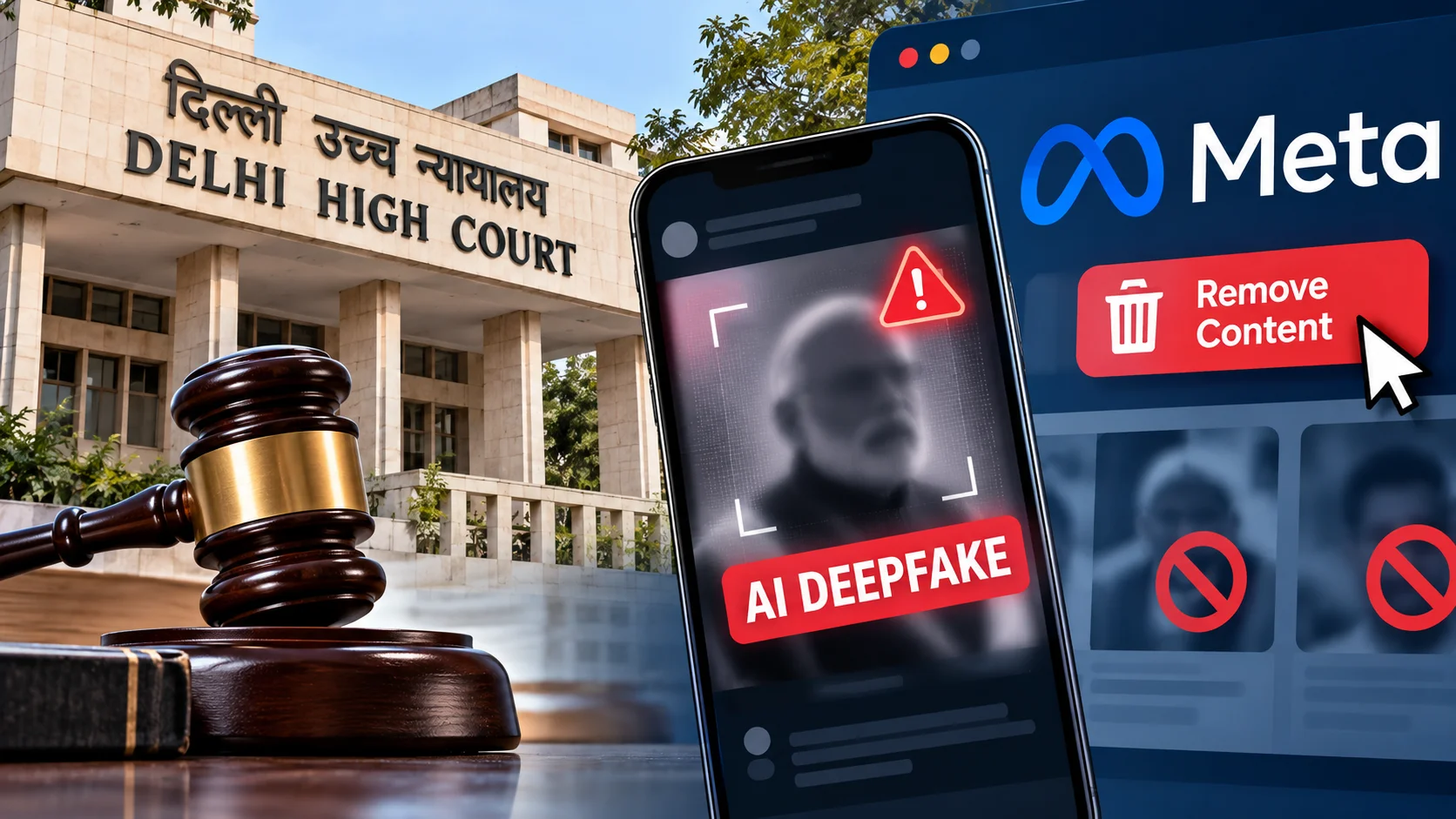
- Delhi High Court has directed Meta to remove alleged explicit AI deepfake content involving a woman and Prime Minister Narendra Modi.
- The fight is not only about one video — it is about how fast platforms must act when someone’s face is pasted into sexual content without consent.
- Deepfakes are getting cheaper and sharper; a phone, a few photos, and an AI tool are often enough to create damage that spreads in minutes.
- For people in India, the practical lesson is simple: report fast, save evidence, and do not forward anything you cannot verify.
- Courts are treating non-consensual sexual deepfakes as urgent harm, not as casual internet drama.
What just happened?
Picture this. You open Instagram or Facebook on the metro. A clip looks real enough. A woman’s face. A familiar political figure. Explicit framing. Your stomach drops before your brain catches up.
That is the kind of mess the Delhi High Court has now stepped into. The court has directed Meta to remove alleged deepfake content that sexually links a woman with Prime Minister Narendra Modi.
This is not a soft suggestion. It is a court direction to take the material down. When a High Court tells a platform to remove content like this, the clock starts ticking in a very real way.
The core issue is consent and dignity. Someone’s identity appears to have been dragged into explicit AI-made material. That is not “edgy meme culture”. That is personal harm at platform scale.
Meta runs Facebook, Instagram, and WhatsApp-linked discovery loops that can push a clip across India before breakfast is over. So a takedown order here is about speed as much as it is about principle.
How does this actually work?
First, the tech bit in plain talk. A deepfake is AI-generated or AI-altered media. Face, voice, body language — the model stitches pieces so the result looks believable.
அதாவது, the tool does not need a real private video of the victim. Public photos, old interviews, scraped social posts — that raw material is often enough for a nasty output.
Explicit deepfakes are especially ugly because sexual content travels faster than corrections. People screenshot. People forward on WhatsApp. People download before the original post disappears.
Platforms usually rely on a mix of user reports, automated detection, and trust-and-safety review. In theory, non-consensual intimate imagery should be priority. In practice, volume is brutal and AI content keeps mutating.
That is why court orders matter. A general “report and wait” path can feel slow when reputation is burning in public. A High Court direction compresses the process: identify the URLs, remove or restrict access, and stop the same file from popping back under new accounts.
Also important: removal is not the same as undoing harm. Once a clip is mirrored on other apps, Telegram channels, or random blogs, the first platform’s delete button cannot vacuum the whole internet. Still, cutting the biggest distribution pipes reduces fresh damage.
For political figures, the risk multiplies. A fake sexual clip does two jobs at once — it humiliates a private person if a woman is inserted into the frame, and it tries to dirty a public leader’s image through shock. Courts looking at such cases often see both privacy injury and public-order noise.
None of this needs a film-studio budget anymore. Open tools, paid “undress” style apps, and face-swap workflows have lowered the barrier. That is the uncomfortable 2026 reality.
What changes for people in India?
If you live in India and use Meta apps daily — which is most of us — this order is a signal, not a one-day headline.
Signal one: non-consensual sexual deepfakes are being treated as urgent legal harm. Not as “someone’s poor taste”. Not as “ignore and it will pass”.
Signal two: big platforms cannot hide forever behind process language when the content is explicit, identity-linked, and clearly abusive in nature. Indian courts have been pushing harder on takedown accountability for years. This fits that pattern.
Signal three: ordinary users are in the blast radius. The woman in such a case is not a public office. Her face becoming internet fodder is a life event — family WhatsApp groups, workplace gossip, mental stress, the whole nightmare.
For creators and page admins, the practical change is caution. “Satire” is not a free pass when the output is sexual and non-consensual. If your page reposts a deepfake for traffic, you are not a neutral pipe. You are part of the harm chain.
For parents and college students, the change is awareness. A classmate’s photo dump from Instagram can become raw material. Locking down old albums, avoiding unknown face-app websites, and treating random “fun AI filters” with suspicion is basic self-defence now.
For political conversation online, expect sharper fights over authenticity. Election season or not, fake sexual content is a dirty tactic because it is hard to unsee. Viewers should train one reflex: if a clip is explosive and intimate, pause before share.
Indian digital life runs on forwards — UPI payment screenshots, job PDFs, temple videos, political reels. The same muscle that spreads useful stuff also spreads poison. Court pressure on platforms helps, but user restraint still matters.
What should you do now?
If you see an explicit deepfake of a real person, do not forward it “for awareness”. Forwarding is distribution. Distribution is the injury.
Report in-app immediately. On Instagram or Facebook, use the report flow for sexual exploitation / non-consensual intimate imagery where those options appear. Add the context clearly if the form allows: AI deepfake, real person, no consent.
Save evidence quietly if you are the affected person or helping them: URLs, usernames, timestamps, screenshots of the post and profile. Do this without resharing to large groups.
If the target is you or someone you are supporting, talk to a lawyer early. Cyber cells and court routes exist for intimate-image abuse and impersonation-style harms. Speed helps when accounts keep re-uploading.
Tighten your own public photo trail. Public figures cannot hide, but private users can reduce easy scrapes — old tagged photos, open albums, reusable face shots on random sites.
Be ruthless with shady AI apps. Anything promising “clothes removal”, “celebrity face swap”, or “adult edit from one photo” is a red flag factory. Your upload can become someone else’s training junk or blackmail fuel.
Talk about this at home without drama lectures. A simple line works: if a video shows a known person in a sexual scene and it feels too convenient, assume fake until proven otherwise.
Platforms will keep shipping detection updates. Courts will keep issuing directions. The missing piece is still human: stop treating someone’s face as free raw material for shock content.
This Delhi HC order against Meta is one concrete push in that direction. Explicit AI deepfakes involving a woman and Prime Minister Narendra Modi are not a trivia item for tech Twitter. They are a reminder that identity theft can look like a 15-second reel.
Stay sceptical. Report fast. Do not amplify. That is the user-side playbook while the legal and product fights continue.


Comments (0)
Be the first to comment!