


Key takeaways
- Patta proves ownership; Chitta shows the land’s live extract—survey number, extent, tax, and classification.
- You can pull view/print copies online through Tamil Nadu’s land e-services if you know district, taluk, village, and survey number.
- Basic online view is usually free or low-cost; certified copies and mutation work still need the proper application path and fees in ₹.
- Wrong survey number, old joint-patta names, and mixing “view copy” with “legal certified copy” are the top time-wasters.
- Buyers, sellers, loan applicants, and heirs all need a clean Patta Chitta before money or registration moves.
What is Patta Chitta, and why is everyone Googling it?
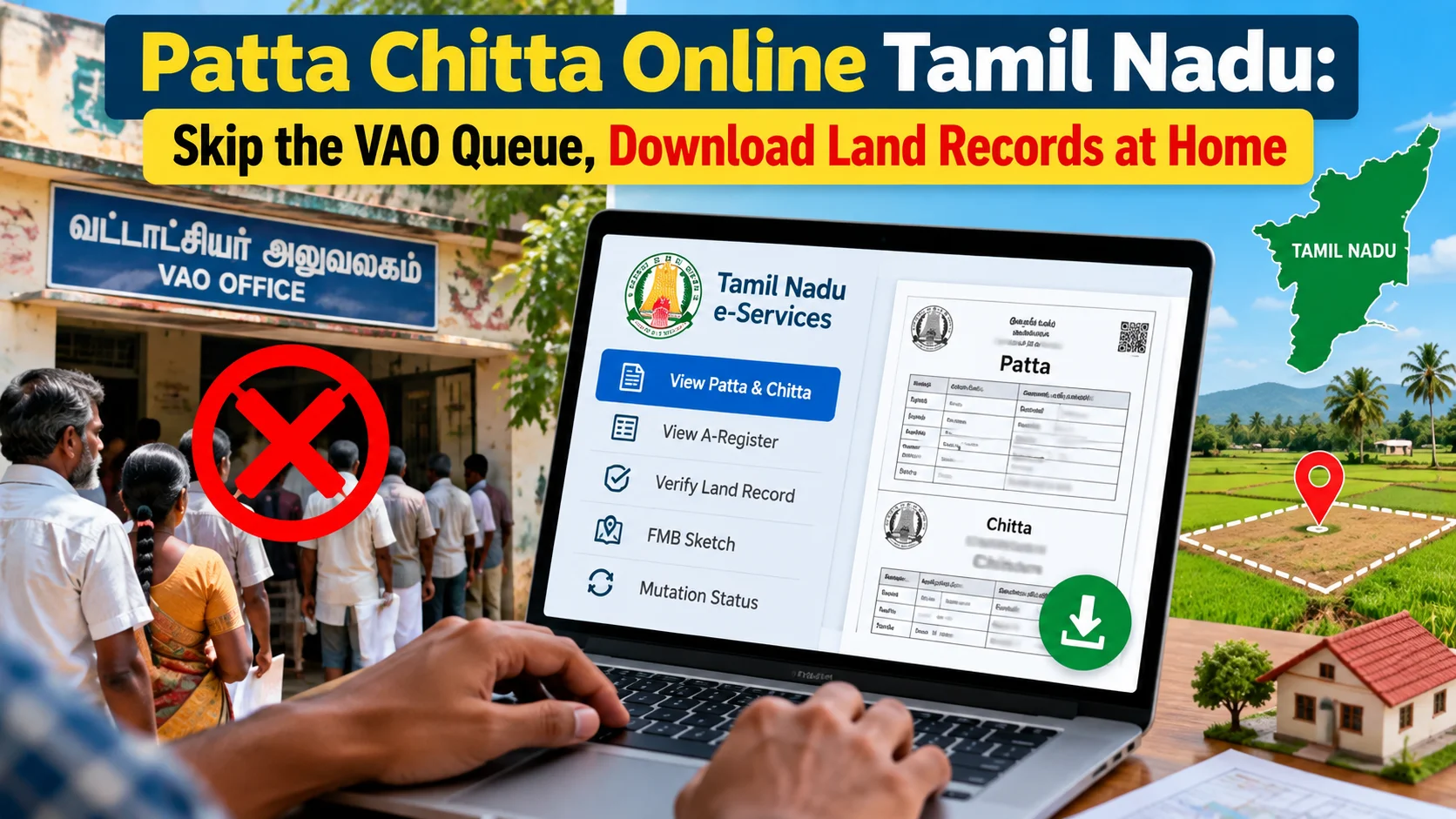
You can pull Patta Chitta online in Tamil Nadu through the state’s land e-services portal if you know district, taluk, village, and survey number—no VAO queue for a basic view or print extract. This guide explains what Patta and Chitta mean, the step-by-step online flow, free versus paid options in ₹, mistakes that waste time, and who needs a clean record before a sale, loan, or family partition.
That is the daily-life mess this search solves.
Patta is the ownership record the revenue department maintains for a land parcel in Tamil Nadu. Chitta is the extract that lists the practical details—survey number, subdivision, extent, land type, and tax particulars. People say “Patta Chitta” as one phrase because you almost never need one without the other.
In India, especially in TN property deals, this pair is the first filter. No clean Patta Chitta, no smooth sale deed, no calm bank officer, no peaceful partition talk at home.
How does Patta Chitta online Tamil Nadu actually work?
Tamil Nadu put land extracts on e-services so you are not stuck only at the Village Administrative Officer counter for a simple view.
The flow is simple when your basics are right. You open the state land / e-services portal on Phone or laptop. You pick district, taluk, village (or town survey details where applicable). You enter the survey number and subdivision if any. The system shows the extract linked to that parcel.
What you usually get online is a view or print-friendly extract. Think of it as the digital readout of the register—not a magic stamp that replaces every physical process.
For many checks—before a site visit, before paying advance, before arguing with a relative—this online view is enough to spot red flags. Name mismatch. Joint holders you were not told about. Different extent than the brochure. Land class that does not match the sales pitch.
When you need a certified copy for registration office, bank legal opinion, or court-related work, you follow the certified-copy / application route the portal or taluk office specifies. Online view helps you verify. Certification is the formal layer.
Same story for changes. If ownership must move after sale, gift, partition, or heirship, that is mutation / transfer work. Downloading yesterday’s Chitta does not auto-update the name. Someone still has to push the transfer with the right documents.
What should you keep ready before you Login?
Do not open the portal empty-handed. You will bounce.
Keep the survey number and subdivision. Keep district–taluk–village names as used in revenue records, not only the real-estate project name. Old sale deed, previous Patta copy, property tax receipt, or FMB sketch reference—any of these can save you when the broker’s WhatsApp note is incomplete.
If the land is in a layout, confirm whether you are dealing with revenue survey details or a different local body reference. People waste evenings searching a marketing plot number that the Patta database does not use.
On Phone, use a stable connection. Jio or any network is fine; the portal mood matters more than the SIM. Prefer a browser session where you can save or print the extract cleanly as PDF when the option is there.
How much does it cost in ₹?
Viewing basic land extract details online is generally kept low-friction on purpose. Many citizens check free or at a nominal service charge depending on the exact service selected.
Certified copies, extract applications, and mutation-related fees are separate. Those are government fee heads in ₹, and they change by service type—not by how loudly the broker argues.
Budget the other real costs too. If a document writer or common service centre helps you, they may charge a service amount on top of the government fee. UPI works at most centres now; you do not need a cash-only mindset.
For a home buyer, the online check itself is cheap. The expensive mistake is paying a big advance before reading the extract.
What mistakes waste a full Saturday?
First mistake: trusting only the seller’s photocopy. Always pull the live extract yourself and match survey number, extent, and names.
Second: confusing a screenshot with a certified copy. Banks and registration workflows often want the formal version. Your Phone gallery image is a study tool, not always the file they accept.
Third: ignoring joint names. If six relatives sit on the Patta, one person’s signature theatre will not finish the sale.
Fourth: assuming online Patta Chitta fixes boundary fights. It will not replace a proper survey, FMB reading, or ground measurement when neighbours disagree about the fence.
Fifth: delaying mutation after registration. Sale deed done, name still old on revenue record—your next buyer or loan officer will make that your problem.
Sixth: typing near-similar village names. Revenue spelling and your Google Maps spelling are not always friends. Match the deed.
Who does this suit—and who still needs the office?
Online Patta Chitta suits buyers doing due diligence, families checking ancestral parcels, people preparing loan paperwork, and anyone tired of a first trip just to “see” the record.
It also suits NRIs who can verify basics before flying down, as long as someone local handles certified copies and physical follow-ups.
You still need offline muscle when the record is disputed, the survey number is unclear, subdivision is messy, the land is under acquisition questions, or names need correction after court orders. Online is the torch. It is not the full workshop.
If your case is a simple “show me the current extract,” start online. If your case is “change history after a fight,” plan taluk / VAO time properly.
What changes for people in Tamil Nadu right now?
The big shift is leverage at the tea-stall stage of a deal. Ten years ago, many buyers paid advance on trust and paper bundles. Today a careful person can check the extract the same evening on Phone and ask sharper questions.
That does not make fraud impossible. It makes lazy fraud harder.
It also changes family arguments. When Chitta shows the extent and holders clearly, vague claims get smaller. Not always peaceful—just clearer.
For loan applicants, pulling the extract early means fewer file bounce-backs. For sellers, keeping mutation updated means fewer “come next month” calls.
What should you do now?
Write down district, taluk, village, survey number, and subdivision from the best old document you have.
Pull the online extract yourself. Match names, extent, and land particulars with the sale story you were told.
If you are buying, do not release heavy advance until the extract and the seller’s story agree. If names need transfer, list the mutation documents before you celebrate on WhatsApp status.
If you only need a quick check, stop at the online view. If bank or registration needs certified paper, apply for that specifically—do not argue with a screenshot.
And if the portal shows something ugly—unknown joint holder, odd extent, odd classification—pause the money. Ugly on screen is cheaper than ugly after registration.
Quick reality check before you share the link in the family group
Patta Chitta online Tamil Nadu is a verification superpower for ordinary people. It is not a substitute for a lawyer on complex title, not a substitute for ground survey on boundary, and not a substitute for proper transfer after every ownership change.
Use it like GPay balance check before a big UPI send: fast, useful, and stupid to skip. Then finish the legal steps like an adult.



Comments (0)
Be the first to comment!