


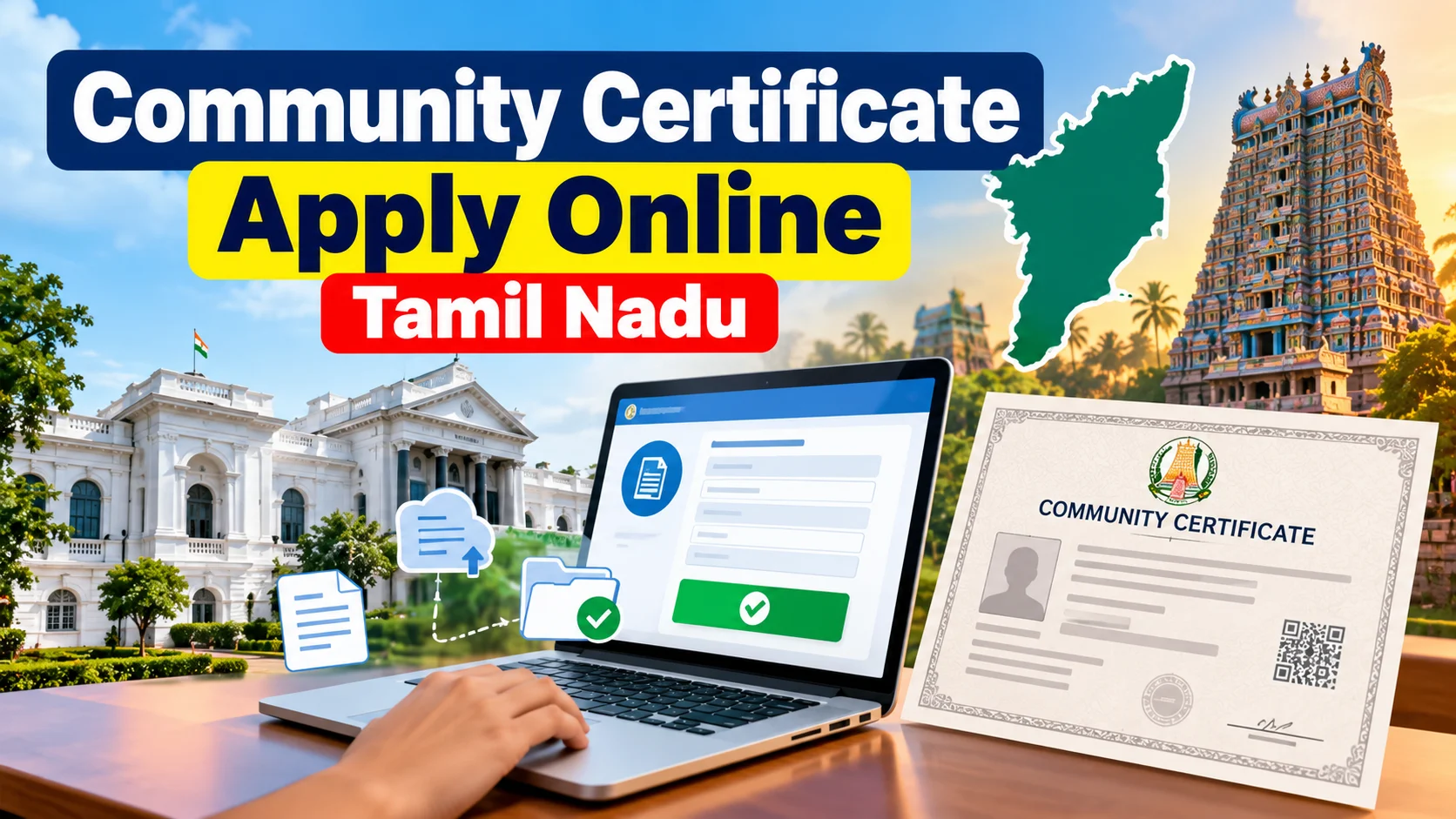
முக்கிய விஷயங்கள்
- Tamil Nadu community certificate-க்கு official online route தான் TN e-Sevai / e-District portal (eservices.tn.gov.in).
- Aadhaar, old family community certificate, ration card, address proof இருந்தா application smooth-ஆ போகும்.
- e-Sevai center-ல apply செஞ்சா approx ₹60 service charge, home-ல self apply செஞ்சா almost free.
- Normal processing 7 to 15 working days, VAO verification இருக்கும்போது கொஞ்சம் extra நாள் ஆகலாம்.
- Document mismatch, wrong community column, old photo scan தான் rejection-க்கு main reason.
What exactly is a community certificate, and why does everyone in Tamil Nadu need one?
A community certificate is the document that officially says which caste category you belong to — OC, BC, MBC/DNC, SC, SC(A) or ST. In Tamil Nadu this single piece of paper decides whether your kid gets into a government college seat, whether you qualify for a reservation-based government job, or whether you can claim a community-specific scholarship.
Without it, half the admission and exam portals in this state simply won't let you proceed. Engineering counselling, TNPSC group exams, polytechnic admissions, even some bank loan schemes ask for it upfront. That's why every October-November, when college admissions and exam seasons peak, searches for "community certificate apply online tamil nadu" shoot up — parents realise at the last minute that their teenager doesn't have one yet.
Here's the good part. You no longer need to physically walk into a Tahsildar's office and wait in that familiar long corridor queue. Tamil Nadu moved this whole process onto its e-Governance portal years back, and today most people apply either from their phone at home or through a nearby e-Sevai centre.
How does the online application actually work?
The official portal is eservices.tn.gov.in, run by TNeGA (Tamil Nadu e-Governance Agency). You can also apply through the TN e-Sevai app or by walking into any e-Sevai Maiyam / CSC centre and letting the operator do it for you.
If you're doing it yourself, the flow is fairly simple. Register on the portal with your mobile number, verify with OTP, and log in. Search for "Community Certificate" under Revenue Department services. Fill in your personal details, father's or family community details, and upload the required documents. Submit, and you'll get an application reference number — save a screenshot of this, you'll need it to track status.
After submission, the application goes to the Village Administrative Officer (VAO) for field verification, then to the Revenue Inspector, and finally the Tahsildar approves and digitally signs it. You can track every stage on the same portal using your application number. Once approved, the certificate is downloadable as a PDF with a digital signature — valid for official use, no need to get it physically stamped again.
What's the fee, documents needed, and how long does it actually take?
Money-wise, this is one of the cheaper government services in Tamil Nadu. The government fee itself is minimal or free depending on the category; what you actually pay is mostly the e-Sevai operator's service charge if you use a centre instead of applying yourself.
| Application Mode | Where to Go | Approx Fee | Processing Time |
|---|---|---|---|
| Self-service online | eservices.tn.gov.in from phone/laptop | Nearly free (nominal govt fee) | 7-15 working days |
| e-Sevai Maiyam / CSC centre | Nearby common service centre | Around ₹60 service charge | 7-15 working days |
| Through school/college helpdesk | Many schools offer this during admission season | Usually just centre charge | 10-20 working days |
| Offline at Taluk office | Tahsildar office directly | Minimal govt fee | 15-30 working days (slower) |
Documents you'll need ready as scans or photos: Aadhaar card, ration card, an existing community certificate of your father or close blood relative (this is the biggest one — first-time applicants in a family struggle without it), school transfer certificate or birth certificate for age/address proof, and a recent passport-size photo.
If nobody in your family has ever got a community certificate before, the Tahsildar may ask for additional proof like a community certificate from your native village records, or an affidavit. This is more common for OC and some BC sub-categories where documentation is thinner.
What should you do now, and what mistakes should you avoid?
Don't wait until counselling week. Apply at least a month before your admission or exam deadline — VAO verification can get delayed during peak season when every student in the district is applying at once.
Double-check the community and sub-caste column before submitting. Selecting MBC instead of BC, or picking the wrong sub-category under SC, is one of the top reasons applications bounce back for correction, costing you another two weeks.
Keep your reference number safe and check status every few days instead of assuming it'll just arrive. If the VAO visits your house for verification and nobody's home, that alone can push your file back by a week.
Finally, if you're renewing or getting a certificate for a second child in the same family, carry the first certificate as proof — it genuinely speeds things up because the Tahsildar's office already has your family's community on record.
Does the certificate expire, and can you use it outside Tamil Nadu?
Short answer: a Tamil Nadu community certificate doesn't carry a fixed "expiry date" printed on it, but most institutions and TNPSC-type exams insist on a certificate issued within the last six months to one year. So even if you got one for your 10th-standard admission, don't assume it'll still be accepted for your engineering counselling two years later — check the specific validity window the admission notice mentions, because colleges differ on this.
Outside Tamil Nadu, this certificate is recognised for central government jobs, railway recruitment, and UPSC-related reservation claims, since caste categories like SC, ST and OBC are broadly uniform across India under central lists. But MBC/DNC is a Tamil Nadu-specific category — it doesn't exist as-is in other states, so if you're applying for a state government job in, say, Karnataka or Andhra Pradesh, that particular sub-category won't translate directly and you may need a separate domicile-based certificate from that state.
One genuinely useful update worth knowing: Tamil Nadu has been pushing digitally signed certificates into DigiLocker, so once your certificate is approved, it's worth linking your DigiLocker account to pull a verified copy instantly instead of hunting for the PDF in your downloads folder every admission season. It's not mandatory everywhere yet, but it saves you the panic of a corrupted file right before a deadline.
What if your application gets rejected — what's the actual next step?
Rejections happen more than people admit, and the portal usually gives a one-line reason like "document mismatch" or "details incomplete," which honestly isn't very helpful on its own. The first thing to do is log back into eservices.tn.gov.in with your application number and check the exact remark the Tahsildar's office left — sometimes it's as small as a name spelling difference between your Aadhaar and your father's old certificate.
If the rejection is genuinely a documentation gap — like no prior family certificate exists — you can't just resubmit the same form and hope for a different result. You'll likely need to visit the Taluk office once in person, carry your original documents, and possibly get a village-level enquiry done again through the VAO. This is slower, usually adding another 10 to 15 days on top of whatever you've already waited.
For genuine delays beyond the stated processing window, Tamil Nadu's e-Sevai system allows you to raise a grievance through the portal itself rather than making multiple trips to the Tahsildar's office. It's not instant — government grievance redress rarely is — but it creates a paper trail, which matters if you need to later explain to a college admission desk why your certificate came in late. Keep every acknowledgment screenshot; in government paperwork, a screenshot has saved more people than any phone call ever has.



Comments (0)
Be the first to comment!