


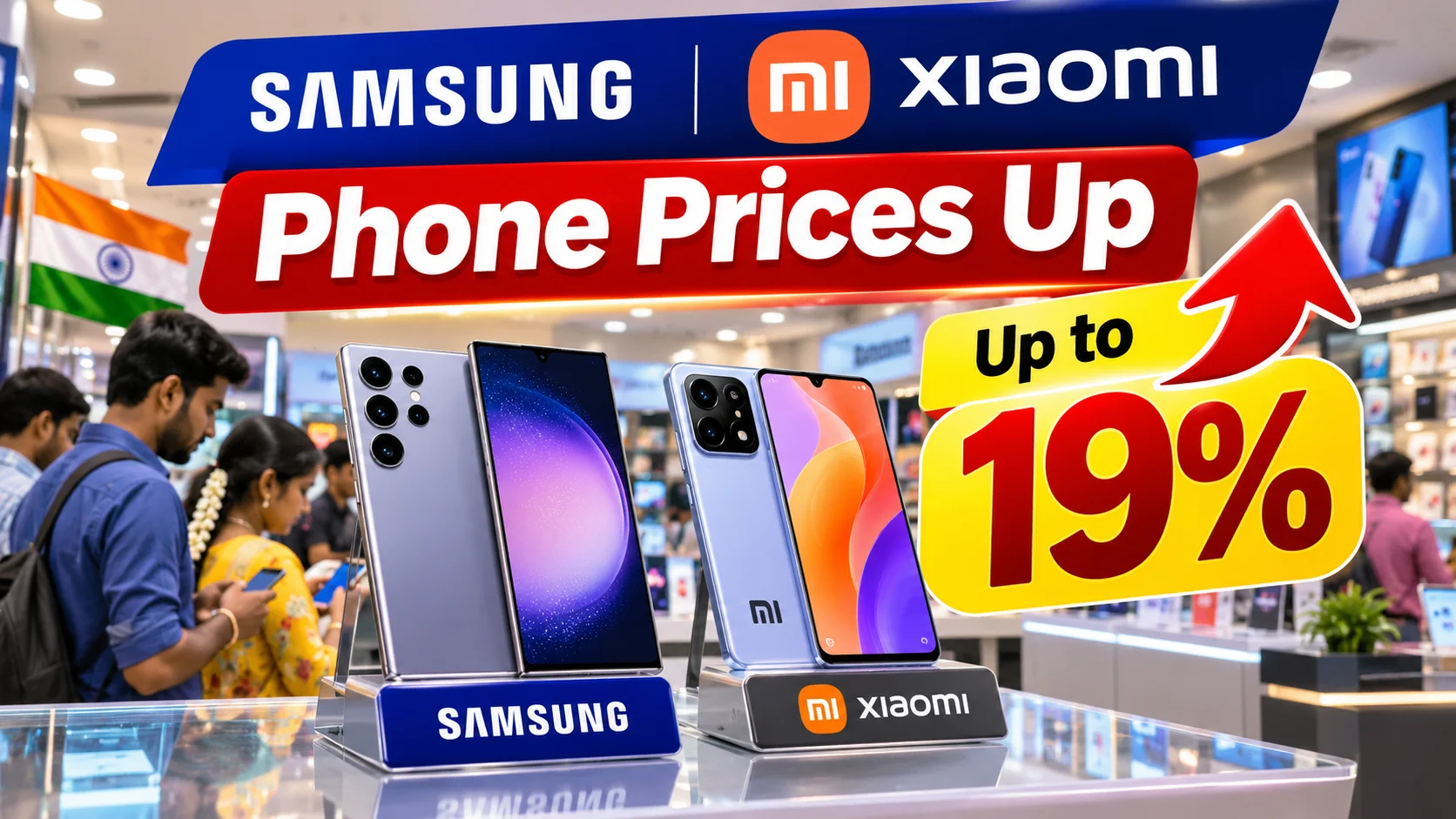
If you left a Redmi or a Galaxy A in the cart overnight, open the page again before you pay. Moneycontrol reported on 16 November 2026 that Samsung and Xiaomi have raised prices on 41 smartphone variants in India, by as much as 18.75 percent. The new tags start today. The headline rounding to “up to 19 percent” is fair. The bill in the shop is not a rounding error.
The revision covers 22 variants across Samsung’s Galaxy A and Galaxy F series, and 19 variants in Xiaomi’s Redmi portfolio. Retailer information with Moneycontrol puts the increase at Rs 1,000 to Rs 4,000, depending on the model and the storage. Samsung’s range is 3.13 percent to 9.52 percent. Xiaomi’s is 4.26 percent to 18.75 percent. Oppo, Vivo and Realme are expected to follow as memory and component costs rise. Queries to all five brands had not drawn a response when the piece went up. Treat this as retailer-channel reporting, not a company press release.
What actually got costlier today
Samsung’s Galaxy A07 5G is up Rs 2,000 on both variants Moneycontrol names. The 4GB plus 128GB model moves from Rs 20,999 to Rs 22,999. Galaxy F17 5G and Galaxy A17 5G are also up Rs 2,000. Select Galaxy A57 variants are up Rs 4,000. The A36, A56 and A37 series are up Rs 2,000 each, as reported.
That Rs 2,000 on the A07 does more than change one SKU. Moneycontrol says the hike has pushed Samsung’s 5G phones in the mainline retail channel above Rs 20,000. The brand is left with little in the sub-Rs 20,000 slot that still moves volume. The Galaxy A06 is still listed below Rs 20,000, but retailers told Moneycontrol it has been in short supply since September. A cheap phone you cannot get is not a cheap phone.
Xiaomi’s steepest line is the Redmi A7 Pro 5G, 4GB plus 128GB. It goes from Rs 15,999 to Rs 18,999. That is the 18.75 percent figure. Redmi Note 17 5G variants are up Rs 3,000. Note 17 Pro 5G models are up Rs 4,000. Across Xiaomi’s 19 revised variants, the average increase works out to 10.02 percent.
| Phone | What changed |
|---|---|
| Galaxy A07 5G, 4GB+128GB | Rs 20,999 to Rs 22,999 |
| Galaxy F17 5G and A17 5G | Up Rs 2,000 |
| Select Galaxy A57 variants | Up Rs 4,000 |
| Galaxy A36, A56, A37 series | Up Rs 2,000 |
| Redmi A7 Pro 5G, 4GB+128GB | Rs 15,999 to Rs 18,999 |
| Redmi Note 17 5G | Up Rs 3,000 |
| Redmi Note 17 Pro 5G | Up Rs 4,000 |
I am not filling in every variant Moneycontrol did not list. Forty-one SKUs and a Rs 1,000–4,000 band is the honest summary until a brand publishes a sheet. If a store quotes a number outside that band, ask them which variant and whether the old stock is still on the shelf.
Old stock is still in the channel
This is the part worth acting on today, not next week. Xiaomi held off on a pre-Diwali hike so festive offers could stay. Industry sources told Moneycontrol that enough inventory at the old prices is still sitting in the mainline retail channel. You can still walk into a shop and find the earlier tag, even though the revised price is now official.
That window is inventory, not a policy. Once those boxes move, the next carton is the new price. If you were already set on a Redmi Note 17 or the A7 Pro, today is the day to ask the retailer which sticker is on the unit in the drawer. Online and offline will not match for long. Moneycontrol also notes that retailers are already angry about online-offline gaps, especially on Samsung, and about discounted e-commerce stock leaking into physical stores through aggregators.
Do not assume Flipkart or Amazon has the old price just because a neighbourhood shop does, or the reverse. Check the variant, the RAM and storage, and the bank offer before you celebrate a “deal.” A Rs 2,000 hike plus a vanished exchange bonus is a different phone budget.
Why the hike landed the morning after the festival
The stated reason is rising memory and component costs. Brands have been passing that through in pieces all year. What is new is the timing. Diwali just ended, and the season did not save the volume.
Moneycontrol says footfalls during the four-day Diwali period were strong, but sales volumes fell 18 to 20 percent from the previous year. Overall sales value stayed broadly flat. People walked in. Fewer of them bought. The seven days before Dhanteras and Diwali were worse: volumes down nearly 40 percent, because buyers waited for the festive deal and then a lot of them still did not buy.
The Rs 30,000 to Rs 60,000 band took the largest share of transactions, then the premium segment. Apple and Motorola did well. Xiaomi grew steadily on the back of competitive pricing, which is exactly the pricing it is now giving up. Realme volumes fell by more than 50 percent across regions, according to industry estimates in the same report. That is why a follow-on hike from Oppo, Vivo and Realme would hurt. The brands that already lost the festival are about to ask more for the phone that did not sell.
Who feels this in India
Entry and mid-range buyers. That is the sentence. A flagship buyer arguing over Rs 4,000 on a phone above Rs 80,000 is annoyed. A student or a parent replacing a three-year-old phone at Rs 16,000 is making a different decision when the same Redmi is Rs 19,000.
Retailers are already seeing people walk out or shift to pre-owned and refurbished phones. All India Mobile Retailers Association founder chairman Kailash Lakhyani told Moneycontrol that mainline shops are squeezed by e-commerce exclusivity, aggregator diversion and rising component costs. He wants pricing parity and longer-tenure finance so the neighbourhood store is not the place you only go to touch a phone you then buy online.
The industry ask in the piece is practical: closer online and offline prices, longer EMI, and sales targets that are not written for a festival that did not happen. None of that is in your checkout today. What is in your checkout is a higher MRP on the phones India actually buys in bulk.
Affordable 5G was the volume story. Samsung’s mainline 5G options sliding above Rs 20,000, with the A06 hard to find, is how that story stalls. Xiaomi’s average 10 percent lift across 19 variants does the same job from the other side of the shelf. If Oppo, Vivo and Realme match it, the sub-Rs 20,000 5G aisle gets thin in a hurry.
What I would do before paying
Ask three things. Which exact variant is this, including RAM and storage. Is this unit from the old-price stock or the 16 November price. What is the effective price after exchange and the bank offer, not the sticker alone.
If the shop still has the Redmi A7 Pro 5G at Rs 15,999, and you needed that phone, the old box is the deal. If they only have Rs 18,999, compare it with whatever Motorola or a refurbished Galaxy is sitting next to it. Apple and Motorola already took festive share. A hike does not make a Redmi a worse phone. It makes the comparison you skipped last week worth doing again.
I would not wait a month hoping the hike is reversed. Component costs are the reason Moneycontrol’s sources give, and the other three big Android brands are expected to move the same way. I also would not treat a random Instagram “old price till stocks last” poster as confirmation. The retailer information is the source. The brands had not confirmed it when the article was published.
The number to remember
Forty-one variants. Rs 1,000 to Rs 4,000. Samsung up to 9.52 percent, Xiaomi up to 18.75 percent, effective 16 November 2026. Galaxy A07 5G 4GB+128GB from Rs 20,999 to Rs 22,999. Redmi A7 Pro 5G 4GB+128GB from Rs 15,999 to Rs 18,999. Diwali volumes down 18 to 20 percent, value roughly flat. Old Xiaomi stock may still be in shops. Oppo, Vivo and Realme are the next names to watch, not a rumour about every phone in India.
Forward the model list, not the panic. The phone you wanted yesterday may still be the phone you want today. It may just cost two to four thousand rupees more, unless you find the carton that was priced before this morning.






Comments (0)
Be the first to comment!