


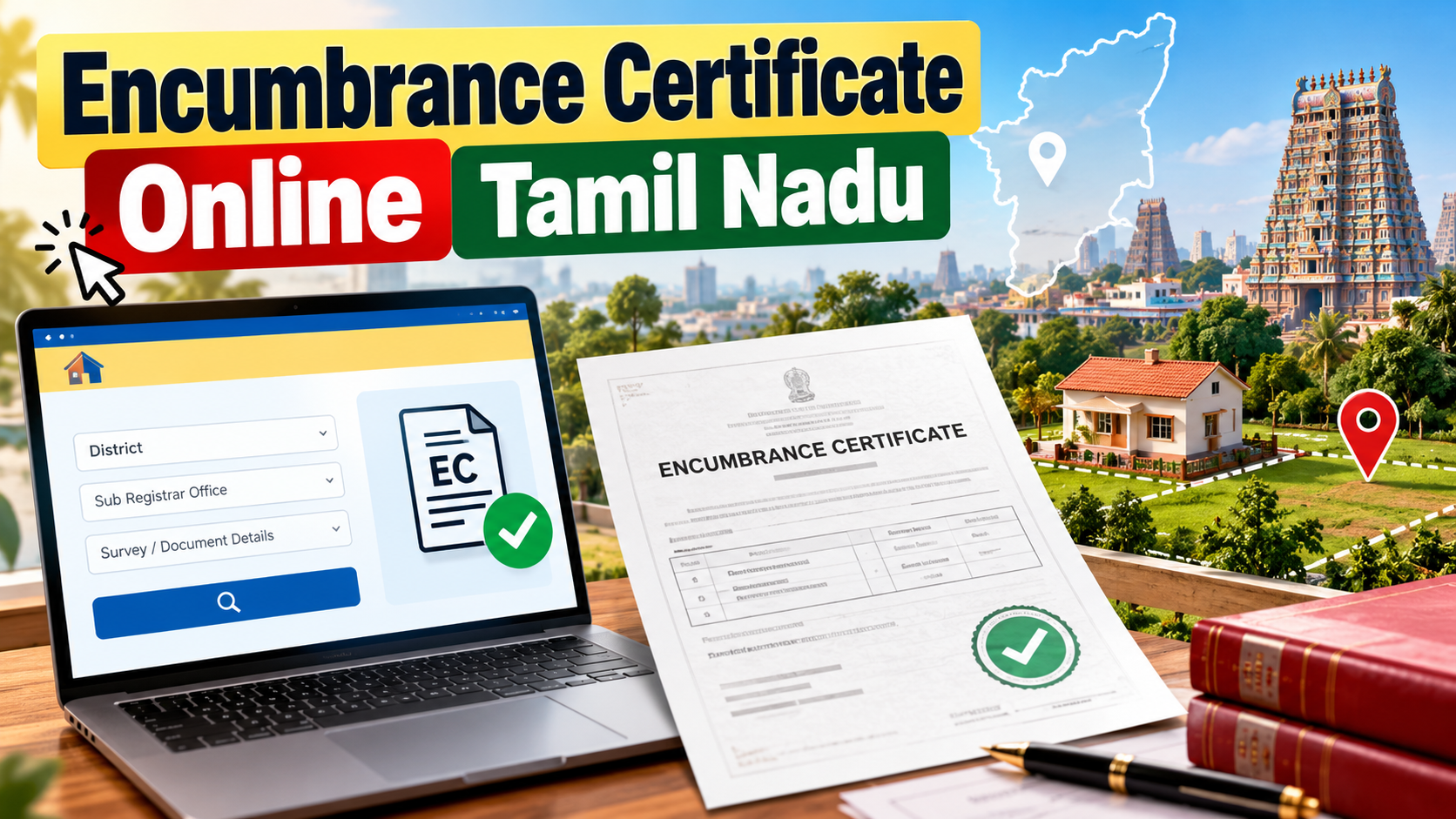
முக்கிய விஷயங்கள்
- An Encumbrance Certificate (EC) proves a property has no pending loans, mortgages, or legal claims against it.
- Tamil Nadu lets you apply for EC fully online through the TNREGINET portal, no registrar office visit needed for the application itself.
- Fees are small, usually a few hundred rupees depending on the years you search, and the certificate is ready in a few working days.
- Banks, buyers, and lawyers all ask for EC before any property sale or loan is approved.
- The most common delay is a wrong survey number, door number, or village name typed at the application stage.
What exactly is an encumbrance certificate, and why does everyone ask for it?
Getting an encumbrance certificate online in Tamil Nadu means logging into the TNREGINET portal, filling in your property's survey number and village details, paying a small fee of a few hundred rupees, and downloading a QR-verified certificate within a few working days without visiting the sub-registrar office. This guide walks through what an EC actually proves, the exact online application steps, realistic fees and processing time, common mistakes that delay applications, and who really needs this document before a property sale or loan.
It tells you whether that property has any loan against it, any pending mortgage, any court case, or any other legal claim registered on it. If the EC comes back clean, it usually means nobody else has a financial or legal hold over that property.
Why does this matter so much in Tamil Nadu? Because property fraud is still common. Someone could sell you a plot that's already mortgaged to a bank, or sell the same land to two different buyers. The EC is the paper trail that catches that.
Banks won't sanction a home loan without it. Buyers' lawyers won't clear a sale deed without it. Even during inheritance or partition of family property, courts and registrars ask for an EC covering the relevant years.
How do you actually get an EC online in Tamil Nadu?
This used to mean standing in line at the sub-registrar office with a token number and a lot of patience. Not anymore.
Tamil Nadu runs this through the TNREGINET portal, which is the state's official land registration site. Here's the flow, step by step.
First, you register on TNREGINET with your mobile number and email if you don't already have an account. Then you go to the Encumbrance Certificate section and choose 'Apply for EC'.
You'll need to enter the property details carefully: district, taluk, village, survey number or sub-division number, and the sub-registrar office under which the property falls. If you already own the property, your sale deed has all of this printed on it.
Next, you pick the time period you want searched. Most buyers go for 13 to 30 years, since that's usually what banks ask for. The longer the period, the slightly higher the fee.
Pay the fee online through net banking, UPI, or card, and submit. You'll get an application number to track status. Once approved, you can download the EC as a digital document directly from the portal, with a QR code that lets anyone verify it's genuine.
What does it actually cost and how long does it take?
This is where people get confused because the fee isn't one flat number. It depends on how many years you're searching and how many property transactions show up in that window.
Here's a rough breakdown of what to expect. Treat these as typical ranges, since the exact fee schedule is set by the state and can be revised.
| Service | Typical Fee (₹) | Processing Time |
|---|---|---|
| EC search, up to 13 years | Around ₹100-200 | 2-5 working days |
| EC search, up to 30 years | Around ₹200-400 | 3-7 working days |
| Certified copy / additional document pages | Small per-page charge | Same as above |
| Urgent/manual verification at sub-registrar office | Varies by district | 1-3 working days extra |
If the records for your village or survey number aren't fully digitised yet, the application may need manual verification at the local sub-registrar office. That adds a few extra days but doesn't usually cost much more.
What mistakes should you avoid when applying?
The single biggest reason EC applications get rejected or delayed is a mismatch in property identification. People type the wrong survey number, miss the sub-division number, or pick the wrong village because two villages in the same taluk have similar names.
Second mistake: applying for too short a search period. If you ask for only 10 years but the property had a loan registered 15 years back, that history won't show up, and your bank might reject the EC and ask you to redo it.
Third, don't skip checking the parent document. Before applying, pull out your sale deed or patta and cross-check every spelling and number against what you're entering online. A single digit wrong in the survey number means you'll get an EC for someone else's land.
Fourth, a 'nil' EC isn't automatically a problem. It just means no transaction was found in that period, which is normal for very old or inherited property that was never mortgaged.
Who actually needs this certificate?
Home buyers need it before registration, to confirm the seller actually has clear title. Home loan applicants need it because every bank in India makes EC mandatory before disbursing funds.
NRIs selling inherited property in Tamil Nadu often need a long-period EC to prove clean title to overseas buyers or for repatriation paperwork. Lawyers handling partition suits or probate cases pull EC as standard evidence.
Even if you're not buying or selling anything right now, it's worth pulling an EC for ancestral property every few years. It's the cheapest insurance against a surprise mortgage or claim you didn't know existed.
What should NRIs and first-time buyers watch out for?
If you're an NRI trying to sell or mortgage property back home, the EC process gets a bit trickier than it looks on paper. You can start the TNREGINET application from abroad since it's fully online, but the payment gateway sometimes has issues with international cards, so it helps to have someone in India with a UPI-linked account handle that last step. Many NRIs also underestimate how long a 30-year search takes if the property changed hands multiple times decades ago, especially if an old transaction was recorded under a slightly different spelling of a name or village.
First-time buyers, on the other hand, usually make a different mistake. They treat the EC as a one-time formality and forget that it only covers the period they paid for. If your bank loan tenure is 20 years, ask your lawyer whether the EC should cover a longer window than just up to the registration date, because disputes can surface from transactions older than the search period you picked. It's a small extra fee to widen the search, and it's far cheaper than fighting a title dispute later.
One more thing worth flagging: a clean EC is not the same as a clear title in every legal sense. It tells you what's registered with the sub-registrar, but it won't catch unregistered agreements, family disputes that never went to court, or encumbrances that someone deliberately kept off the books. Pair the EC with a lawyer's title search and, where possible, a physical visit to the property before you sign anything. Treat the EC as your first filter, not your only one.

Comments (0)
Be the first to comment!