


முக்கிய விஷயங்கள்
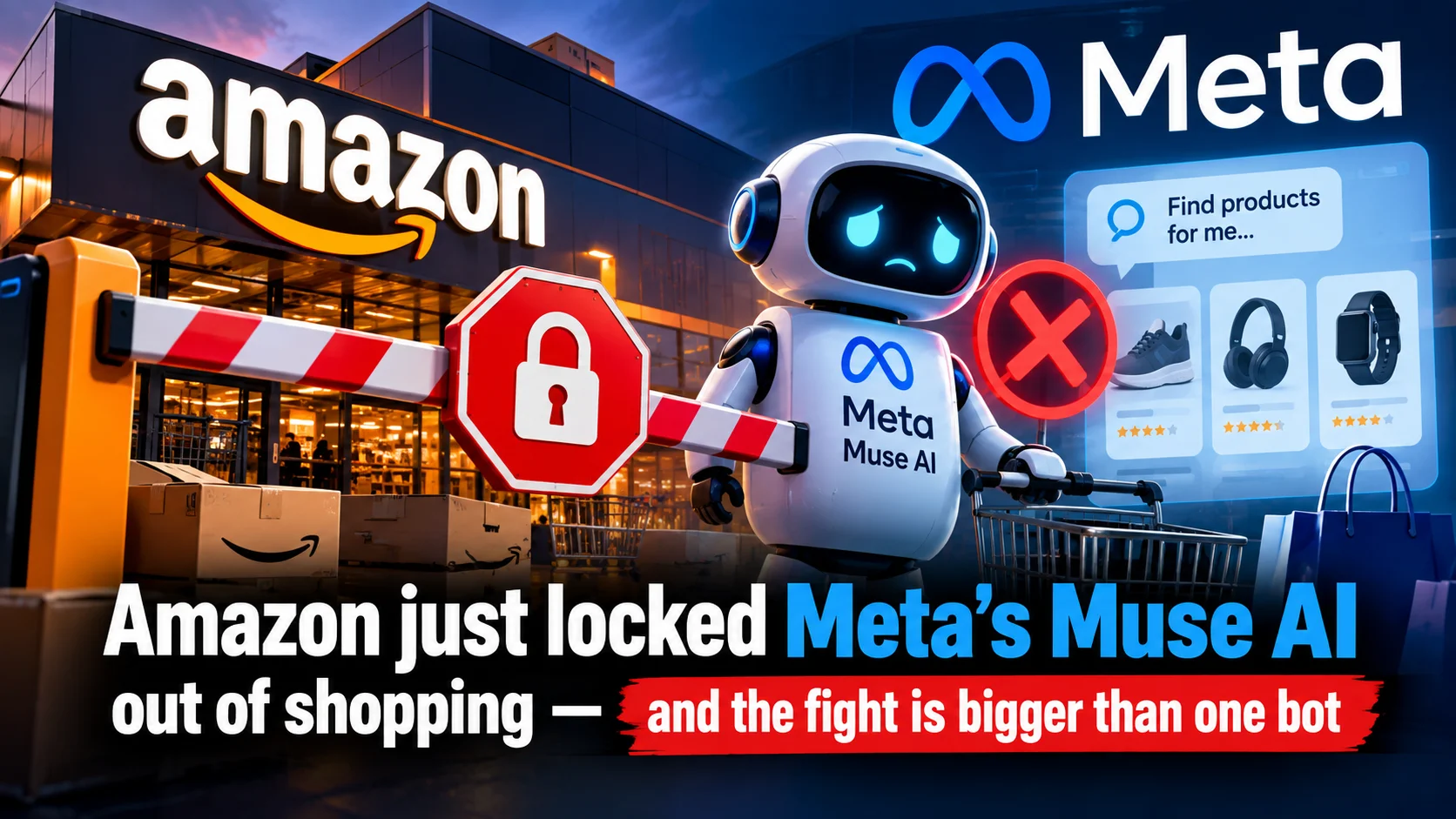
- Amazon has blocked Meta’s Muse AI agent from shopping on Amazon.com on behalf of users.
- Amazon’s stated reasons: Terms of Service violations, security risks, and no merchant consent.
- Muse is a personal AI agent meant to act for you — browse, pick, and buy — not just chat.
- This is an early skirmish in the agent-commerce war: who owns the checkout, the data, and the customer relationship.
- For India users, the same pattern will hit Flipkart, Amazon.in, and UPI-linked checkouts as AI agents get bolder.
- Until platforms publish clear agent rules, treat “buy for me” bots as experimental, not default shopping.
What just happened?
Picture this. You tell an AI, “Get me a phone case under ₹800, black, ships fast.” The AI opens a store, compares listings, drops something in cart, and pays. That is the promise of personal shopping agents.
Amazon just slammed the door on one of them.
According to the topic and public reporting around it, Amazon says it blocked Meta’s new Muse personal AI agent from accessing Amazon.com to shop on users’ behalf. The company is not soft-pedalling the why. It points to Terms of Service violations, security risks, and a simple missing piece: merchant consent.
In plain words — Meta’s agent tried to act like a customer on Amazon’s site. Amazon said: not on our turf, not like this.
This is not a small product spat. It is a signal. Big platforms want AI helpers on their own terms. They do not want a rival’s bot walking through the front door, scraping the aisle, and closing the sale while the store loses control of the experience.
How does this actually work?
First, what Muse is trying to be. A personal AI agent is not ChatGPT with nicer manners. The idea is agency. You give a goal. The agent breaks it into tasks — search, filter, compare, add to cart, checkout — and does them without you tapping every step.
That is the jump from “assistant” to “agent.” An assistant answers. An agent acts.
On a marketplace like Amazon, acting means touching the live storefront. Product pages. Prices. Stock. Reviews. Cart APIs or browser flows. Payment rails. Account sessions. All of that sits behind rules Amazon wrote for humans and for Amazon’s own tools — not for a Meta-built shopper roaming free.
Amazon’s three objections stack cleanly.
ToS violations. Most big e-commerce terms ban automated access, scraping, or using the site in ways the company did not approve. If an outside agent logs in, scripts browsing, or mimics a user at scale, platforms often treat that as a breach even when a real person “authorised” the bot.
Security risks. Agents hold session cookies, saved addresses, and sometimes payment shortcuts. A third-party agent sitting between you and Amazon creates a new attack surface. Account takeover, poisoned recommendations, fake “buy” confirmations — the risk list is not theoretical for security teams.
No merchant consent. This one is the business knife. Amazon is the merchant platform. Sellers list there under Amazon’s rules. A rival AI inserting itself into discovery and checkout without a deal means Amazon loses page views, ad inventory, and the ability to shape conversion. Consent is not a polite extra. It is how marketplaces keep the economic model intact.
So the block is technical and contractual at once. Cut the agent’s access. Force the industry conversation back to partnerships, official APIs, and approved agent programs — if those ever arrive in a clean form.
Will Meta re-route Muse through some approved channel later? Maybe. Right now the public story is simpler: Muse does not get to shop Amazon.com for you the way it wanted.
What changes for people in India?
You might think, “I use Amazon.in and Flipkart, not Amazon.com. Why should I care?” Fair. Care anyway. The pattern travels faster than the product name.
India already lives inside super-apps and one-tap pay. UPI, saved cards, GPay, PhonePe, one-click reorder — our checkout is already half-automated. The next layer is an AI that reorders atta, compares phone deals across Amazon.in and Flipkart, or books when a price drops.
When a US marketplace draws a hard line on outside agents, Indian platforms watch the playbook. Expect sharper bot detection, tighter login challenges, and colder treatment of any “shop for me” tool that is not born inside the store’s own app.
Here is the bit Flipkart and Amazon.in shoppers will feel first if agent wars heat up: broken automations. Yesterday your clever script or third-party AI found a deal. Tomorrow the session dies, the captcha loops, or the cart never loads. Not because you did something shady. Because the store decided third-party agents are a threat class.
There is also a trust angle that hits harder in India. Shared family accounts. OTP on a parent’s phone. Domestic helpers ordering groceries. If an AI agent sits on top of that mess without clear consent screens in Tamil, Hindi, or plain English, fraud and confusion multiply. Platforms know this. Blocking unapproved agents is partly them saying they will not inherit Meta’s blast radius.
Price comparison culture is another pressure point. Indians hunt deals across apps before paying. An honest agent would need multi-store access. Multi-store access without deals between companies is exactly what Amazon just rejected on its .com property. So the dream of one neutral AI that quietly shops every Indian storefront just got a reality check.
Jio-era bandwidth made always-on AI feel normal on mid-range phones. Policy and platform power will decide whether that AI can actually complete a purchase or only suggest a link for you to open yourself.
What should you do now?
Do not panic-uninstall anything. Do get sharper about who is allowed to click Buy.
If you were testing Muse or any “buys for me” agent against Amazon, assume Amazon.com access for that flow is dead until both sides say otherwise. Fall back to manual checkout or the store’s own features — Subscribe & Save style tools, in-app assistants, official wish lists.
Read permission prompts like a landlord, not like a gamer skipping cutscenes. Can this agent see your orders? Can it store card nicknames? Can it change your address? If the answer is fuzzy, do not connect it to your main shopping account. Use a separate login with a low limit UPI or a virtual card if you must experiment.
For India daily life, keep high-value buys human. Phones, appliances, jewellery, anything with warranty and return drama — you want the invoice trail and the OTP in your hand. Let agents, if any, handle boring reorders after you have verified the first run.
Watch for official agent programs. The durable version of this story is not “AI banned forever.” It is “AI only through the front door.” Amazon, Flipkart, and payment apps will eventually publish partner rules, rate limits, and certified agent badges. Until then, unapproved bots are guests who can be thrown out mid-meal.
One more practical habit: when an AI summarises a deal, open the real product page once. Confirm seller, delivery date, and return window. Agents compress information. Compression drops the awkward details that cost you money later.
Amazon’s block of Meta’s Muse is a store reclaiming the aisle. Meta wanted a personal shopper that works across your life. Amazon wants the shopper to play by Amazon’s house rules — or not play at all. That tension is the next five years of e-commerce, not a one-week headline.
If you shop with your thumb and your OTP, you are still in charge. Keep it that way until the platforms and the agent-makers sign something adults can read.



Comments (0)
Be the first to comment!