


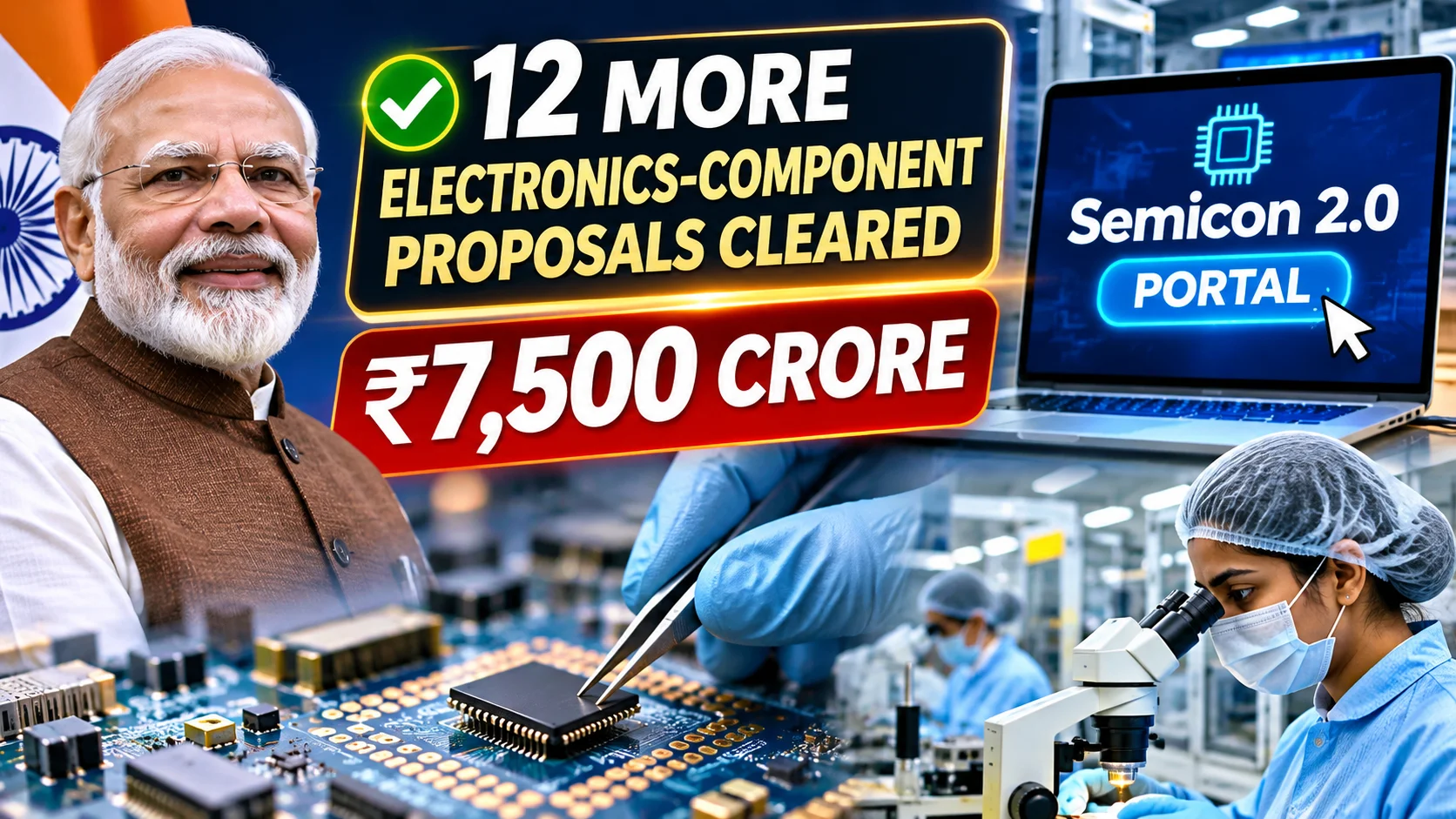
- Media reports say the government has cleared 12 more proposals worth over Rs 7,500 crore under the electronics components scheme.
- This money is aimed at the parts inside gadgets, not at another phone-assembly line.
- The same reports say a Semicon 2.0 web application portal is live under the Semicon India Programme.
- Your next Flipkart checkout will not magically get cheaper this month. Component plants take years.
- The reports we used did not name the 12 applicants. We are not guessing.
What just happened?
You drop a phone on a tiled floor in Coimbatore. The screen dies. The shop guy opens it in two minutes: camera, battery, a green board, a few chips. The retail box said Made in India. A lot of those tiny bits still did not start life here.
That gap is the story this week. Not a new flagship. Not a launch event with smoke machines.
Media reports said the government has cleared 12 more proposals worth over Rs 7,500 crore under the electronics components scheme. The same reports said the government also launched the Semicon 2.0 web application portal under the Semicon India Programme.
Twelve proposals. Over Rs 7,500 crore. Components, not finished phones. India already assembles a huge number of mobiles. Walk into any big store and you will see it on the box. Assembly is the last stretch of the race. The long stretch is making the camera module, the display bits, the printed circuit board, the connectors, the power parts.
Those are the unsexy pieces. They also decide whether Made in India means a screwdriver in Noida or a real supply chain.
Reports did not publish a full public list of the 12 applicants in the material we are working from. So we are not inventing company names, cities, or capacity numbers. If a firm puts out its own statement later, that is a separate story.
The Semicon 2.0 portal is a different door to the same house. Semicon India is the chip-side push. A web application portal is how companies are supposed to file and track a bid without a suitcase of paper.
How does this actually work?
Think of a phone as a thali, not a single dish. The steel plate is the brand. The rice, sambar, poriyal are the components. Chips are the ghee you cannot skip.
For years India got very good at putting the thali together. The kitchen still imported too much of the cooking.
An electronics components scheme puts policy money behind that kitchen. Help in programmes like this usually targets plant and machinery, and parts that keep showing up on the import bill. The exact incentive grid lives in official scheme documents. We are not quoting a gazette.
Why 12 more? Because this is a pipeline, not a one-day mela. Proposals come in. A committee looks at them. Some clear. Some wait. Media reports framed this batch as an additional clearance, worth over Rs 7,500 crore in project size. That figure is the scale of the proposals, not cash handed over in a sack on Monday morning.
People mix this up with PLI for mobile phones. Different shelf. Phone PLI paid you to make more handsets. A components scheme tries to make the insides. You can assemble a lakh phones and still import the display and the camera.
Then there is Semicon India. That is the chip ambition: design, fabrication, packaging, the slow expensive stuff. A Semicon 2.0 web application portal, as reported, is the digital front desk for that programme. We have not been given a feature-by-feature tour, so we will not fake one.
Put the two together and the map is simple. Components scheme: boards, modules, the physical bits around the chip. Semicon: the chip itself. Your phone needs both. So does a laptop. So does an EV charger, a set-top box, a 5G radio in a tower.
None of this is overnight. A component plant needs land, tools, clean processes, trained people, and a buyer who will trust the first lot. From clearance to the first box leaving the gate is a long calendar.
What changes for people in India?
If you are buying a phone on Flipkart this week, almost nothing changes tomorrow. Do not wait for a Rs 2,000 price cut because a committee cleared 12 files.
The first people who feel this are not shoppers. They are engineers, technicians, tool-room staff, and the small vendors who sit around a big factory: packing, plastics, testing, logistics.
Tamil Nadu, Karnataka, Uttar Pradesh, Telangana and a few other states already host electronics clusters. We do not know if these 12 proposals sit in those clusters. We are not pinning a map on a rumour. When component work grows, the jobs are not only on the final assembly line. They are in SMT lines, quality labs, and maintenance shifts that run at 2 a.m.
For students in ECE and mechanical courses, this is the boring-good news. India does not only need app developers. It needs people who can hold a microscope over a solder joint and not panic.
For the repair economy, the shop in T. Nagar or the lane in SP Road in Bengaluru, local parts can, over years, mean easier spares. That is a hope, not a guarantee. If the plants make export-grade modules for brands, those parts may never show up in a local spare-parts box.
Import bills are the quiet national angle. India still spends heavily on electronic components and chips from East Asia. Every bit made here is one less container on that route. It also means a shock in one overseas factory does not kill every production line in India the next week. 2020 taught that lesson. 2026 is still living with it.
Will Jio and the phone brands pass any of this to you as cheaper 5G handsets? Only if costs actually fall and competition stays ugly. Policy clearance is not a discount coupon. Over Rs 7,500 crore is serious money across 12 projects, and still not the whole electronics industry. Treat the headline as a batch, not the finish line.
What should you do now?
If you are a consumer, you do nothing. Your UPI payment for a new phone does not need a new setting. There is no app to download. There is no public portal to apply for cheaper gadgets.
If you are a student or a mid-career engineer, look at skills around components, not only at coding bootcamps. PCB design, embedded testing, quality, supply-chain, semiconductor packaging: these are the jobs that show up when plants actually start hiring. Watch company career pages and state skill missions. Ignore WhatsApp forwards that promise a semicon job next week.
If you run a small electronics unit, cables, plastics, metal parts, EMS work, read the actual scheme notes from government sites, not from a forwarded PDF. The Semicon 2.0 portal, as reported, is for applications under Semicon India. Use official URLs. Do not pay a consultant on Telegram who claims a back door.
If you are staring at listed electronics stocks tonight, stop. This article is not a buy call, not a sell call, not a multibagger thread. Clearances can take years to turn into revenue. This is information, not investment advice.
And if you just wanted to know whether India is still only assembling phones: a little less than before, on paper. Twelve more proposals got a nod. The portal for the chip programme is open, according to reports. The real test is the first Made-here camera module that a big brand trusts without a backup shipment from abroad.





Comments (0)
Be the first to comment!