

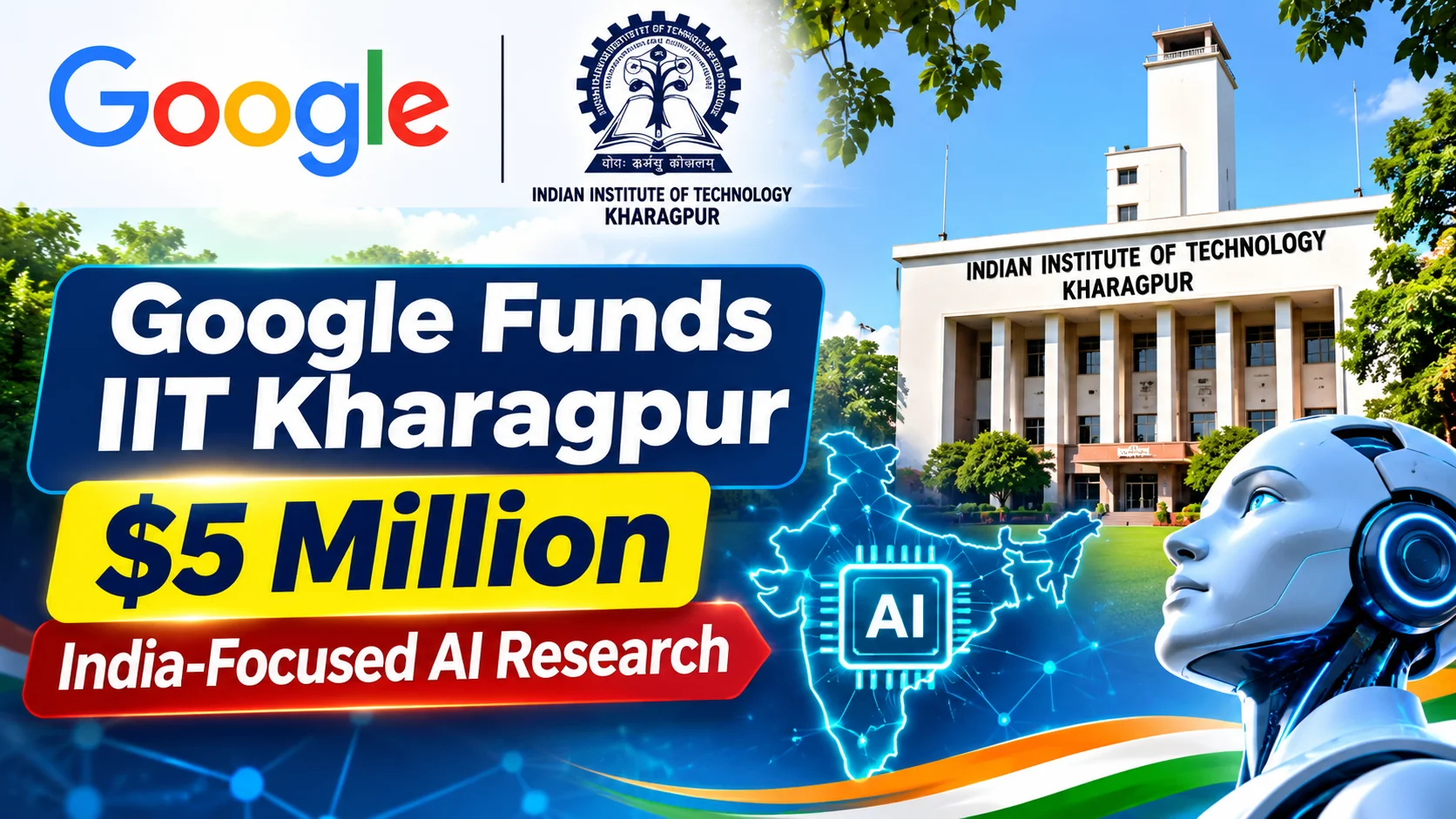
Google is putting $5 million behind IIT Kharagpur’s artificial intelligence ambitions, and this is not just another big-tech funding headline. The partnership is aimed at areas that directly affect India: Indian languages, agriculture, materials science and education technology. Google CEO Sundar Pichai, an IIT Kharagpur alumnus, also recalled the institute’s role in shaping his academic journey. For students, researchers and anyone watching India’s AI race, this is a significant development.
The announcement means IIT Kharagpur will get support for AI research, training programmes and technology infrastructure. The funding is expected to help researchers build and test AI applications for India’s diverse requirements. That could include tools that understand Indic languages, systems that assist agriculture and education, and research infrastructure that allows students and faculty to work on more demanding AI projects.
What exactly has Google announced?
Google has announced a $5 million funding commitment for IIT Kharagpur. The money will support three connected areas: artificial intelligence research, AI education and capacity building. This is important because research funding alone does not automatically create useful technology. Universities also need trained people, computing resources, software tools and a long-term environment in which ideas can be tested.
According to the announcement, IIT Kharagpur’s research focus will include Indian languages, agriculture, materials science and education technology. The partnership will also support training for students, teachers and faculty members. In addition, Google will help strengthen AI tools, frameworks and infrastructure across the campus.
In simple terms, the funding is expected to help IIT Kharagpur work on AI models and applications while also preparing more people to use and develop those systems. It is a research and capability-building partnership rather than a promise that a consumer-facing chatbot will appear immediately.
Why Indian languages are a major focus
India does not have one dominant internet language. Millions of people use Tamil, Hindi, Bengali, Telugu, Marathi, Kannada, Malayalam, Gujarati, Punjabi, Odia and other languages to search, learn, shop and communicate online. Yet many digital tools still work more naturally in English than in Indian languages. AI that understands local languages, accents, scripts and cultural context could make technology more accessible.
Indian-language AI is not simply a translation problem. A useful system must understand mixed-language speech, local names, regional expressions, spelling variations and the way people actually speak. A Tamil user may type English technical terms inside a Tamil sentence. A farmer may use a local crop name that is not common in standard datasets. A student may ask a question through voice rather than typing it. These details make local research essential.
IIT Kharagpur’s work could contribute to better language datasets, speech systems, translation tools and educational assistants. The direct impact may not be visible immediately, but stronger research can eventually improve search, government services, banking support, healthcare information and learning platforms in Indian languages.
What AI could mean for Indian agriculture
Agriculture is another area named in the partnership. Indian farmers deal with changing weather, pests, water availability, crop prices and regional soil conditions. AI cannot remove every risk, but it can help analyse large amounts of information and present useful guidance more quickly.
Research could explore systems that identify crop diseases from images, predict irrigation needs, analyse weather patterns or provide information in local languages. The practical challenge is reliability. A farming tool must work with imperfect photographs, uneven internet access and local variations. It should not give confident but wrong advice. Any such system needs field testing, agricultural expertise and clear communication about uncertainty.
For a farmer, the best AI product will not be the one with the most impressive demo. It will be the one that works on an affordable phone, supports the farmer’s language, understands local conditions and gives advice that can be checked. University research can help move the conversation from flashy demonstrations to dependable applications.
Materials science and education technology
Materials science may sound distant from daily life, but it supports batteries, electronics, construction, energy systems and manufacturing. AI can help researchers study materials, identify patterns and narrow down promising combinations for experiments. That does not replace laboratory work. Instead, it can help scientists decide which questions deserve closer attention.
Education technology is another direct focus. AI tools could help create personalised explanations, assist teachers, translate learning material and support students who need extra practice. India’s education system includes students with different languages, learning speeds and access to coaching. Properly designed AI could make learning support more available beyond major cities.
There are also risks. AI-generated explanations can contain errors, students may depend on tools instead of learning fundamentals, and personal education data needs protection. Any system used in classrooms should have teacher oversight, transparent limitations and strong privacy safeguards.
Pichai’s personal connection with IIT Kharagpur
The announcement has an additional layer because Sundar Pichai studied at IIT Kharagpur. He said the institute is doing important work in areas such as Indic languages, agriculture and education, and that Google is excited to help accelerate its impact. He also spoke about how the institute shaped his own journey.
That personal connection gives the announcement a strong symbolic value, but the real test will be execution. Funding announcements matter only when they produce research, training, open knowledge, useful tools and opportunities for students. IIT Kharagpur will need to show how the partnership becomes measurable work over time.
How this fits Google’s India AI strategy
The IIT Kharagpur partnership arrives as Google expands its wider AI and cloud investment in India. Google has also committed around $15 billion over five years, from 2026 to 2030, towards establishing an AI hub in Visakhapatnam. The university partnership fits into that larger push by connecting industrial technology investment with academic research and talent development.
India is increasingly important to global AI companies because it has a large digital population, a deep engineering talent pool and complex problems that can inspire new applications. But India also needs AI that reflects local realities rather than simply importing systems designed for other markets. Work on languages, agriculture and education can help build that local relevance.
What it means for students and researchers
Students could benefit through training programmes, curriculum development, research exposure and access to better tools. Faculty members may get opportunities to work with advanced AI frameworks and collaborate across disciplines. The biggest long-term benefit may be the creation of a stronger research culture around practical Indian problems.
Students should not read the announcement as a guarantee of a job or a direct cash award for every learner. The exact programmes, selection processes and opportunities will depend on how IIT Kharagpur and Google implement the partnership. Anyone interested should watch official institute announcements rather than relying only on social-media posts.
Pros and challenges
Potential benefits
- More research support for Indian-language AI and locally relevant applications.
- Training opportunities for students, teachers and faculty members.
- Better AI tools, frameworks and infrastructure on campus.
- Research attention for agriculture, materials science and education technology.
- A stronger connection between Google’s technology ecosystem and Indian academia.
Important challenges
- Research results may take years before becoming public products.
- AI systems need high-quality Indian datasets and careful testing.
- Language and agricultural tools can cause harm if they give inaccurate advice.
- Student, teacher and community data must be protected.
- Funding should support open, measurable research rather than only promotional demonstrations.
What happens next?
The next step is implementation: defining research projects, training programmes, infrastructure plans and measurable outcomes. The public will want to know which teams are involved, what tools are built, whether results are shared with the wider research community and how students outside major technology circles benefit.
My take is simple: this is good news for India’s AI ecosystem, especially because the focus goes beyond generic chatbots. Indian languages, farming, materials and education are difficult domains where local expertise matters. The $5 million commitment gives IIT Kharagpur more room to work on those problems. Now the important story is not the size of the cheque—it is whether the partnership creates AI that Indians can actually use, trust and benefit from.





Comments (0)
Be the first to comment!