


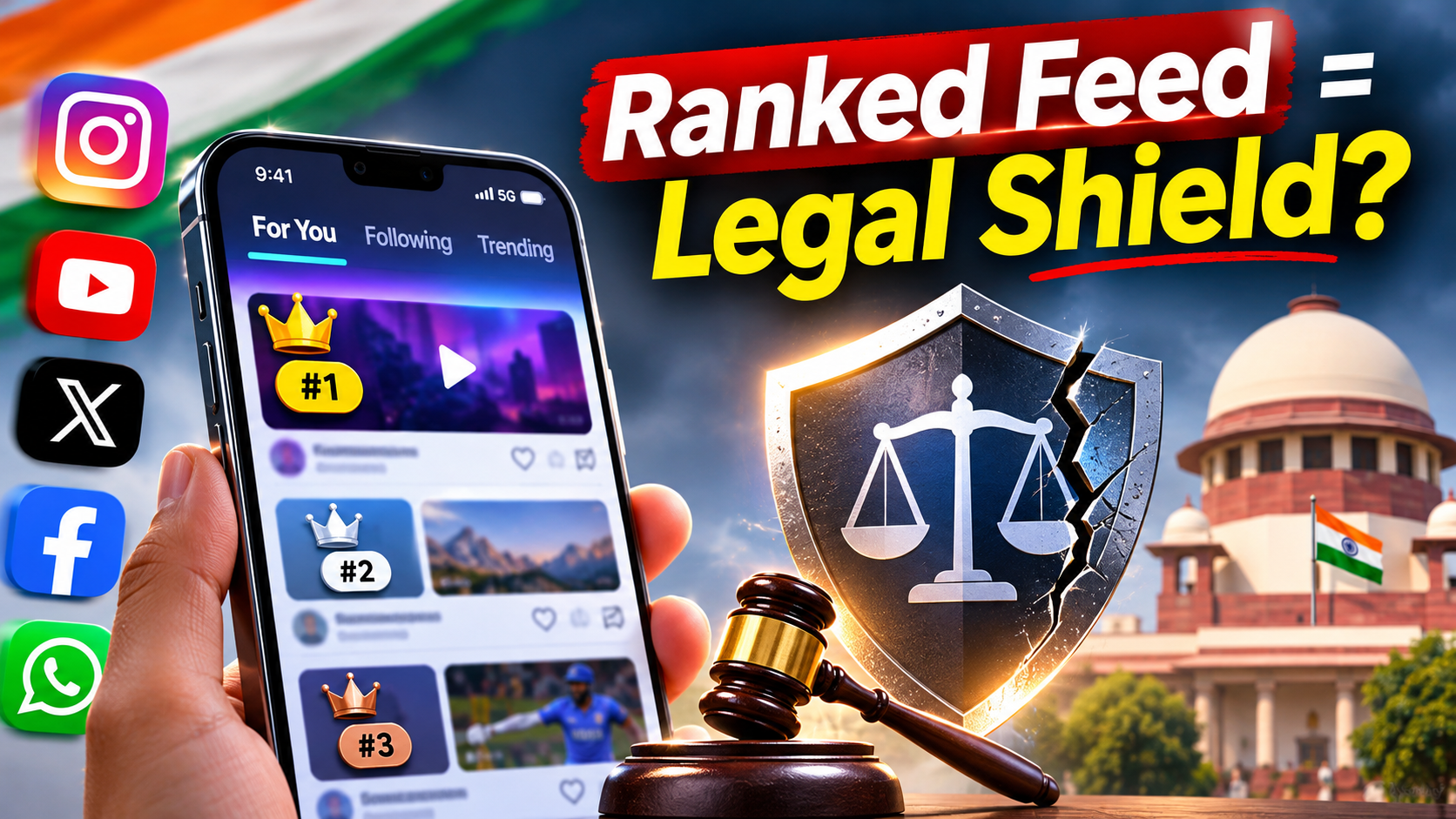
- Media reports, including a MediaNama story, say the Indian government is considering limiting safe harbour for social platforms that use algorithms to rank or promote content.
- Safe harbour is the IT Act shield that usually stops a host from being treated as the publisher of every user post, if it stays inside the stated conditions.
- If ranking or boosting content knocks a platform out of that shield, legal risk for user posts could rise.
- On the information we have, this is a reported consideration, not a notified law or a public draft we can quote.
- If a rule in this direction ever lands, Indian users could see twitchier takedowns and weaker recommendation feeds. Creators who live on Reels and Shorts would feel that first.
What just happened?
Open Instagram on the 7.40 bus. The first video is not your cousin in Coimbatore. It is a stranger making filter coffee, because the app decided you would watch till the end.
That choice is the algorithm. Rank, promote, repeat. That is how a social app fills a screen, and how a small creator becomes a big one overnight.
According to media reports this week, the Indian government is considering whether that ranking should cost platforms their legal shield. A MediaNama report says the government is looking at removing or limiting safe harbour protection for social media platforms that use algorithms to rank or promote content. That would potentially increase their liability for user posts.
Read it slowly. The live question is not "can you post a status". It is "if the app boosts the status, is the app still a neutral host".
TamilTech is going by that reported idea. We have not seen a gazette, a Bill text, or a consultation paper in the notes for this story. So there is no invented ministry quote here, and no fake line from a platform spokesperson. If a company has not spoken on record in the material, we will not put words in their mouth.
Why the headline travels: almost every big feed on your Phone runs on ranking. YouTube Home, Instagram Reels, Facebook, X, ShareChat, Moj. A pure notice board does not. WhatsApp is mostly messages you chose to receive, which is a different design, even if Status and Channels sit in the same app family. The report, as framed, is about social platforms and ranking or promoting content.
One more grounding point. Today is 6 November 2026. A report that the government is "considering" something is a policy signal. It is not the same as the Information Technology Act changing overnight. Indian internet rules usually show up as a draft, a public note, or a notified amendment. Until one of those is public, your feed still runs on the law that is already there.
How does this actually work?
Safe harbour. Heavy phrase. Simple idea.
You upload a video. Your friend comments. A stranger stitches it. The company did not shoot the video. Under Section 79 of the IT Act, 2000, intermediaries can get protection from liability for third-party information, subject to conditions. They should not initiate the transmission, select the receiver, or modify the information. They should also follow due diligence and the extra duties later rules piled on.
That is the shield. Without some version of it, a site that lets millions of Indians post would be one lawsuit away from shutting the comment box.
Due diligence is not a vibe. For significant social media intermediaries, the IT Rules, 2021, already ask for things like a grievance system, named compliance roles, and action on certain content within set timelines once the platform has actual knowledge. Safe harbour in India was already conditional. It was never "anything goes".
Now look at ranking.
A chronological list of people you follow is close to a pipe. Newest first, from your own graph. A ranking algorithm is a choice machine. It scores watch time, shares, reports, your past taps, maybe what kept people like you scrolling last Tuesday. Then it promotes some posts and buries others.
If you have ever wondered why one half-baked meme hits 10 lakh views and a careful 12-minute video dies at 400, that is ranking. Promotion is the cousin: suggested users, Explore, the Shorts shelf, "you may like".
Media reports say the government may treat that active ranking as a reason to limit safe harbour. The logic, in policy debates in more than one country, goes like this: once you are not passively hosting, once you are amplifying, you look less like a notice board and more like an editor who picked the front page.
Whether Indian courts already draw that line under today's statute is a live legal argument. TamilTech is not your lawyer, and this is not a case comment. We are explaining the report: algorithms that rank or promote could, if the idea becomes a rule, pull a platform outside the comfortable reading of "intermediary".
What we will not do is invent the threshold. Will a "sort by most liked" comments widget count? Will a news site's trending module count? Will YouTube search rank count? The report, as summarised, talks about social media platforms that use algorithms to rank or promote content. That is broad. Broad rules are where product lawyers earn their keep, and where users get confused.
Also separate two ideas people smash together. Hosting content and then ignoring a valid notice is already a problem under current law. Algorithmic ranking of messy-but-ordinary posts — satire, neighbourhood drama, cricket hot takes — is the newer tech-policy fight. The report is about the second idea sitting on top of the first.
What changes for people in India?
If you only read global tech Twitter, this sounds like a Silicon Valley problem. It is not. India is one of the largest user bases for these apps. The feed is how a lot of people get cricket clips, recipe demos, exam tips, shop fronts, and festival dance videos.
Here is what could move, if a limitation on safe harbour for ranked content ever becomes enforceable law. Could. Not will. Not next Monday.
Discovery gets harder for small creators. The whole Reels and Shorts economy in India runs on the machine finding you an audience you do not personally know. A tailor in Tiruppur, a maths teacher in Kota, a cook in Madurai — they do not have a TV channel's PR team. They have the algorithm. Turn down ranking, and you turn down that lottery. Some people will cheer, because the same lottery also spreads scams and pile-ons. Both things can be true at once.
Moderation gets twitchy. Liability is a cost. The cheap corporate response is delete first, restore later if ever. You may see more "this content is not available", more silent takedowns, more appeals that go nowhere. That can reduce garbage. It can also reduce messy speech that is still legal.
Product design may split. A platform might push a following-only mode for India, stop ranking comments, or slap bigger labels on recommended posts. You have already seen "suggested" tags on some apps. Expect more friction if legal risk attaches to the suggestion itself.
Indian startups feel this differently from the giants. A global company can hire a floor of trust-and-safety people and still argue in court. A homegrown social app in Pune cannot. If the rule is blunt — any ranking kills the shield — the safe product decision for a young company is to not build a social graph at all. That is how you accidentally freeze a whole category.
Users who mainly chat on WhatsApp, or pay with UPI on GPay, are not the centre of this report. Those are different products. Do not mix a ranking-feed story with your UPI pin. Stay on the plot: social platforms, algorithms, liability for user posts.
Existing user duties do not vanish in the meantime. Platforms in India already have to act on certain categories of content when they get a proper notice. This headline does not invent the internet's first content rule. It asks whether ranking should change who carries the risk.
What should you do now?
Keep using your apps. A media report of a policy being considered is not a takedown notice on your account.
If you are a creator or a small shop that lives on Instagram, YouTube, or ShareChat, do one practical thing: give your audience a way to find you that is not only the For You page. A website, an email list, a channel you actually control. Algorithms were already moody. Legal risk on ranking would make them moodier.
If you run a product with user posts — even a college alumni app with a "hot" tab — ask your counsel whether you look like an intermediary, and what ranking you actually do. Do that with the current IT Act and IT Rules on the table, not with panic about a draft that is not public in our notes.
If you care about the rule itself, wait for a public draft. When Indian internet policy is done by the book, comments get invited. Industry bodies and user groups usually file theirs. That is the useful window. A screaming screenshot is not a consultation.
For everyone else, learn the two phrases and drop the panic. Safe harbour means a platform hosting your joke is not automatically the person who told the joke, if it follows the conditions. Ranking means the machine decided the joke should hit strangers, not just your 200 followers. Media reports say the government may join those two and change the risk.
Check primary sources when they appear: a gazette notification, a released draft, a government press note. Until then, treat "considering" as considering. That is the whole action list. Short on purpose.



Comments (0)
Be the first to comment!