


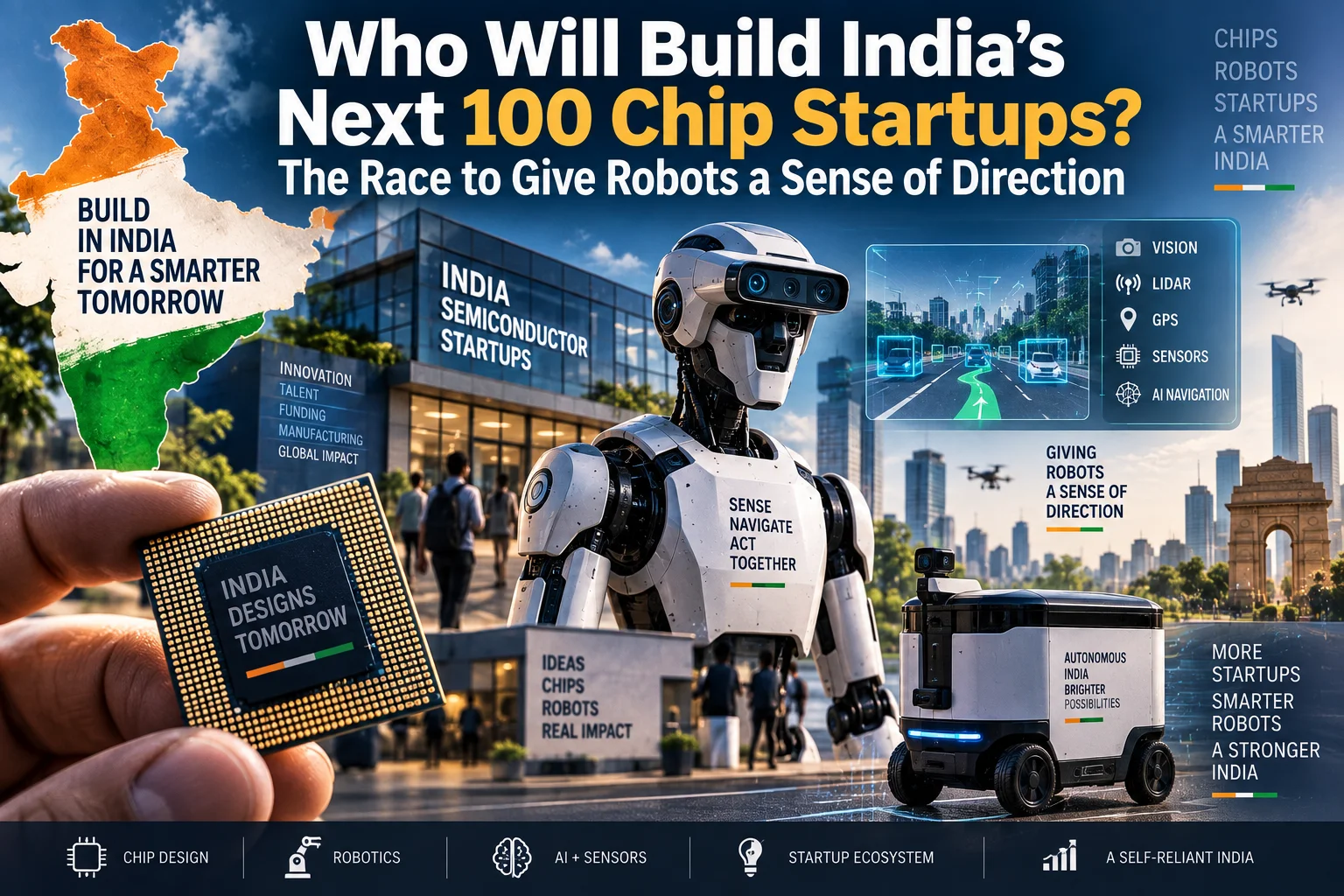
- India Semiconductor Mission (ISM) has transitioned from policy drafts to active operational semiconductor units over the last four years.
- The next big frontier isn't just silicon fabrication, but specialized chip design for spatial AI and autonomous robotics.
- Homegrown fabless startups are stepping up to build edge processors that help warehouse bots and drones navigate without burning massive battery power.
- Engineering talent across Indian tech hubs is moving from service-layer IT toward deep-tech silicon architecture.
What just happened?
Walk into any tech park in Bengaluru, Chennai, or Hyderabad, and you will notice a quiet shift. For decades, Indian engineers designed chips for global giants like Qualcomm, Intel, and Texas Instruments. The IP belonged to California; the testing happened in Taiwan; the packaging sat somewhere in Southeast Asia. India was mostly the back-office brains behind foreign silicon.
That dynamic is shifting fast. At Semicon India 2026 in New Delhi, MeitY Secretary S. Krishnan pointed out how the India Semiconductor Mission has moved from pure policy discussions to actual operational facilities on the ground in under four years. We now have commercial foundries, assembly plants, and testing facilities taking shape across Gujarat, Assam, and Tamil Nadu.
Building the factories is only step one. The bigger question being asked across the hardware community is straightforward: who is going to design the chips that run inside these fabs? More specifically, who will build India's next 100 fabless chip companies?
A major chunk of the answer lies in robotics and spatial computing. As autonomous machines move into Indian warehouses, delivery hubs, and factories, they need chips that can help them understand 3D space, calculate depth, and navigate complex terrain in real time.
How does this actually work?
To understand why this is such a big deal, think about how a human walks through a crowded railway station. You do not send your visual data to a cloud server, wait two seconds for a reply, and then decide which step to take. Your brain processes depth, speed, and obstacles instantly, right on your neck, using very little energy.
Robots and autonomous drones need the exact same thing. When an automated cart moves inside a massive Flipkart or Amazon warehouse in Bhiwandi, it uses cameras, LiDAR, and inertial sensors to avoid running into shelves and workers. If that machine has to send every single video frame to an off-site cloud server to figure out where to turn, two things happen: it lags, and it eats through its battery in an hour.
This is where specialized spatial computing chips come into play. Instead of running heavy general-purpose processors, these dedicated chips process visual data, optical flow, and sensor signals directly at the edge. They give the robot an instant sense of direction using minimal power.
Building these requires a fabless design model. A fabless company creates the architectural blueprints, tests the logic in software simulators, and sends the finished design to a manufacturing foundry. It costs a fraction of building a multi-billion-dollar silicon foundry, meaning small, sharp startup teams can create world-class silicon right out of an incubator.
What changes for people in India?
The ripple effect hits our domestic industry faster than you might think. Here is where the impact lands first:
1. Smarter local automation: From automated sorting in e-commerce fulfillment hubs to precision pesticide spraying drones flying over Punjab and Tamil Nadu farmland, edge-navigation chips make machines significantly cheaper. When hardware teams do not have to import expensive, general-purpose computing boards from overseas, the cost of robotics drops across the board.
2. High-value hardware engineering jobs: For decades, the career advice for an Indian electronics graduate was simple: learn Java or Python and join an IT services firm. Now, with design-linked incentive schemes and venture funding flowing into fabless semiconductor startups, hardware design and VLSI engineering are offering top-tier career paths right here at home.
3. Domestic supply chain security: When critical systems—like logistics bots, power grid sensors, and defense drones—run on domestic chip architectures, the risk of foreign supply chain chokepoints disappears. You control the silicon, the firmware, and the security layer from top to bottom.
What should you do now?
If you are an engineer, student, or founder looking at the hardware space, here is how you should position yourself:
For engineering students: Focus your attention on Verilog, RISC-V architectures, and edge compute optimization. The demand for engineers who understand both hardware description languages and spatial sensor fusion is outstripping supply.
For tech founders: Look at vertical hardware problems rather than generic AI wrappers. Solving a specific physical sensing problem—like low-latency obstacle avoidance for small delivery bots—creates far higher defensibility than building another dashboard app.
For investors and operators: Keep a close watch on the Design-Linked Incentive (DLI) schemes supported by the central government. The companies emerging from these programs are solving real physics problems with high-margin hardware intellectual property.
India won the software services race over the last thirty years. The battle for the next decade will be fought on silicon boards, giving machines the intelligence and direction they need to navigate the physical world.




Comments (0)
Be the first to comment!