


Key takeaways
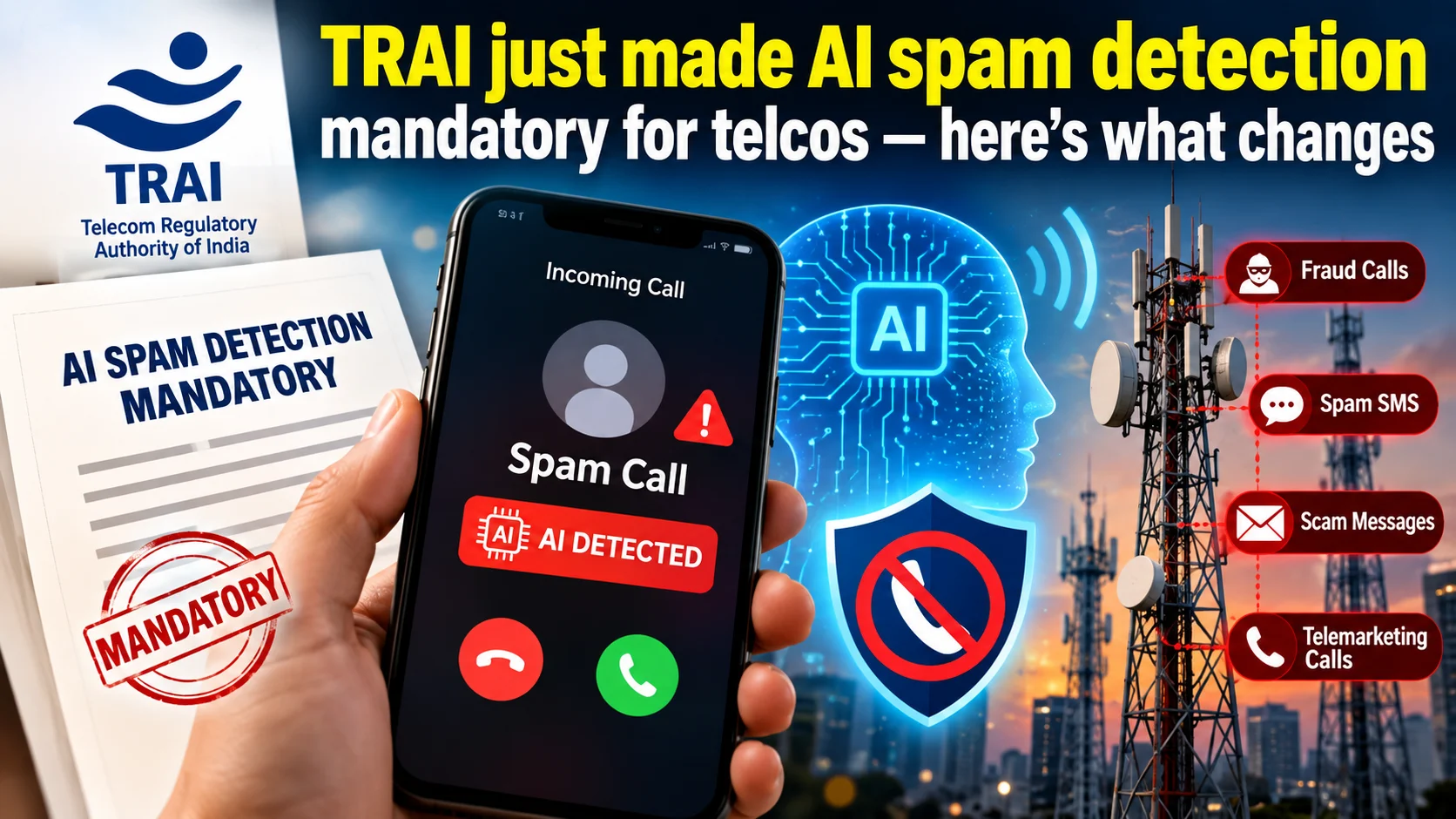
- TRAI’s amended UCC regulations require telecom operators to run AI/ML systems that spot suspected spam numbers, not wait only on user complaints.
- Flagged numbers must be shared across operators, then put through fresh KYC checks and a proper investigation before enforcement.
- Action is not instant block-on-algorithm. Probe first, punish after — that is the design.
- For you, the hope is fewer loan, insurance and “RBI freeze” calls. For genuine businesses, cleaner bulk SMS and voice rules matter more than ever.
- Save official short codes, stop sharing OTPs, and report spam in-app — your complaints still feed the system the AI is supposed to learn from.
What just happened?
You know that 11:30 am call. Unknown number. “Sir, your loan is pre-approved.” Or worse — “Your bank account will be blocked in two hours.” You cut the call. Block. Still three more by evening.
TRAI has tightened the Unsolicited Commercial Communication (UCC) rulebook again. The big shift is simple to say and heavy to run: telecom operators cannot treat spam as a pure complaints desk problem anymore.
They now have to use AI and machine learning to hunt suspected spammers on their own networks. Find patterns. Flag numbers. Share those flags. Re-verify who is behind the SIM. Investigate. Then take enforcement action.
This is not a cute “AI feature” press note. It is a compliance duty on Jio, Airtel, Vi, BSNL and the rest of the chain that carries voice and SMS in India.
UCC, quickly: those calls and texts you never asked for. Promo blasts, fake KYC alerts, random insurance pitches. TRAI has been chasing this for years with scrubbing, headers, consent templates and whitelists. The amended layer adds something the old paperwork could not do at scale — pattern spotting across millions of calls and messages in near real time.
How does this actually work?
Think of it as a four-step factory line, not a magic spam filter on your Phone.
Step 1: AI/ML watches the pipe. Operators must run systems that look for spam-like behaviour. Sudden burst calling. The same script hitting thousands of handsets. Numbers that hop behaviour after a quiet phase. Routes that smell like a call centre farm, not a normal customer.
AI here means models trained on traffic and complaint signals. ML means the system keeps adjusting as spammers change tactics. Spammers already rotate SIMs and change pitch every week. A static blocklist dies fast. A learning system is the only thing that keeps up.
Step 2: Flag and share. When a number looks dirty, it does not stay as one telco’s private note. The regulations push sharing of flagged numbers so a spammer cannot burn a Jio SIM in the morning and an Airtel SIM at night with zero gossip between networks.
That shared suspicion list is the unglamorous heart of this reform. Spam is a multi-operator sport. Enforcement has to be multi-operator too.
Step 3: KYC, again. A flagged number triggers fresh know-your-customer checks. Who took the SIM? Is the ID real? Is the same person sitting on a pile of “customer” SIMs? Is a business connection being misused for bulk nuisance calls?
India already has tight SIM KYC on paper. The gap was always misuse after activation — rented SIMs, mule IDs, bulk connections sold with a wink. Pointing AI at behaviour, then dragging the subscriber back to KYC, closes that loop a little.
Step 4: Investigate, then enforce. This part matters. The rule is not “algorithm says spam, line goes dead in 10 seconds, no questions.” Operators are expected to investigate suspected spammers before enforcement action.
Why? Because false positives hurt. A small shop running festive offers, a school sending fee reminders, a local clinic with an awkward calling pattern — all of them can look noisy to a blunt model. Probe first. Then warn, restrict, scrub, or disconnect as the framework allows.
If you have ever had a DND-registered number still get “sir, loan” calls, you have lived the old failure mode: rules on the books, weak detection in the wild. AI duty tries to fix detection. KYC plus investigation tries to fix identity. Sharing tries to fix the whack-a-mole across telcos.
What changes for people in India?
For normal users, the win is boring and beautiful: fewer unsolicited calls and SMS, especially the scam flavour that pretends to be your bank, courier, or a government refund.
You will not see a new “TRAI AI” icon on your home screen. The work sits inside operator network operations, fraud teams, and the UCC ecosystem — headers, principal entities, registered templates, consent registers, and the complaint pipes you already use in MyJio, Airtel Thanks, Vi app or the 1909 / TRAI DND path.
For people who run genuine business communication — banks sending OTP and transaction alerts, UPI apps, Flipkart delivery updates, IRCTC tickets, hospitals, colleges — the bar for clean registration and clean traffic gets higher. If your bulk traffic starts looking like a spam burst, you want your templates, headers and consent trail in order before someone else’s model waves a red flag.
For the spam industry, life gets harder in theory. Behavioural detection plus cross-operator sharing plus KYC recall is a tougher combo than “wait for 50 users to complain.” In practice, gangs will still try SIM farms, VoIP tricks, and social-engineering texts that look like one-to-one chats. Regulation raises the cost. It does not delete crime.
There is a privacy and fairness angle worth saying out loud. Network-level AI means your call and SMS patterns are being scored for spam risk as traffic, not as a human reading your private life. That is different from a phone app listening to your mic. Still, any scoring system can over-flag. That is exactly why the amended approach ties detection to investigation instead of pure auto-punish theatre.
Also be clear about what this does not do. It does not replace your brain on a call that asks for OTP, UPI PIN, or “full KYC video with your ATM card.” AI at the telco can cut volume. It cannot save you from one successful social engineering hit.
What should you do now?
Keep doing the unsexy things. They still matter, and they still train the same systems operators are being told to build.
Register on DND if you have not. Report spam calls and SMS through your operator app or the official complaint channels instead of only blocking locally. A local block protects your evening. A filed complaint feeds the network-side picture.
Never share OTP, CVV, UPI PIN, or card numbers on a call you did not place. Real banks and UPI apps do not cold-call you to “complete KYC in 10 minutes or account bandh.”
If you run a business that sends SMS or voice campaigns, audit your principal entity registration, headers, templates and consent records. Quiet compliance now beats a frantic explanation after your numbers get flagged in a shared suspicion pool.
If your own number suddenly starts getting blocked by others for no reason, talk to your operator early. Wrong flags happen. The investigation step exists partly for that mess.
And if the calls still pour in next month, do not assume the regulation “failed overnight.” Spammer tactics shift in days. Model rollouts, KYC queues and inter-operator sharing take longer. The direction of travel is clear: detection is now an AI/ML obligation, not a best-effort side project.
Your silence button stays useful. It should just have less work.



Comments (0)
Be the first to comment!