


Key Takeaways
- Indian private space startups have graduated from test launches to orbital business delivery.
- Weekly venture funding shows capital is flowing strictly to startups with secured launch orders, functioning test beds, and clear revenue pipelines.
- The real battleground in 2026 is cost-per-kilogram to orbit and dependable launch cadence rather than valuation headlines.
- Satellite data applications in precision agriculture, disaster mapping, and maritime tracking are driving actual paying demand.
- Tier-2 precision manufacturing clusters in Coimbatore, Rajkot, and Peenya are quietly becoming the backbone of the domestic space supply chain.
Why is everyone suddenly talking about commercial launch deadlines?
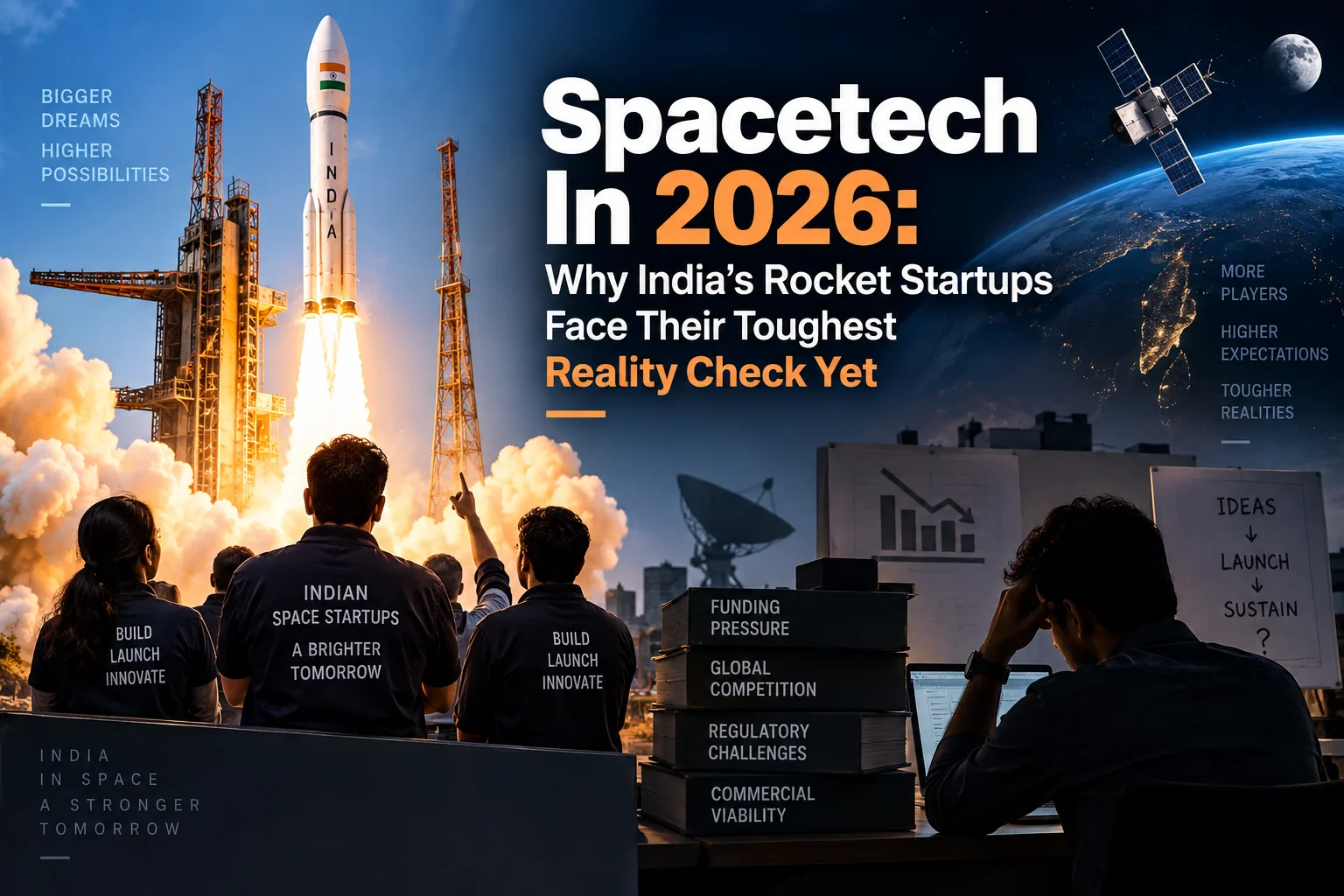
Remember when launching a private Indian rocket was treated like a science-fair miracle? Those days are officially over. The domestic spacetech sector has entered its operational phase, and the excitement around prototype launches has given way to cold, hard spreadsheets.
Over the past week, venture funding rounds across Indian tech showed a steady, no-nonsense pattern. While consumer apps and quick-commerce clones fight over wafer-thin margins in grocery deliveries, deeptech and spacetech are still drawing serious cheques. But there is a clear catch. Venture capitalists are no longer funding glossy pitch decks filled with computer-rendered rockets and ambitious promises.
The question every founder in Chennai, Bengaluru, and Hyderabad is answering right now is simple: can your rocket carry a paying customer's satellite into orbit this quarter without blowing the schedule?
Between IN-SPACe authorisations, dedicated launchpads at Sriharikota, and a persistent global shortage of reliable small-satellite launchers, the window of opportunity is wide open. But the tolerance for failed test windows and delayed missions is thinner than ever before.
How does the money actually work in Indian spacetech?
To understand why this phase is so tricky, think of a private space startup like a private interstate bus operator. Building a custom bus from scratch takes years of engineering. That was phase one, where startups designed 3D-printed engines, tested cryogenic stages, and conducted suborbital demonstration hops.
Phase two is running a scheduled bus route every Tuesday at 6 AM, regardless of weather or minor mechanical glitches. That is orbital cadence. If an international satellite maker books a slot to deploy an Earth-imaging sensor, they cannot wait six months because an injector valve needed re-machining.
Here is where the actual money flows in the spacetech business model:
- Dedicated launch services: Startups charge satellite operators per kilogram of payload to reach low Earth orbit (LEO). If your rocket costs too much to build, your pricing cannot compete with global ride-share missions or established national launchers.
- Earth observation data feeds: Companies building their own satellite constellations sell hyperspectral imagery to farming conglomerates, mining corporations, and infrastructure planners.
- Space situational awareness: Tracking orbital debris and providing traffic management for other satellites in increasingly crowded orbits.
- Downstream analytics platforms: Processing raw satellite data into actionable dashboards for insurance firms, port authorities, and state disaster management bodies.
The weekly funding data confirms that investors are backing teams with end-to-end hardware readiness. If a startup relies entirely on third-party test facilities with multi-month waiting queues, their burn rate eats up runway before they ever reach the launchpad.
Where is the weekly funding money really going?
Look at the deal sheets from the past few quarters, and you will notice a clear bifurcation. General tech funding has stayed cautious, but spacetech startups with working propulsion systems, flight-proven avionics, or active data contracts are closing structured Series A and Series B rounds.
Investors are writing cheques for three specific line items:
First, automated production facilities. Building a rocket engine by hand is fine for a college competition, but commercial scale requires automated CNC milling, industrial-grade additive manufacturing, and automated quality testing. Money is flowing directly into manufacturing hangars.
Second, proprietary ground station networks. Launching a satellite is only half the battle. You need reliable ground infrastructure to download data packets every time the bird passes overhead. Startups building their own phased-array tracking antennas are keeping operational costs significantly lower than those renting third-party ground networks.
Third, regulatory clearances and insurance deposits. Commercial orbital missions require comprehensive insurance coverage and strict statutory compliance. Having venture capital in the bank ensures a company can absorb regulatory lead times without halting ongoing research and development.
What does a rocket launch in Sriharikota change for daily life in India?
You might wonder why a startup launching a 300-kilogram rocket from Andhra Pradesh matters to someone paying for groceries via UPI in Madurai, Jaipur, or Pune. The connection is much closer to ground reality than it looks.
First, consider precision agriculture and climate monitoring. Indian imaging satellites are now tracking soil moisture, crop health, and flood patterns at field-level resolution. That means crop insurance claims that previously took four months of manual village revenue surveys can settle in days using verifiable satellite passes.
Second, the local manufacturing ecosystem is getting a massive structural upgrade. When a spacetech startup builds a rocket in Tamil Nadu or Karnataka, they do not make every single bolt in-house. They contract precision engineering micro-enterprises in Coimbatore, Peenya, and Rajkot. Small machine shops that once made automotive gears and textile spindles are now machining aerospace-grade titanium and carbon-fiber composites.
Third, remote connectivity and logistics tracking are quietly improving. While telecom giants cover urban centers with optical fiber and 5G towers, deep-sea fishing trawlers, mountain border checkposts, and isolated island territories rely entirely on satellite networks. Indigenous satellite manufacturing drives down the cost of tracking fishing fleets and remote weather monitoring stations.
What are the biggest bottlenecks startups are running into right now?
Despite the optimism, building a commercial space company in India is not a smooth trajectory. There are three serious friction points every founder is navigating.
Supply chain lead times for aerospace-grade raw materials remain tricky. Sourcing specific high-temperature alloys and space-qualified semiconductor components often involves long import cycles and strict export controls. Startups that have not localized their component sourcing face sudden project stalls.
Testing infrastructure is another real hurdle. While ISRO and IN-SPACe have opened national test stands and integration facilities, commercial demand is high. If five different private companies need the same vacuum test chamber or static fire pad in the same month, schedules inevitably slip.
Finally, talent acquisition in niche deeptech domains is fiercely competitive. Finding engineers who understand orbital guidance algorithms, cryogenic turbopumps, and high-vibration avionics takes time. Startups are actively hiring specialists from automotive, defense, and industrial robotics sectors to bridge the gap.
How should you track this space without getting caught in the hype?
If you are an engineer, founder, investor, or tech enthusiast tracking the Indian space economy, here is how to read the sector clearly:
Look at launch cadence instead of valuation announcements. A company raising $40 million is an interesting headline, but a company completing three successful orbital insertions in twelve months is a functioning business. The real winners in 2026 will be the operators who treat rocket launches like routine logistics rather than once-a-year celebrations.
Keep an eye on downstream software applications. The largest recurring revenue in spacetech rarely comes from the launch vehicle itself; it comes from analyzing the gigabytes of data beamed down every single day. Startups building intelligence platforms for defense, urban planning, crop yield forecasting, and supply chain tracking are where steady cash flow lives.
For hardware engineers and software developers, the private aerospace supply chain is hiring aggressively. If you have hands-on experience in advanced composites, telemetry systems, embedded firmware, or computer vision for satellite imagery, the private aerospace cluster in southern India offers serious career momentum.





Comments (0)
Be the first to comment!