


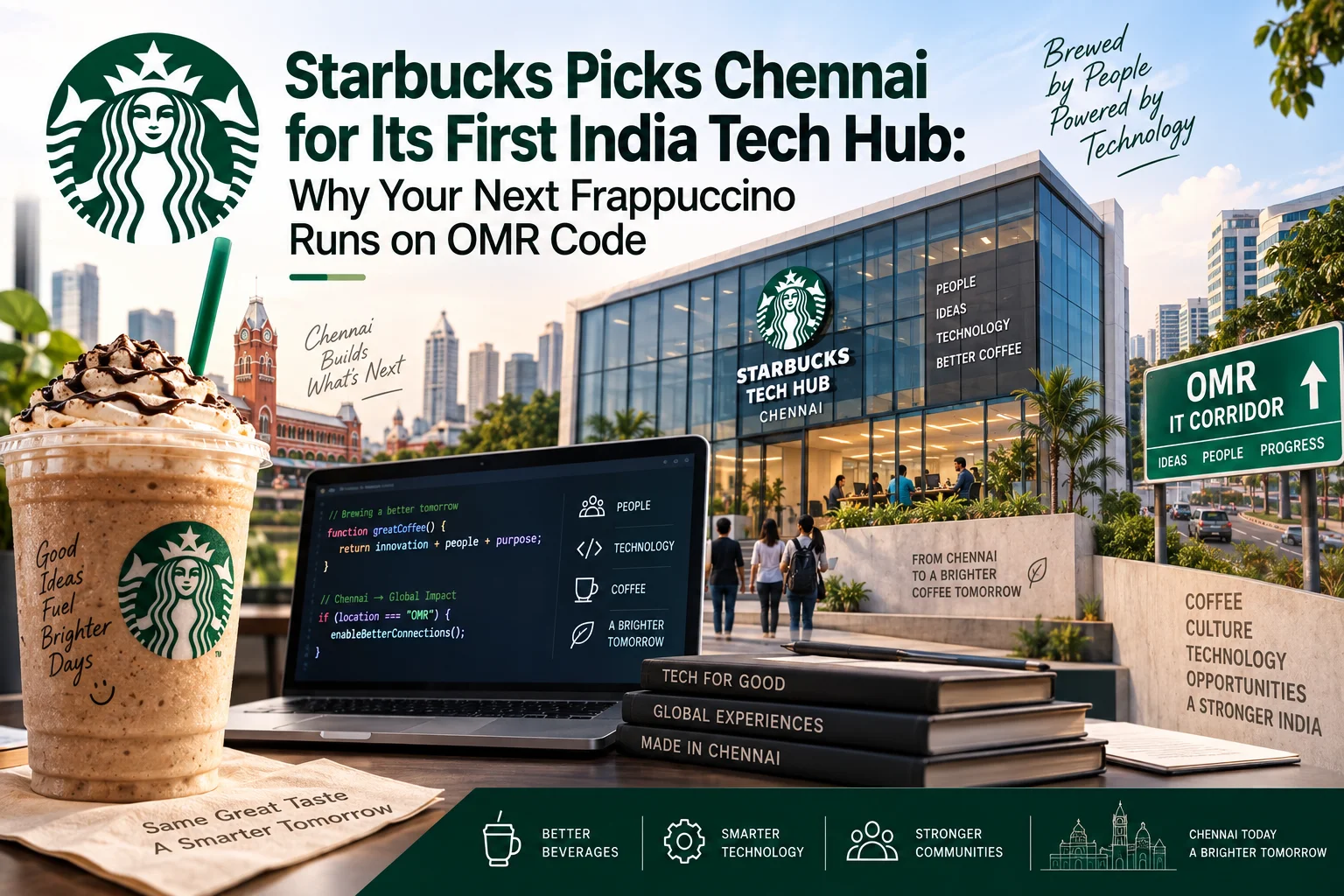
- Starbucks has chosen Chennai, Tamil Nadu, to establish its very first Global Capability Centre (GCC) in India.
- The centre will focus on building core software, global in-store networking stacks, and enterprise Wi-Fi systems powering thousands of outlets worldwide.
- Starbucks CTO Anand Varadarajan cited Chennai's rich engineering talent pool and noticeably lower attrition rates as pivotal reasons for the choice.
- This move brings high-value product development and network engineering opportunities directly to Tamil Nadu's tech corridor.
Wait, why is a coffee company setting up a massive software hub?
Walk into any Starbucks outlet anywhere in the world. You pull out your phone, tap to connect to the free customer Wi-Fi, scan a QR code or use the app to place an order, and settle the bill in seconds with a tap. To you, it feels like a standard coffee break.
Behind that counter, a massive digital machine is running non-stop. Tens of thousands of stores across dozens of countries need continuous network connectivity, split-second inventory tracking, secure cloud syncing, and zero-latency payment processing every single minute of the day.
If the in-store Wi-Fi glitches, the digital payment registers freeze. If the network drops, mobile orders pile up and store operations grind to an instant halt. Starbucks is not just a coffee brand; it runs on an enormous enterprise software backbone.
Now, the core engineering engine responsible for that digital backbone is setting up shop in Chennai. Starbucks has officially picked Tamil Nadu's capital to launch its first-ever Global Capability Centre (GCC) in India.
Why did Chennai win over Bengaluru or Hyderabad?
For years, whenever a Fortune 500 company decided to build a tech centre in India, Bengaluru or Hyderabad was the automatic, predictable answer. Boardrooms rarely looked past the usual suspects. Starbucks decided to break that pattern entirely.
Starbucks Chief Technology Officer Anand Varadarajan laid out the reasoning clearly. Chennai offers an enormous pool of deeply skilled software engineers, paired with something tech leaders value even more right now: significantly lower attrition rates.
In hyper-competitive tech hubs, job-hopping every ten months is common practice. Teams spend half their time hiring and onboarding replacements instead of shipping stable products. Chennai operates differently.
Engineers here tend to stay, build deep domain understanding, and stick with complex architectures across multi-year development cycles. When you are writing mission-critical networking protocols and point-of-sale systems that cannot fail during peak morning rushes, continuity matters far more than hype.
What kind of code will actually run out of OMR?
A modern Global Capability Centre is miles away from old-school outsourced back-office support. Chennai will not be managing simple ticket queues or basic bug logs. Local teams will own and build core intellectual property for Starbucks worldwide.
Think about the sheer scale of in-store connectivity. Millions of people log into Starbucks Wi-Fi every day. Managing those connections requires custom captive portals, automated bandwidth shaping, enterprise-grade authentication, and real-time security monitoring across diverse operating systems.
Beyond guest Wi-Fi, modern commercial espresso machines and cold-brew tap systems are smart IoT devices. They continuously stream diagnostic telemetry back to cloud dashboards. If a machine's water temperature drifts by half a degree, software catches it before the barista even notices an off taste.
Engineers working out of offices along Old Mahabalipuram Road (OMR) will build the edge computing layers, firmware updates, and microservices architecture that coordinate all of this hardware seamlessly. It is full-stack systems engineering applied to physical retail at an unprecedented global scale.
How does this change the game for Indian techies?
Tamil Nadu already holds a powerhouse reputation as India's enterprise SaaS and deep-tech corridor, with home-grown product giants scaling globally from the state. Adding a global retail giant's dedicated tech centre accelerates that momentum.
For local developers, network architects, and cloud specialists, this creates direct access to high-impact product engineering roles. Instead of patching legacy code for third-party clients, teams in Chennai will design systems deployed across stores from Seattle to Tokyo.
The demand spans multiple technical disciplines. Network engineers working on custom mesh routing, cloud architects building fault-tolerant microservices, security researchers testing wireless protocols, and mobile developers refining customer-facing apps will all find high-stakes problems to solve.
It also sends a clear signal to other multinational retail and consumer giants. If a brand with the global footprint of Starbucks can run its mission-critical networking and digital operations out of Chennai, others will follow quickly.
What does this mean for your everyday coffee run?
While the centre builds enterprise infrastructure for global deployments, the ripple effect reaches domestic retail tech too. As global retail engineering teams set up bases in India, consumer experiences get noticeably tighter.
Expect faster in-app loyalty integrations, seamless localized payment flows including instantaneous UPI handling, and frictionless in-store network onboarding. When software is designed in the same market where digital payments like UPI process billions of transactions a month, systems become much more resilient under high traffic.
It also means global tools get stress-tested against high-density network environments early in the product design phase. That results in faster load times on apps and zero lag at point-of-sale terminals.
So what should you do if you are looking for a job?
If you are a techie based in Chennai or looking to move back to Tamil Nadu, keep your profile polished for systems-heavy engineering tracks. Brush up on distributed systems, wireless networking standards, edge computing, Kubernetes orchestration, and telemetry pipelines.
If you manage engineering teams, take a look at the factors driving this move. Stability, high technical capability, and steady engineering culture are becoming the primary currencies for global tech expansions.
Next time you walk past an IT park on OMR or order your favourite cold brew, remember that the software keeping millions of people connected across global coffee houses is being built right down the street.




Comments (0)
Be the first to comment!