


OpenAI Codex now has plugins — and it's clearly playing catch-up
If you use AI coding tools professionally, you already know the landscape has shifted significantly. Claude Code has been pulling developers away from ChatGPT and Codex for months. One of the features people kept citing? Its plugin and integration system that let you connect external tools cleanly instead of constantly wrestling with manual setup. OpenAI just responded: Codex now has plugins too.
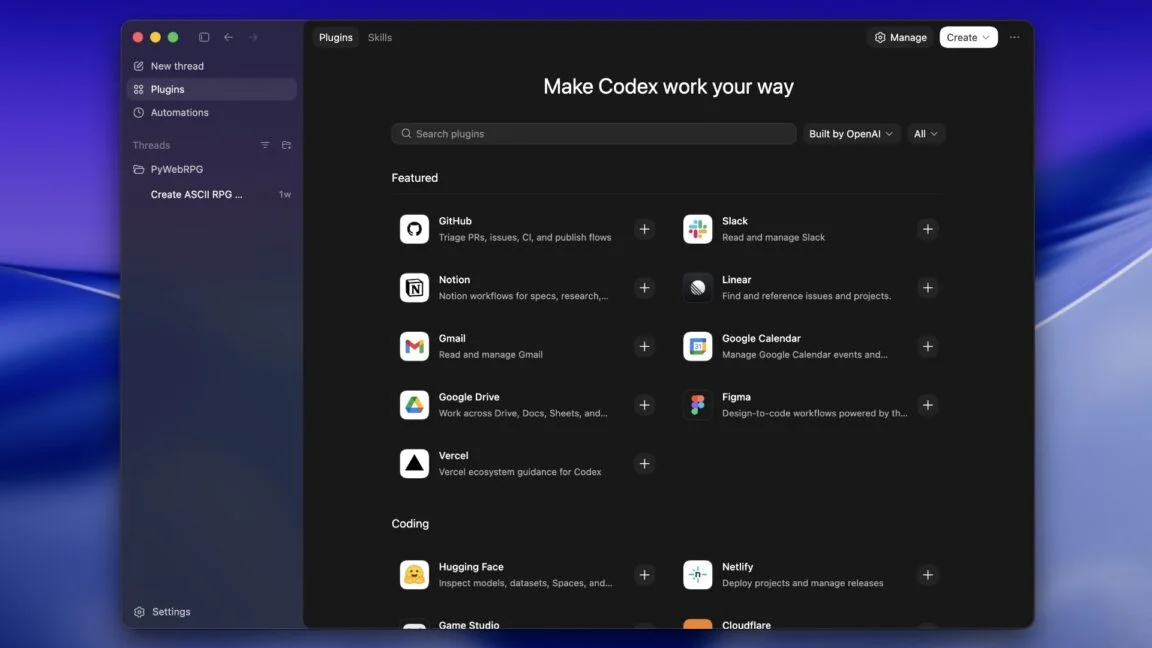
Starting today, there's a dedicated Plugins section inside the Codex app — a searchable library where you can install bundles that connect Codex with external services. The initial lineup includes GitHub, Gmail, Box, Cloudflare, and Vercel. One-click installation, no manual configuration required. This is the move OpenAI needed to make to stay relevant in the developer tools space.
What exactly are Codex plugins — and what do they do?
The word "plugin" here means something more specific than browser plugins or VS Code extensions. In Codex, a plugin is a bundle that can contain three things: skills, app integrations, and MCP server configurations.
Skills are pre-written prompts that describe specific workflows — things like "review this PR for security issues" or "summarize this GitHub issue and suggest a fix." Instead of typing the same complex prompt every time, you install a plugin and the workflow runs consistently. Every developer in your team who installs the same plugin gets the same workflow behaviour.
App integrations are the connections to external services — GitHub, Gmail, and the others in the launch library. When you install a GitHub plugin, Codex can pull context directly from your repositories, read issues, check PRs, without you copy-pasting anything into the chat.
MCP servers are Model Context Protocol configurations — a standardised way for AI models to connect to remote tools and data sources. If your company runs internal tools on custom MCP servers, you can bundle that configuration into a plugin that your whole engineering team installs once.
The key thing to understand: power users could already do all of this manually with custom instructions and MCP server configurations. Plugins don't unlock new capabilities — they make existing capabilities accessible without expertise. That's actually the entire point. One-click vs. spending 30 minutes figuring out configuration syntax is the difference between most of your team using a feature and almost none of them using it.
How it compares to Claude Code's version
Honest answer: Claude Code got here first, and its plugin/integration marketplace has already seen widespread adoption. The Codex plugin marketplace closely mirrors what Claude Code built — same general concept, similar execution. Claude Code has had the head start and the mindshare advantage in this specific feature category.
Where does Codex stand competitively right now? If you talk to developers at Indian startups, engineering teams, and tech companies, Claude Code has been gaining ground steadily. The combination of Anthropic's model quality, better context handling, and the existing integration features made it the preferred choice for many teams that tried both.
OpenAI clearly knows this. Adding plugins is a direct acknowledgment that the feature parity gap was costing them users. Whether the execution is good enough to win some of those users back depends on how quickly they expand the plugin library and how well the integrations actually work in practice.
The broader move: AI coding tools becoming workflow platforms
Here's the more interesting strategic shift underneath the plugins announcement. Several of the new Codex plugins are only indirectly related to writing code. Gmail integration. Box for document access. These aren't developer-specific tools — they're general knowledge work tools.
What this signals is that companies like OpenAI, Anthropic, and Google are repositioning their "coding assistants" as general-purpose work automation platforms that happen to be especially good at code. The next phase of these tools isn't about helping you write better functions — it's about handling entire workflows that happen to involve code as one component among many.
Think about what a developer at an Indian software services company actually does in a day. They write code, yes. But they also read requirement documents, communicate in Slack and email, update project management tools, review documentation, and cross-reference with cloud infrastructure dashboards. A tool that only helps with the code-writing part is useful. A tool that handles the entire workflow is transformational.
The Gmail and Box integrations in Codex are OpenAI's first real step toward the second category. If those integrations work well, it starts making Codex relevant for the product manager, the technical writer, the engineering lead — not just the developer writing functions.
What this means for Indian developers and tech teams
India has one of the largest developer communities globally, and AI coding tool adoption has been accelerating fast. Indian developers are among the most active users of GitHub Copilot, Codex, Claude Code, and Cursor. The competitive dynamics between these tools matter directly for what you end up using at work.
For individual developers: if you've been using Codex already, the plugins are a genuine improvement to your daily workflow. GitHub integration in particular is immediately useful — being able to pull PR context, review issues, and run security checks through a consistent plugin rather than manual setup saves real time.
For engineering teams and startups: the organizational consistency argument is the strongest one here. When your entire team installs the same set of plugins, workflows become standardised. The intern running the same Codex setup as the senior engineer produces more predictable output. That's a legitimate value proposition for any team above 5-10 people.
For developers considering which AI coding tool to adopt: Claude Code still has the adoption advantage and arguably the more mature plugin ecosystem at this point. Codex plugins launching today means both options are now feature-comparable on this dimension. The actual model quality, pricing, and integration depth matter more now that plugins are table stakes.
TamilTech's take
OpenAI needed to make this move and they made it. Plugins closing the gap with Claude Code is the right call. The question is timing — Claude Code already has significant developer mindshare and an established plugin ecosystem. Catching up in features is necessary but not sufficient to win back developers who've already switched.
The most interesting long-term angle is the non-coding integrations. Gmail and Box plugins suggest OpenAI is serious about positioning Codex as a work platform, not just a code assistant. If the next 6 months brings solid Notion, Jira, Slack, and Google Drive integrations with genuine workflow quality, the story changes substantially. Watch the plugin library expansion rate as the real signal of how committed OpenAI is to this direction.



Comments (0)
Be the first to comment!