


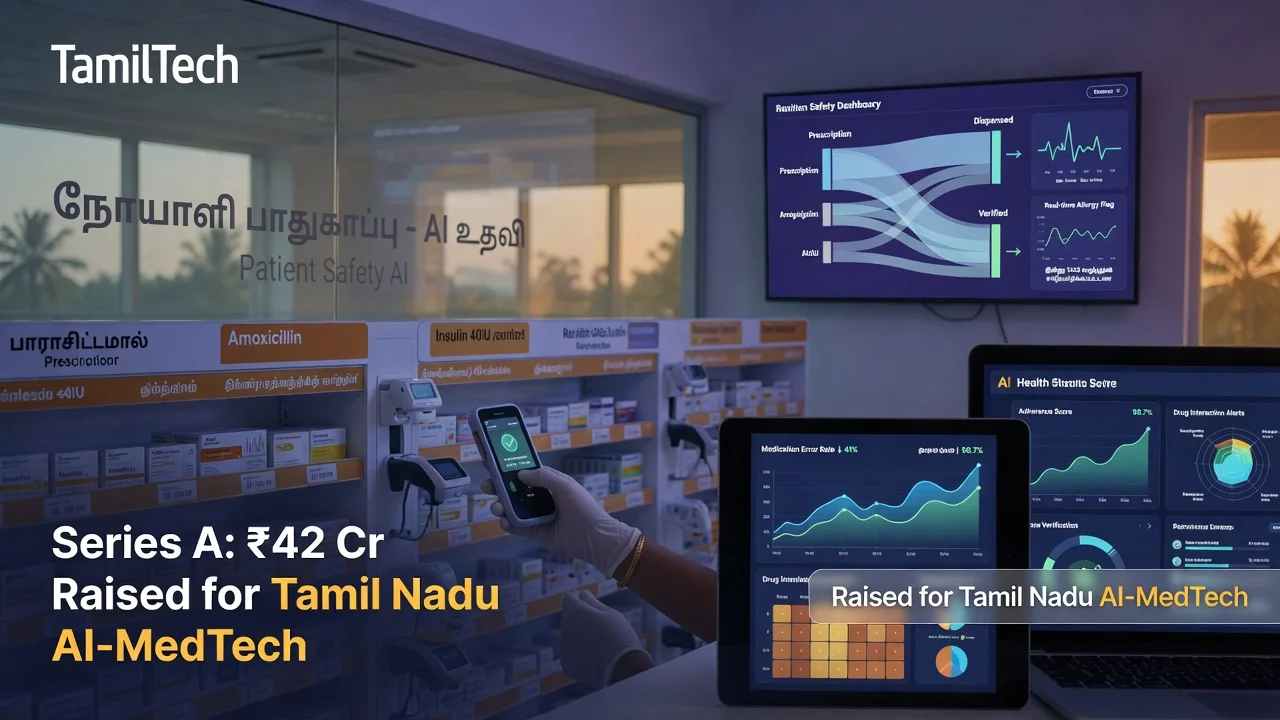
Key Takeaways
- Graph AI secures $13.3 million Series A led by Insight Partners, with Bessemer Venture Partners participating again.
- The round follows its October 2025 seed round, indicating strong investor confidence just a year later.
- Funds will be used to expand AI‑based patient safety platforms across Indian hospitals and select international markets.
- India's digital health market is projected to exceed $50 billion by 2030, offering a large addressable space for such solutions.
- Graph AI intends to connect with existing hospital IT systems using HL7 FHIR standards for seamless data exchange.
What's the news
On 11 September 2026, AI‑focused patient safety startup Graph AI announced the closure of a Series A financing round totalling $13.3 million. The round was led by Insight Partners, with continued participation from earlier backer Bessemer Venture Partners. The announcement arrives roughly twelve months after the company’s seed round in October 2025, highlighting how quickly investors are backing its technology.
Details
Graph AI builds machine‑learning models that continuously analyse data streams from bedside monitors, infusion pumps, and laboratory systems. By detecting subtle deviations from baseline patterns, the platform generates real‑time alerts that clinicians can act upon before an adverse event escalates. The startup emphasizes explainability, providing clinicians with a short rationale for each alert to foster trust and reduce alarm fatigue.
During its seed stage, Graph AI validated the approach in a handful of private hospitals in Bengaluru and Hyderabad, reporting a measurable drop in medication‑error rates during the trial period. The Series A will allow the company to run larger multi‑site studies and to seek regulatory clearances that are required for broader rollout.
The fresh capital will be directed toward product development, expanding the engineering and clinical teams, and funding pilot deployments in tertiary care centres across India. Graph AI says it aims to deepen its integration with electronic health record (EHR) platforms and to broaden the scope of its predictive alerts beyond medication safety to include early warning signs of sepsis and postoperative complications.
To achieve this, the startup is investing in a modular adapter layer that can translate proprietary device formats into standard FHIR resources. This approach reduces the need for hospitals to replace existing equipment while still delivering timely insights.
India impact
Patient safety remains a pressing concern in India’s healthcare delivery. Studies estimate that avoidable adverse events contribute to a significant proportion of inpatient morbidity and mortality, especially in overburdened public hospitals. Digital tools that can flag risks early have the potential to ease the load on clinicians while improving outcomes.
The Indian government's push for a unified digital health ecosystem under the Ayushman Bharat Digital Mission creates a favorable environment for startups like Graph AI. With the nationwide rollout of health IDs and the encouragement of FHIR‑based interoperability, integrating an AI safety layer becomes less technically friction‑heavy.
Infrastructure upgrades such as Jio's 5G rollout promise low‑latency connectivity that can support continuous streaming of device data to cloud‑based analytics platforms. Meanwhile, logistics networks exemplified by Flipkart's health‑care vertical could facilitate the rapid distribution of any hardware components or consumables tied to the solution.
From a market perspective, analysts forecast India’s digital health sector to surpass $50 billion by the end of the decade. A slice of that pie will be allocated to clinical decision‑support and patient‑safety tools, giving Graph AI a sizable addressable market if it can demonstrate clear return on investment for hospitals.
The startup also notes that state‑level health missions in Tamil Nadu, Maharashtra, and Kerala are allocating budgets for AI‑based safety pilots, which could accelerate early adoption in those regions.
Use cases
- Early sepsis detection: The model analyses vital‑sign trends and lab results to raise an alert hours before clinical signs become obvious.
- Medication safety: By cross‑checking physician orders with pharmacy dispensing logs and patient‑specific factors, the system flags potential overdoses or allergies.
- Surgical safety checklist compliance: Real‑time verification that critical steps (e.g., antibiotic prophylaxis, site marking) have been completed before incision.
- Remote ICU support: Smaller hospitals can stream ICU telemetry to a central command centre where Graph AI’s alerts guide on‑site staff or remote intensivists.
- Readmission risk scoring: Post‑discharge, the platform evaluates medication adherence cues and vital‑sign trends to identify patients likely to return.
- Operational efficiency: By highlighting bottlenecks in medication rounds and equipment utilisation, the tool helps administrators optimise staffing and reduce wait times.
Honest take
While the technology shows promise, several hurdles remain. Hospital IT landscapes in India are often a mix of legacy systems and newer modules, making uniform data extraction a challenge. Graph AI will need to invest in robust adapters and possibly offer on‑premise options for institutions wary of sending patient data to the cloud.
Regulatory clearance for AI‑based clinical decision tools is still evolving. The startup must navigate the guidelines issued by the Central Drugs Standard Control Organisation (CDSCO) and adhere to data‑protection norms under the forthcoming Digital Personal Data Protection Act.
Finally, convincing clinicians to trust algorithmic alerts requires transparent performance metrics and a design that minimizes false positives. Over‑alerting can lead to alert fatigue, negating the very safety benefits the tool aims to deliver.
To address these concerns, Graph AI plans to conduct regular training workshops for clinicians and to publish real‑world performance dashboards that update monthly.
Future roadmap
Graph AI intends to use the new funding to hire additional data scientists, software engineers, and clinical specialists. The company plans to open a dedicated research centre in Pune to focus on model explainability and edge‑computing optimisations. Pilot programmes are slated to begin in early 2027 at three government medical colleges in Tamil Nadu, Karnataka, and West Bengal, with the goal of publishing peer‑reviewed results by mid‑2028.
Beyond India, the startup is evaluating opportunities in Southeast Asia where national health‑digital strategies are gaining traction. Any international expansion will follow the same compliance pathway, ensuring that local data‑protection laws are met before deployment.





Comments (0)
Be the first to comment!