


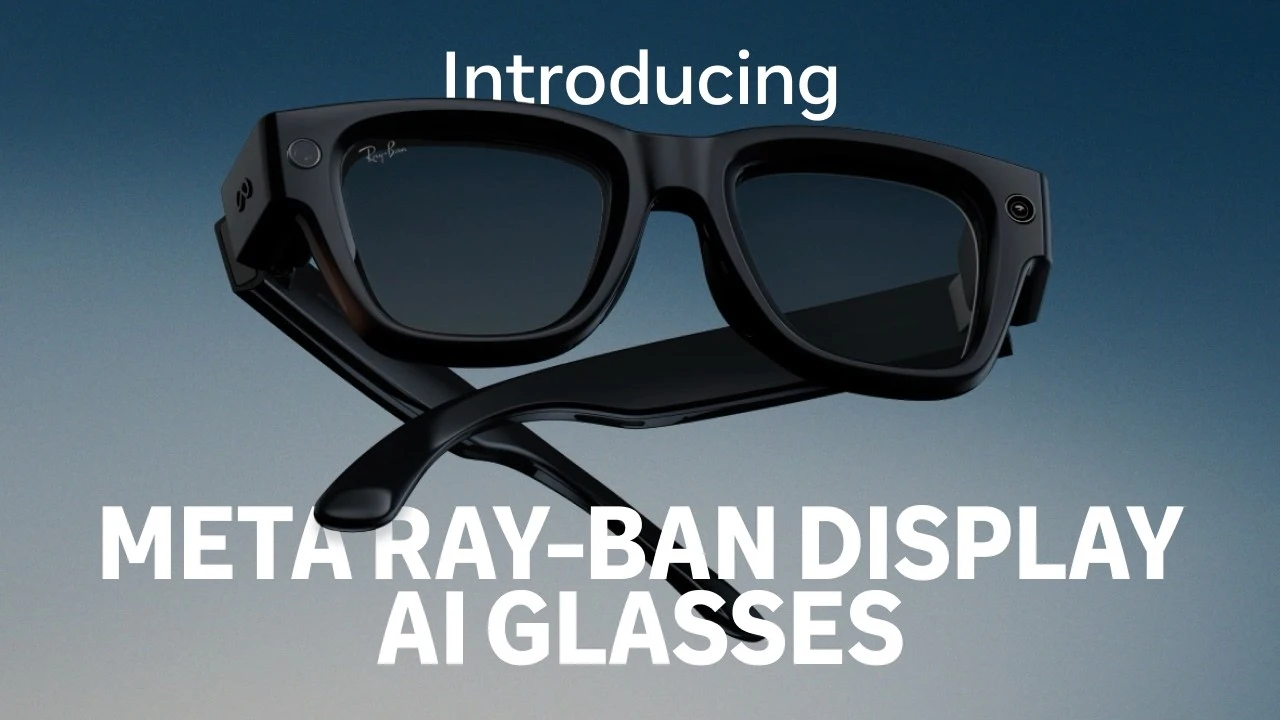
The reason most people haven't bought AI glasses — and Meta's about to fix it
Here's the obvious problem with AI smart glasses that nobody talks about enough: most people who wear glasses aren't wearing them by choice. They wear them because they need vision correction. And until now, AI glasses like the Ray-Ban Meta series were designed primarily for people with perfect or near-perfect vision — people who don't need prescription lenses to see properly.
That's a massive chunk of the potential market locked out. Globally, over 2.2 billion people have a vision impairment or use corrective lenses. In India alone, an estimated 550-600 million people have some form of refractive error. You can technically add prescription lenses to the existing Ray-Ban Meta glasses, but they weren't specifically engineered for that use case.
Meta is about to change that. Two new Ray-Ban Meta smart glasses models — internally codenamed Scriber and Blazer — are reportedly set to launch within days, specifically designed for people who need prescription lenses. This isn't a next-generation product with new AI capabilities; it's a prescription-first design approach on the existing hardware platform.
What we know about Scriber and Blazer
The two models come in different form factors: a rectangular style and a rounded style. This mirrors the standard approach in prescription eyewear where people have different face shape preferences that determine frame style. That's not coincidence — it signals Meta is thinking about these glasses from the perspective of an optician's customer, not just a tech consumer.
Both models were spotted in US Federal Communications Commission filings — the regulatory submission required before any wireless product can be sold in the US. Those FCC filings are a reliable advance signal of imminent product launches. They reveal a few technical details: Blazer will be available in a larger size option, and both models will support Wi-Fi 6 UNII-4 band. That last part is notable because existing Ray-Ban Meta glasses don't support this band. Wi-Fi 6 UNII-4 is particularly good at high-speed data transfers, which might be used for livestreaming improvements — one of the features the Ray-Ban Meta glasses already support.
The glasses will be sold primarily through traditional prescription eyewear channels — meaning optometry stores and optical retailers, not just Meta's online store or general electronics retailers. This is a deliberate distribution strategy that puts the product in the physical locations where people go to get their vision corrected.
They're made in partnership with EssilorLuxottica — the company that owns Ray-Ban and operates as the world's largest eyewear manufacturer. EssilorLuxottica's global network of optical retail partners is massive, and that distribution relationship is arguably one of Meta's biggest advantages over any AI glasses competitor entering the market from scratch.
What Zuckerberg has been saying about prescription glasses
Meta CEO Mark Zuckerberg has been unusually direct about the prescription market opportunity during earnings calls this year. His framing was interesting: he compared the moment to when flip phones became smartphones — drawing the argument that just as it was inevitable that every phone would eventually become a smartphone, it's inevitable that most glasses will become AI glasses.
The prescription angle specifically matters to this argument. If AI glasses only work for people who don't need vision correction, they'll always be a niche product. But if they work equally well for the billions of people who already wear glasses daily for vision correction, the addressable market transforms completely. The glasses are already there on their face. Adding AI to something they already wear is a much easier adoption curve than asking someone to start wearing a new device.
Meta's target of producing 10 million Ray-Ban Meta smart glasses by end of 2026 makes a lot more sense if prescription users are included. The non-prescription smart glasses market is genuinely limited by how many people choose to wear glasses aesthetically versus functionally.
What these glasses actually do — a quick refresher
The Ray-Ban Meta glasses are not AR glasses — they don't overlay information on your vision. There's no display. What they have: built-in speakers for audio, microphones for voice commands and calls, a camera for photos and video, Meta AI integration for voice queries, and now the Wi-Fi 6 UNII-4 capability for data transfer.
The practical daily use case: you're wearing glasses you need anyway (for vision correction), and those glasses can play music, let you take hands-free calls, answer voice questions through Meta AI, capture first-person photos and short videos, and soon potentially livestream. All without taking out your phone. That's the value proposition — not AR, not a display, just AI and connectivity embedded in something you're already wearing.
The competition is coming — and Meta needs to move fast
Apple is reportedly planning to launch its own smart glasses — without a display and without AR — as soon as next year. Apple's first glasses are expected to be a wearable audio and AI device similar in concept to what Ray-Ban Meta does now. Apple's distribution through its retail stores and partnership with existing eyewear makers could be formidable once it launches.
OpenAI is also working on hardware that may include smart glasses, following its acquisition of designer Jony Ive's startup. OpenAI entering wearables would put the company behind the most popular AI assistant directly on users' faces.
Meta's advantage right now is that it has years of head start with Ray-Ban Meta, an established user base, EssilorLuxottica's manufacturing and distribution network, and a product that actually works in daily use. Extending that product to prescription wearers before Apple and OpenAI even launch their first glasses is a smart preemptive move.
India perspective — when might this reach Indian consumers?
Ray-Ban Meta glasses are currently available in India through select channels, though pricing in INR and widespread availability haven't matched the US market rollout. The standard Ray-Ban Meta glasses are priced around ₹24,000–₹30,000 in India depending on the variant.
The prescription versions will likely command a premium over standard frames because of the optical prescription work involved — similar to how prescription sunglasses cost more than non-prescription ones. Pricing in India will depend on how EssilorLuxottica's Indian optical retail network prices the product through local optometry chains.
For Indian consumers who already wear prescription glasses and are curious about AI wearables — this is potentially the first genuinely accessible on-ramp. You'd be replacing your current glasses with a pair that does everything your old ones did (vision correction) plus adds audio, AI assistant, and camera capabilities. That's meaningfully different from buying an entirely new device.
The traditional optical retail channel distribution strategy is also well-suited for India, where prescription eyewear chains like Titan Eye+, Lawrence & Mayo, and local opticians have extensive reach into tier 2 and tier 3 cities. If Meta distributes through these channels in India eventually, the accessibility story improves significantly.
TamilTech's take
Meta's prescription glasses move is the single most strategically important product decision they've made in the smart glasses category. Not because Scriber and Blazer are dramatically better hardware — they're not a new generation — but because they remove the fundamental barrier that kept most glasses-wearing people out of the AI glasses market.
The timing against incoming competition from Apple and OpenAI is also smart. When Apple launches its first glasses and gets the inevitable media coverage, Meta will already have the prescription market established. That's a harder position to compete against than if Meta had waited until after Apple entered.
For Indian consumers specifically: watch for availability announcements through optical retail chains. If the price lands reasonably and the prescription integration works smoothly through familiar optometry channels, this could be the AI wearable that finally makes sense for the majority of glasses wearers who've been on the sidelines.






Comments (0)
Be the first to comment!