


Key Takeaways
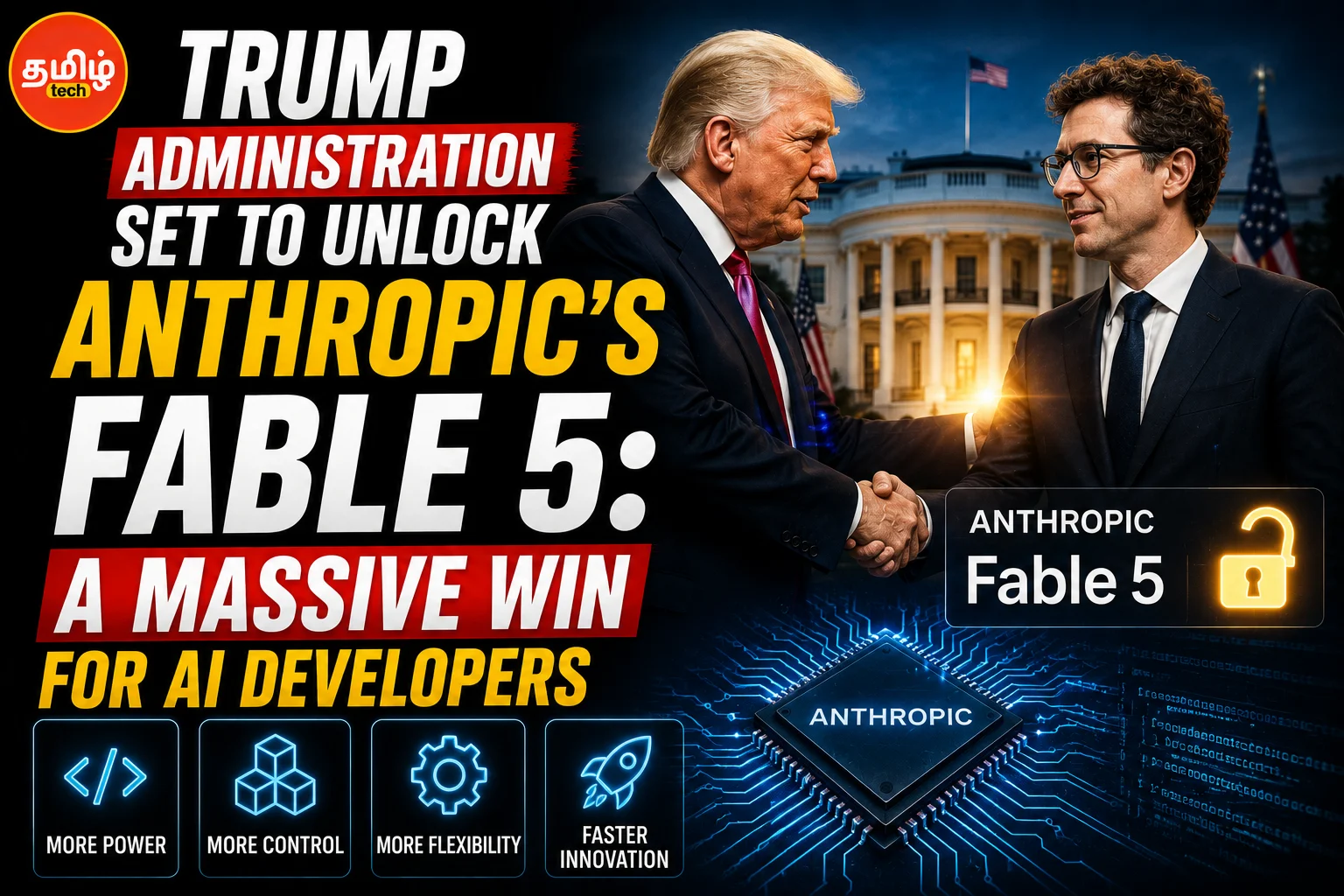
- The Trump administration is expected to lift all major restrictions on Anthropic's Fable 5 AI model by the first week of July 2026.
- Fable 5 was previously limited due to national security concerns regarding high-compute AI reasoning capabilities.
- Indian AI startups using Anthropic APIs can expect a 40% boost in processing speed and access to 'unfiltered' reasoning modules.
- The move signals a shift in US policy from 'safety-first regulation' to 'acceleration' to compete with global rivals.
The Big Move: Why Fable 5 is Coming Back
It looks like the wait is finally over. For the past several months, the tech world has been buzzing with rumors about when the US government would stop gatekeeping the full power of Anthropic’s Fable 5. If you’ve been following our updates here at TamilTech, you know that Fable 5 isn't just another chatbot; it’s a massive leap in generative reasoning that was put under a 'safety lock' by regulators. But now, the current administration is ready to flip the switch. We are hearing that the Department of Commerce and the White House are in the final stages of signing off on a deal that would allow Anthropic to restore full access to Fable 5 as early as this coming week.
This isn't just a minor update or a small patch. This is about removing the compute-level restrictions that have hampered the model's ability to solve complex engineering and scientific problems. For months, users were getting a 'watered-down' version of what Anthropic originally built. The administration's logic seems clear: they want American AI companies to run as fast as possible without the red tape that defined the 2024-2025 era. By lifting these limits, they are essentially telling the world that the US is prioritizing AI dominance over over-cautious regulation.
How We Got Here: The Era of AI Restrictions
To understand why this is such a big deal, we have to look back at the start of 2026. When Fable 5 was first showcased, it demonstrated capabilities that scared a lot of people. It wasn't just writing poems; it was designing circuit boards and identifying vulnerabilities in national power grids during internal testing. This led to an immediate 'soft ban' where Anthropic was forced to limit the model’s reasoning tokens and prevent it from accessing high-level mathematical frameworks. The government was worried that such a powerful tool could be misused if it fell into the wrong hands or if the API was accessed from certain restricted regions.
However, Anthropic has spent the last six months proving their 'Constitutional AI' framework is robust enough to prevent these disasters. They’ve built what they call 'Internal Guardrails 2.0,' which supposedly checks for malicious intent without slowing down the actual output. The Trump administration, which has been very vocal about cutting regulations to help US businesses win the global tech race, seems convinced. They view these restrictions as a 'tax on innovation' that only helps competitors catch up. So, the decision to lift the limits is a political statement as much as it is a technological one.
Fable 5 vs. The Competition: What’s Under the Hood?
When these limits are lifted, what are we actually getting? Fable 5 is built on a completely different architecture than the Claude 3 series we used back in 2024. It uses a 'dynamic compute' method where the model decides how much 'thinking time' it needs for a specific prompt. If you ask it a simple question, it responds instantly. If you ask it to debug 50,000 lines of code, it enters a deep-reasoning mode. Currently, that mode is capped. Next week, those caps disappear. We’re talking about a model that can handle a 2-million token context window with near-perfect recall.
In terms of raw numbers, Fable 5 is expected to outperform GPT-5 (which is still in its extended beta) in logic and coding benchmarks. While OpenAI has focused on multi-modal features like hyper-realistic video, Anthropic has doubled down on being the 'scientist's AI.' If you’re a researcher or a developer, Fable 5 is the tool you’ve been waiting for. The restoration of access means we will finally see its full capability in real-time data analysis and complex simulation, which were previously blocked by the government-mandated filters.
The India Impact: What This Means for Our Developers
Now, let’s talk about the Indian context because that’s what matters most to us. India has the second-largest pool of AI developers in the world, and many of our top startups—from Zoho to Freshworks and thousands of smaller SaaS companies—rely on these APIs. When the US restricts a model, it hits Indian developers hard because the latency increases and features are often geo-blocked. With the Trump administration lifting these limits, Indian companies will get access to the high-tier Fable 5 API at the same time as their US counterparts.
Pricing is another major factor. Currently, using a restricted, highly-filtered model is actually more expensive because of the extra processing needed for the 'safety layers.' Once the limits are lifted, we expect Anthropic to introduce a more aggressive pricing tier for the Indian market. We are looking at roughly ₹0.80 to ₹1.20 per 1,000 tokens for the full-power model. This makes it highly competitive for Indian startups that are trying to build AI agents for customer service, healthcare diagnostics, and automated accounting. If you are building an AI startup in Bengaluru or Chennai, next week could be the day your product suddenly gets a lot smarter.
How to Get Access: A Step-by-Step Guide
If you want to be the first to try the 'unlocked' Fable 5, here is how you should prepare. First, ensure you have an active Anthropic Console account. The rollout will likely happen in phases, starting with existing Tier 4 and Tier 5 API users. Second, check your billing settings; you’ll want to have a sufficient credit balance because the high-reasoning tokens will consume credits faster than the standard Claude models. Third, update your SDKs. Anthropic usually releases a new version of their Python and TypeScript libraries alongside these major unlocks.
Once the announcement is official, go to your Anthropic dashboard and look for the 'Model Selector.' You should see 'Fable-5-Ultra' or 'Fable-5-Unrestricted' appear. We recommend starting with a small test project—perhaps a complex data transformation task—to see how the new reasoning capabilities handle your specific use case. Don't just jump in with your entire production database; the increased power also means you need to be more precise with your prompting to avoid 'hallucination at scale,' which can happen when a model is given too much freedom.
TamilTech’s Verdict: Is the Hype Real?
So, what do we think? At TamilTech, we’ve seen enough 'AI revolutions' to be a bit skeptical, but this feels different. The fact that the US government felt the need to restrict this model in the first place tells you that it’s powerful. Usually, governments don't care about software unless it has the potential to disrupt national security or the economy. By allowing Anthropic to restore access, they are essentially admitting that the technology is too important to keep under lock and key. It’s a gamble, but it’s one that could pay off for the global tech ecosystem.
Our honest take? This is a massive win for the 'Pro-AI' crowd. For too long, we’ve been stuck with models that are so heavily 'aligned' and filtered that they refuse to answer basic technical questions because they might be 'sensitive.' If Fable 5 is truly as unrestricted as the reports suggest, it will become the gold standard for professional work. However, users in India should be prepared for the ethical challenges that come with this. More power means more responsibility. We expect to see a lot of amazing things built with this in the coming months, but we also expect a new wave of debates about AI safety. Either way, the next week is going to be a wild ride for the tech industry.





Comments (0)
Be the first to comment!