


Key Takeaways
- AI investment in Indian enterprises grew 78% YoY in 2025, but average ROI didn’t break even until the third year of deployment.
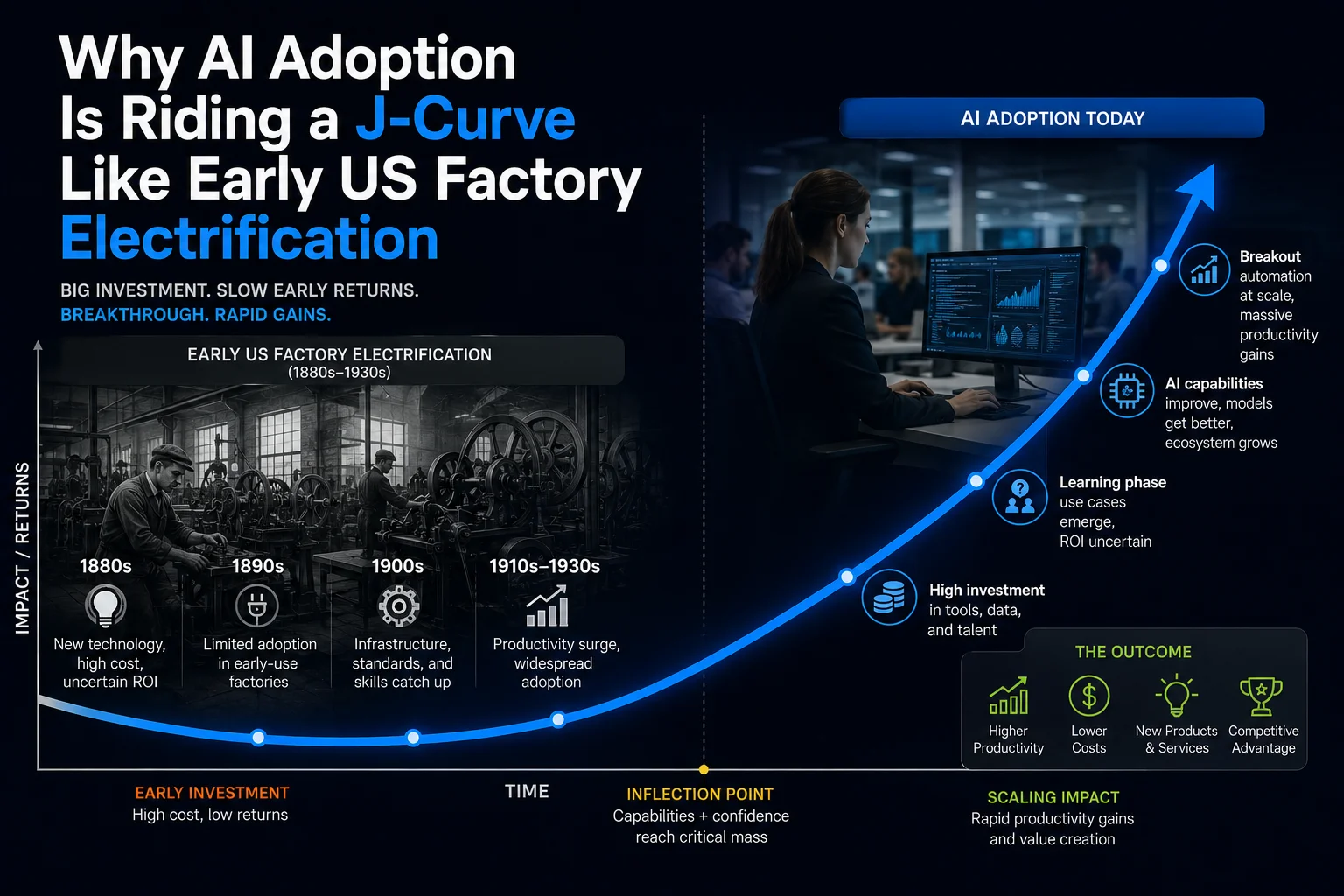
- Early US factories saw a 5‑year lag between electrification spend and productivity gains; AI shows a similar 3‑5 year lag today.
- Mid‑size firms can start seeing measurable cost savings at ₹2‑3 crore annual spend by FY2028 if they follow a phased rollout.
- Bottom line: Treat AI like a long‑term infrastructure project, not a quick‑win hack.
Hook
Picture a factory floor in 1905, wires everywhere, workers grumbling about “new‑fangled electricity”. Fast forward to 2026 – we’re hearing the same chorus about AI. The hype is deafening, but the cash‑flow reality? It’s a classic J‑curve.
What’s the news?
Across India, CEOs are announcing multi‑crore AI budgets. Yet the first‑year numbers are flat or even negative. That’s not a failure – it’s the first dip of the J‑curve that every general‑purpose technology has to endure.
The details
In the 1910s, US manufacturers spent roughly 12% of their capital on electrical wiring and motors. Productivity didn’t spike until 5‑7 years later, when the new power grids finally synced with process redesigns. AI is mirroring that pattern:
- 2023‑2025: Indian firms poured an estimated ₹45 billion into AI licences, custom models and talent acquisition.
- 2026: Average ROI is still negative – about –8% on the first‑year spend.
- 2027‑2028: Companies that paired AI with process re‑engineering start seeing 12‑18% efficiency lifts.
- 2029‑2030: The curve turns upward – profit margins improve by 5‑7% on AI‑enabled supply‑chain and customer‑service functions.
Why the lag? Three reasons:
- Data readiness: Legacy ERP systems need cleaning before AI can learn.
- Talent gap: Skilled data scientists are still scarce in Tier‑2 cities.
- Change management: Workers need time to trust automated recommendations.
Impact on India
For Indian businesses, the J‑curve means two practical steps:
- Allocate at least 3‑5 years of budget for AI, treating it as a core infrastructure expense.
- Start small – pilot a single use‑case like invoice‑processing, measure the KPI, then scale.
Mid‑size firms can expect a break‑even point at around ₹2‑3 crore of annual AI spend, provided they:
- Invest in data‑governance tools (think Collibra, Talend) – roughly ₹50 lakh upfront.
- Hire or upskill 1‑2 data engineers per 10 crore of revenue.
- Partner with local AI service providers (e.g., Niki.ai, Haptik) for rapid prototyping.
TamilTech’s take
We’re not saying “don’t spend on AI”. The upside is massive – personalized marketing, predictive maintenance, and fraud detection can shave billions off Indian P&L sheets. But treating AI like a one‑off software licence is a recipe for disappointment.
Pros:
- Long‑term cost reduction once the models are tuned.
- Competitive edge for early adopters in e‑commerce and fintech.
Cons:
- High upfront CAPEX with delayed cash‑flow benefits.
- Risk of “pilot‑paralysis” if you never move beyond proofs of concept.
Our verdict: Start with a clear ROI roadmap, lock in a 3‑year horizon, and keep the human‑in‑the‑loop governance tight.
What to expect next
By 2028 we’ll see the first wave of Indian unicorns reporting double‑digit AI‑driven margin lifts. Government incentives for AI‑ready MSMEs are also on the table, which should shrink the lag period. Keep an eye on the data‑pipeline market – that’s where the next cash‑flow surge will happen.
Bottom line – if you’re ready to play the long game, the J‑curve will eventually lift you higher than any quick‑win hack ever could.





Comments (0)
Be the first to comment!