


What Is Fibr AI and Why Should You Care?
Imagine visiting a bank's website and instead of seeing the same generic page everyone else sees, the website automatically adapts — showing you home loan options if you're a first-time buyer, or investment products if you're a high-net-worth individual. No clicks needed. The page just knows what you need.
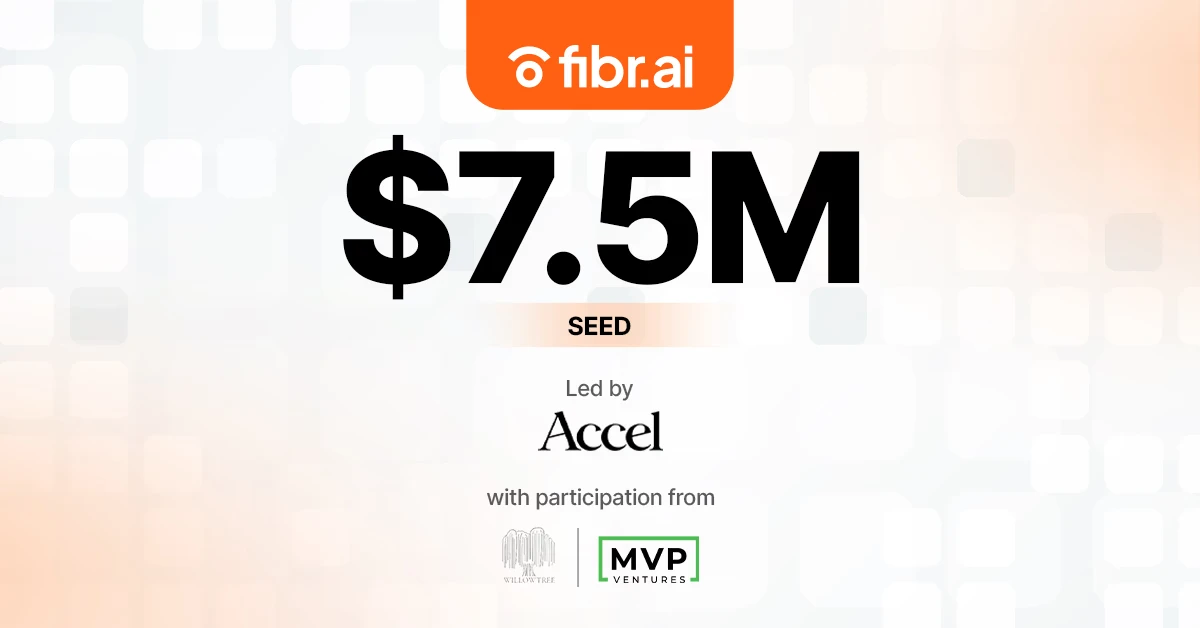
That's exactly what Fibr AI is building. Founded by two IIT alumni, this startup just raised $7.5 million in seed funding led by Accel (one of India's top VC firms, early backers of Flipkart, Swiggy, and Slack). The round also included participation from WillowTree Ventures and MVP Ventures, alongside Fortune 100 operators as angel investors.
What makes this raise notable isn't just the amount — $7.5 million is a healthy seed round by any standard — it's the idea behind it. Fibr is betting on what they call the "Agentic Web" — a future where websites aren't static pages but intelligent agents that respond in real-time.
The Founders: IIT Delhi + IIT Bombay + Stanford
Fibr AI was founded in 2023 by:
- Ankur "AJ" Goyal (CEO) — IIT Delhi alumnus, Stanford Graduate School of Business (GSB) graduate. Before Fibr, AJ worked in enterprise tech and identified a fundamental gap: websites hadn't evolved despite AI transforming everything else.
- Pritam Roy (CPO) — IIT Bombay graduate with deep expertise in product development and AI systems. Pritam focuses on building the core platform that powers Fibr's intelligent website layer.
The Indian IIT-to-Silicon-Valley pipeline continues to produce world-class founders. From Sundar Pichai (Google) to Aravind Srinivas (Perplexity), and now AJ Goyal and Pritam Roy — IIT alumni are increasingly founding companies that aren't just serving India but redefining entire global categories.
The Problem: Websites Are Stuck in 2010
Think about how much technology has evolved in the last decade. We have AI writing code, self-driving cars, and smartwatches tracking our health in real-time. Yet most websites still serve the same experience to every visitor.
Here's the fundamental disconnect:
| What Exists Today | What Fibr AI Enables |
|---|---|
| Same page for every visitor | Dynamically personalized for each visitor |
| Static content that doesn't change | Content that adapts in real-time based on intent |
| Multiple tools needed (CMS, A/B testing, personalization) | One agentic platform replaces all |
| Websites can't interact with AI agents | URLs become intelligent agents that AI can interact with |
| Manual optimization by marketing teams | Autonomous optimization by AI |
As AJ Goyal explains:
"Every URL operates as a living experience system that understands context and responds in real time — for humans and AI agents alike."
What Is the "Agentic Web"?
This is the key concept that makes Fibr different from traditional website personalization tools. The "Agentic Web" means:
- For Human Visitors: The website recognizes whether you're a new visitor, returning customer, or specific demographic — and adapts the entire experience (layout, content, CTAs, offers) in real-time.
- For AI Agents: As AI assistants (like ChatGPT, Perplexity, or Google's Gemini) increasingly browse the web on behalf of users, Fibr ensures websites can communicate effectively with these AI agents — providing structured, contextual information rather than raw HTML.
Think about it this way — when you ask Perplexity "best savings account in India", it browses bank websites to find answers. Right now, it scrapes static pages. With Fibr's agentic layer, the bank's website could actively serve the AI agent exactly the right information, creating a richer answer for you.
Who's Already Using Fibr?
Despite being a seed-stage startup, Fibr is already serving:
- Fortune 50 banks — Major financial institutions using Fibr for personalized banking experiences
- Global enterprises — Companies across banking, financial services, and healthcare
- High-traffic consumer platforms — Websites handling millions of monthly visits
This is significant. Most seed-stage startups are still searching for product-market fit. Fibr already has enterprise customers including Fortune 50 companies — indicating the product solves a real, urgent problem.
The Funding Details
| Detail | Information |
|---|---|
| Round | Seed |
| Amount | $7.5 million (approximately ₹63 crore) |
| Lead Investor | Accel |
| Other Investors | WillowTree Ventures, MVP Ventures |
| Angel Investors | Fortune 100 operators and advisors |
| Founded | 2023 |
| Headquarters | San Francisco, CA (Indian-founded) |
| Use of Funds | Strengthen agentic AI martech stack |
How Fibr Compares to Existing Solutions
| Feature | Traditional CMS | A/B Testing Tools | Fibr AI (Agentic) |
|---|---|---|---|
| Personalization | Manual, segment-based | Variation testing | Real-time, individual-level |
| AI Agent Support | None | None | Native AI agent communication |
| Setup Complexity | High (dev team needed) | Medium | Low (overlay layer) |
| Optimization | Manual | Statistical testing | Autonomous, continuous |
| Cost | Multiple tools needed | Per-experiment pricing | Single platform |
Why This Matters for Indian Tech
Fibr AI represents a growing trend of IIT-founded startups solving global problems from day one. While the company is headquartered in San Francisco, its DNA is deeply Indian — both founders are IIT graduates, and their approach to building efficient, scalable AI systems reflects the engineering depth that Indian tech talent brings to Silicon Valley.
For Indian entrepreneurs watching this space, the takeaway is clear: the martech (marketing technology) market is estimated at $500+ billion globally, and AI is creating entirely new categories within it. Fibr isn't competing with existing tools — it's creating a new layer that didn't exist before.
Future Scope
- AI Agent Economy: As AI assistants become the primary way people interact with the web, Fibr's agentic layer becomes critical infrastructure
- E-commerce Revolution: Imagine every Flipkart or Amazon product page adapting in real-time to each shopper
- India Expansion: Indian banks and enterprises are likely future customers as the platform scales
- Series A Expected: With Fortune 50 clients and Accel backing, a Series A at $30-50M valuation is likely within 12-18 months




Comments (0)
Be the first to comment!