


Key takeaways
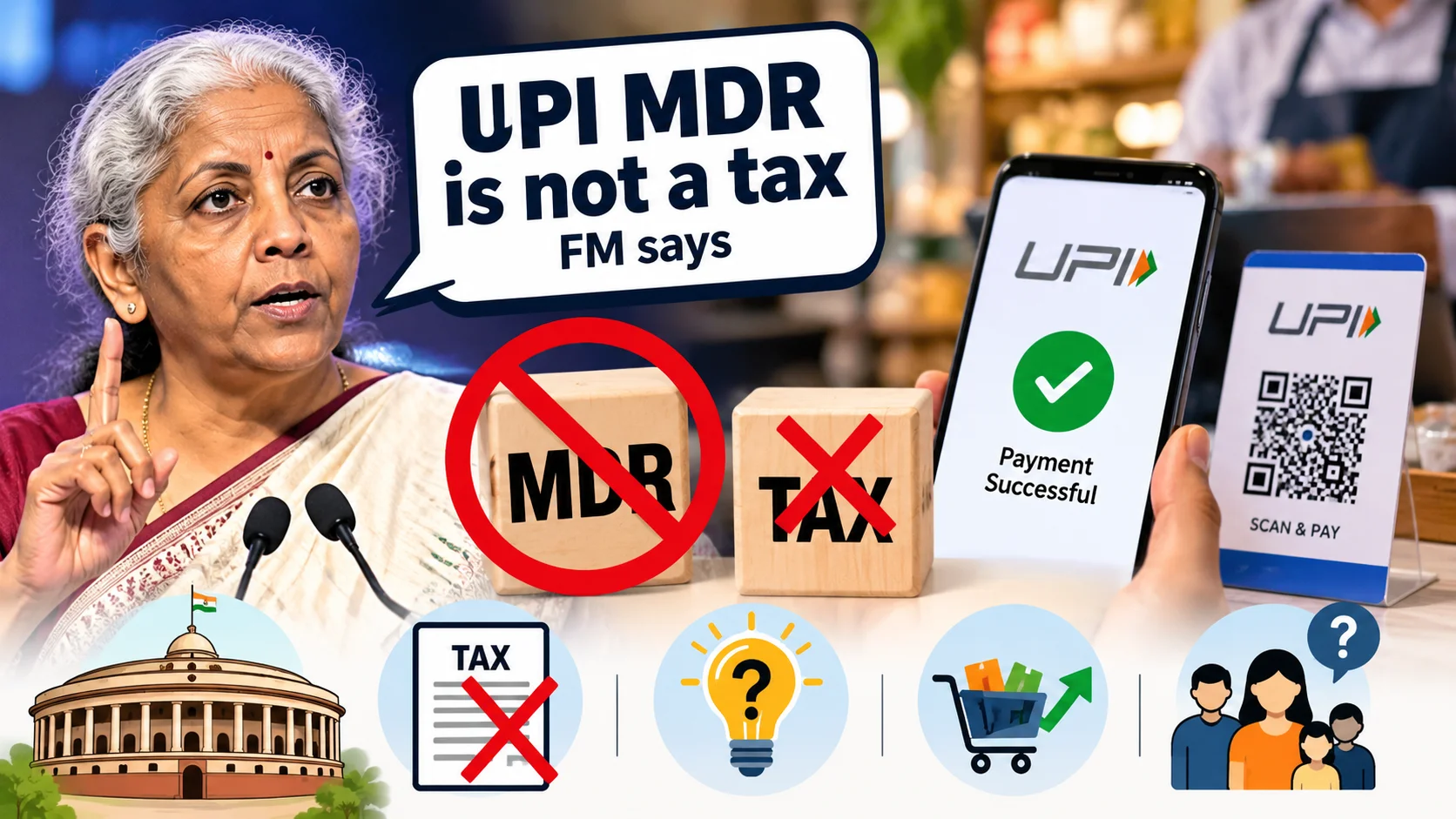
- The Finance Minister has clarified that a proposed UPI Merchant Discount Rate (MDR) is not a tax, cess or surcharge.
- MDR is described as a charge inside the digital payments ecosystem — paid among players who make the transaction work.
- Entities in that loop include payment service providers, the merchant’s bank and other UPI participants.
- Official line: this should not burden consumers on everyday UPI spends.
- For shoppers, the practical question is whether merchants quietly bake any cost into prices — watch small kirana and online checkouts, not just the UPI app screen.
What just happened?
You open GPay or PhonePe, scan a QR, pay for groceries, done. That muscle memory is why any UPI fee headline hits hard. The latest noise is about a proposed Merchant Discount Rate on UPI. People heard “rate” and “charge” and immediately thought: is the government taxing my chai payment now?
The Finance Minister’s answer is blunt. This MDR is not a tax. Not a cess. Not a surcharge. It sits inside the digital payments ecosystem as a charge among the parties that actually move the money.
In simple terms, the state is saying: we are not slapping a new government levy on your UPI tap. The conversation is about how banks, apps and other rails get paid for keeping those free-feeling payments alive.
That distinction matters. A tax shows up as government collection. MDR, as framed here, is industry plumbing money — the fee layer that card payments always had, and that UPI largely soft-pedalled for years to drive adoption.
How does this actually work?
MDR sounds scary until you break the letters.
Merchant Discount Rate, அதாவது the small cut that traditionally sits on a digital sale. On cards, you already lived with this idea even if you never saw the line item. The shop’s bank, the card network, the payment gateway — someone takes a thin slice so the swipe works.
UPI made India forget that slice. Scan, pay, zero drama. Adoption went vertical. Kiranas, street carts, school fees, rent splits — UPI became the default rail.
But free for the user does not mean free to run. Every UPI hit still touches payment service providers, the merchant’s bank, switches, fraud checks, settlement, customer support when a payment hangs at 11 pm. Those are real costs in INR, not vibes.
So the proposed MDR, in the Finance Minister’s framing, is that ecosystem charge. It is levied by the entities facilitating the UPI transaction — payment service providers, the merchant’s bank and other participants in the chain — not billed as a tax to your PAN.
Think of it like the commission layer behind a successful order on a marketplace. You pay the shop. Behind the screen, platforms and banks settle who owes whom. You were never meant to see a “UPI tax” line on the phone.
Will some merchants feel a cost? That is the merchant-side question. The official consumer line is different: this structure is not designed as a burden on the person tapping Pay.
Also worth separating three words the FM knocked down:
Tax — government levy on income, goods or activity.
Cess — earmarked government charge for a stated purpose.
Surcharge — extra government add-on, often on top of tax.
MDR, as described, is none of those. It is commercial rail economics inside UPI’s participant stack.
What changes for people in India?
Short version for your daily life: your UPI app is not suddenly a tax counter.
If you are paying a friend, splitting a bill, or scanning a neighbourhood QR, the political message is that consumers are not the target of a new government fee. The charge conversation lives with merchants and the payment companies around them.
Here is where India reality still sneaks in. Merchants run on thin margins. A kirana owner, a salon, a small online seller on Flipkart-style marketplaces — if their bank or payment stack costs tick up, some will absorb it, some will renegotiate plans, and a few may quietly nudge prices.
That is not the same as “UPI tax on consumers.” It is the older story of business cost passing through to MRP when margins hurt. You already see that with packaging, delivery and card MDR in many stores. UPI’s superpower was delaying that pressure while the rails scaled.
For salaried folks paying rent, utilities, school fees or IRCTC-style bookings over UPI, nothing in the FM’s clarification points to a new government line item on those payments. The phone flow should still feel like UPI, not like a toll booth.
For freelancers and small sellers who collect via QR all day, this is more relevant. You will want clarity from your bank or payment app on whether merchant-side pricing changes, what slabs look like, and whether micro-merchants keep softer treatment. That detail will come from product circulars and bank communication — not from panic forwards.
Big chains and serious online merchants already model payment cost as a line in finance. They live with card MDR. UPI MDR talk is them updating a spreadsheet, not rewriting the idea of digital India.
One more India-specific angle: trust. UPI won because it felt public-good cheap. Any fee headline risks a WhatsApp spiral — “Modi tax on GPay,” “every scan ₹2,” pure fiction mixed with half-read news. The FM’s not-a-tax line is partly about killing that spiral before it becomes “fact” at the tea shop.
So what actually changes on Monday morning? Policy clarity more than your balance. The charge, if and when structured, is framed as ecosystem economics. Your job as a user is to watch merchant behaviour and official app/bank notices, not to assume a cess hid inside BHIM.
What should you do now?
No need to delete UPI apps or switch back to cash out of fear. That overreaction helps nobody, least of all small shops that rely on QR.
Do this instead.
Read the difference out loud once: tax versus MDR. Tax goes to government books. MDR, in this telling, is how payment facilitators and banks price the service of moving money to a merchant. When a relative forwards “UPI tax coming,” you can shut it down in one sentence.
If you run a shop or collect customer payments, message your bank relationship manager or check your payment service provider dashboard. Ask whether any UPI merchant pricing change applies to your category, from when, and whether settlement slabs change. Get it in writing. Do not price your menu off a forwarded screenshot.
If you only pay — office crowd, students, parents — watch the QR screen and the final amount. UPI should still show what you owe the merchant. If a store adds a random “digital convenience fee” that was never there, that is a shop policy issue. Ask. Walk away if it feels shady. Plenty of next-door QRs exist.
Keep apps updated. GPay, PhonePe, Paytm, bank UPI apps — fee displays, merchant categories and dispute flows improve through updates. Old APKs are how confusion multiplies.
For family groups, share the plain version: government says this is not tax, cess or surcharge; consumers are not meant to carry it; the charge lives with ecosystem players facilitating UPI. Boring clarity beats viral panic.
And breathe. India’s UPI story is still the envy piece in global fintech chats. Tweaking how merchants and banks sustain the rails is maintenance on a system that already changed how this country pays. Maintenance is not the same as pulling the plug on free-feeling payments.
Bottom line from the desk: the FM drew a bright line — MDR ≠ tax. Your everyday scan-to-pay life is not being redesigned as a revenue gimmick on the consumer. Stay sharp on merchant pricing, ignore dramatic forwards, and let the ecosystem circulars do the heavy lifting when they land.


Comments (0)
Be the first to comment!