


முக்கிய விஷயங்கள்
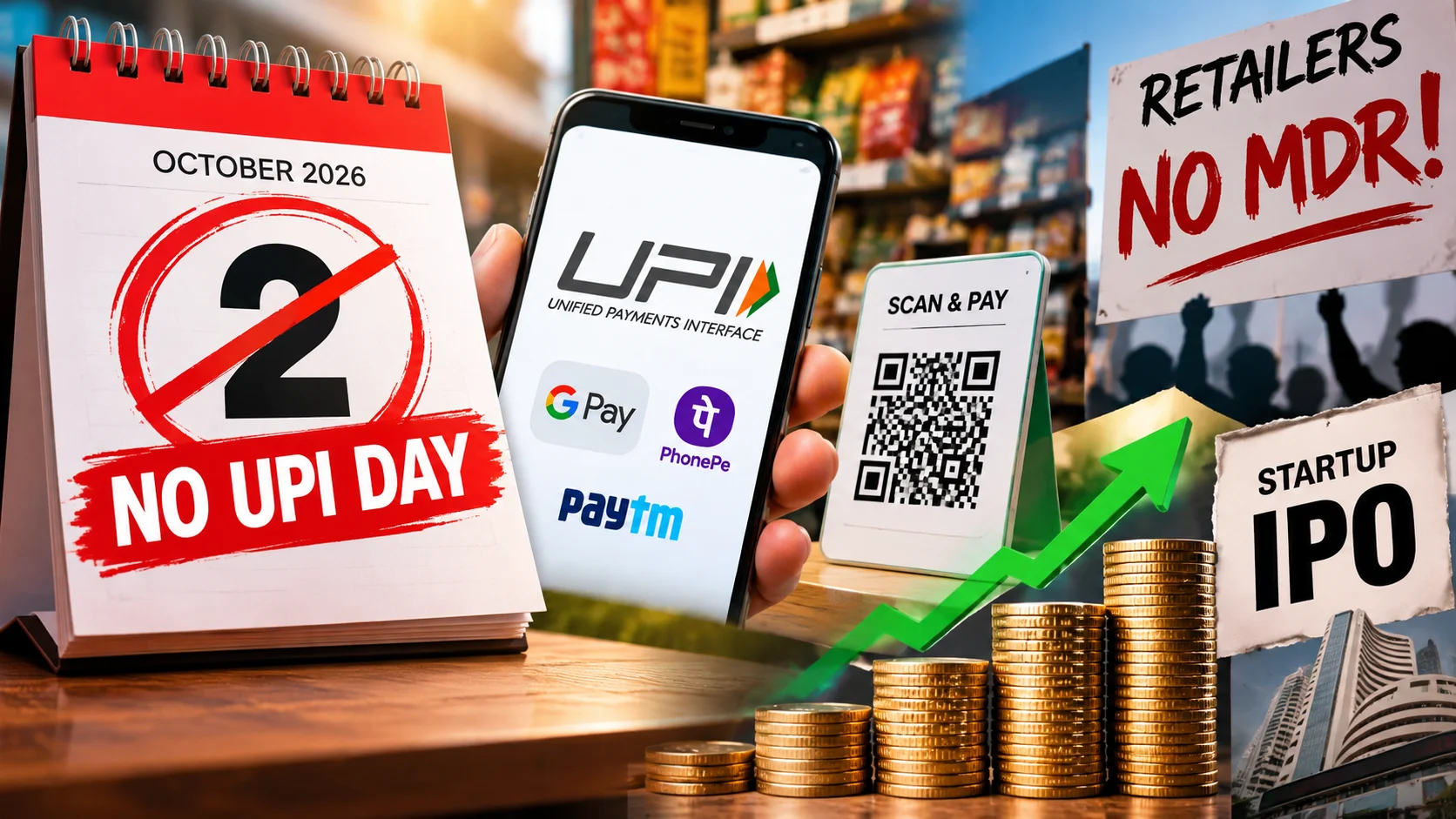
- Retailer groups are pushing a nationwide “No UPI Day” on 2 October 2026 — yes, Gandhi Jayanti.
- The flashpoint is MDR: the small cut merchants pay (or refuse to pay) on digital payments.
- UPI made QR checkout normal across India; a one-day freeze will hit kiranas and customers first.
- Banks and apps argue zero-fee rails are hard to run forever; shopkeepers say any new fee kills thin margins.
- Same week, startup IPO chatter is loud again — public markets want profitable stories, not just growth slides.
- For you: keep cash handy on the 2nd, don’t panic-delete apps, and watch whether this stays a protest or becomes a longer standoff.
What just happened?
You walk into your usual tea stall. Owner points at the QR sticker, then at a handwritten note: “2 Oct — no UPI.” That’s the mood right now.
Retailer bodies are lining up a nationwide “No UPI Day” on 2 October 2026. The date is not random. It’s Gandhi Jayanti, shops are already in holiday rhythm, and a payment boycott on a big public holiday gets attention fast.
This is not “UPI is broken.” UPI still works. The fight is about money under the hood — who funds the rails when you scan and go.
Shopkeepers say their margins are already thin. Vegetables, mobile covers, medical stores, small electronics — many run on 5–10% profit if they’re lucky. Any extra cut on every scan feels like death by a thousand QR codes.
On the other side, banks, payment apps, and infrastructure players have repeated the same point for years: zero-fee merchant UPI is great for adoption, rough for unit economics. Someone pays for servers, fraud checks, support, and settlement. If merchants pay nothing, the cost sits elsewhere.
So you get the showdown in one line: free and famous versus paid and sustainable. Retailers are choosing a loud protest day to force the conversation.
How does this actually work?
MDR. Say it once, then forget the jargon.
MDR means Merchant Discount Rate. அதாவது, when a customer pays digitally, a small percentage can get sliced before the shop gets the money. Cards had this for years. UPI, for a long stretch, made person-to-merchant payments feel “free” at the counter — that was the magic.
Here’s the simple loop. You open GPay, PhonePe, Paytm, or your bank app. You scan the shop QR. Money leaves your account. The shop’s account gets credited. In between sit banks, the UPI network, and app companies. Each layer has a cost. MDR is one way to cover that cost from the merchant side.
Why did zero MDR spread so hard in India? Because it removed the awkward conversation. No “card minimum ₹200.” No “we’ll add 2%.” Grandma could pay the local medical shop. The kirana could accept UPI without doing maths on every ₹40 curd cup.
That habit is now muscle memory. Billions of scans. Small-ticket everything. From chai to college fees to roadside punctures.
The tension starts when free meets scale. At small volumes, a free rail is a growth hack. At India-scale volumes, free becomes a budget problem. Governments have nudged, capped, reimbursed, and debated this for years. The details shift; the core argument does not.
Retailers hear “possible fee” and think: I already pay rent, staff, GST compliance, and spoilage. Don’t tax my QR. Payment companies hear “forever free” and think: we can’t keep building fraud tools and uptime on vibes.
A “No UPI Day” is leverage. One day without scans is meant to show how deep UPI sits inside daily trade — and how angry the counter side is about who bears the bill.
Will every shop join? No. Big chains, delivery-heavy sellers, and city cafes that barely touch cash may quietly keep accepting UPI. The protest heat is highest among trader groups and smaller physical stores that still live on cash-plus-QR.
What changes for people in India?
Here’s the bit you’ll feel before any policy PDF lands.
On 2 October, if your neighbourhood shops join in, the QR may be covered with tape. Cash becomes king again for a day. Some places may take bank transfer as a workaround. A few may still accept UPI and ignore the call. It will be messy, local, and uneven — like most India-wide trader protests.
For customers, the pain is practical, not ideological. You’re used to leaving the wallet at home. Metro cities especially. If the medical shop next door switches off UPI for a day, you need notes, not a thread on who’s right about MDR.
For kirana owners, this is identity plus arithmetic. UPI brought formal payments into informal shops. It also brought chargebacks, wrong transfers, “money sent to wrong UPI ID” dramas, and settlement anxiety. When margins are thin, even a small MDR feels like the app is eating dinner.
For payment apps and banks, a boycott day is a reputation stress test. UPI’s brand is convenience. Anything that makes people associate UPI with conflict is unwanted. They want Delhi, RBI-linked frameworks, and industry bodies to settle the fee question without turning the QR into a political poster.
And yes — the same news cycle is carrying a startup IPO sprint. Different story, same country mood: money wants clarity.
After years of “growth later, profits maybe,” public-market talk in India has been tougher. Investors want cleaner unit economics. Less burn theatre. More path to cash. So while retailers argue about a few paise on a scan, startup founders are arguing about whether their story can survive a prospectus.
Connect the dots loosely, not lazily. Both threads are about who pays for convenience. Cheap checkout for users. Cheap growth for startups. Eventually the bill arrives — at the shop counter or on the IPO roadshow.
What does not change overnight: UPI does not disappear on 3 October. India is not going back to only cash. The rails are too deep inside salaries, refunds, shared autos, temple donations, and school fees. A protest day is a signal flare, not a system shutdown.
What should you do now?
Don’t perform panic. Do a small prep.
If you shop local on 2 October, carry cash. Not a brick of notes — enough for groceries, medicines, fuel if needed, and the unexpected. ATMs see holiday queues; fill up a day earlier if you can.
Ask your regular shops what they plan. Many owners will tell you straight: full boycott, half-day, or “we’re open for UPI, association noise is association noise.” Local reality beats national WhatsApp forwards.
Keep your UPI apps updated, but don’t uninstall anything for politics. Your salary credit, rent transfer, and mutual-fund mandates are not part of a kirana protest. Separate the rails from the one-day counter action.
If you run a small store yourself, decide your lane early. Put a clear board outside. “UPI off on 2 Oct” or “UPI as usual.” Confusion at the counter wastes time and goodwill. If you switch off UPI, make sure you can handle change and card-less customers without a fight.
If you’re a customer stuck without cash, try another shop before you start arguing policy with a busy owner. The person weighing tomatoes is not setting national MDR rules that afternoon.
Watch what happens after the 2nd, not only on it. One-day protests sometimes end as theatre. Sometimes they harden into longer selective refusals. The tell will be whether trader bodies announce follow-ups, and whether fee talk moves from TV panels into actual rule clarity.
For the IPO side of this week’s buzz: if you invest, ignore the noise diet. Read filings when they exist. Prefer businesses that make money the boring way. A sprint to list is not the same as a business that survives a dull quarter.
One last practical note. Scams love confusion. Any “special UPI link to support retailers” or “verify your account before No UPI Day” message is garbage. Real protests don’t need your OTP.
So: cash for the holiday, calm for the apps, patience for the policy fight. The QR isn’t dying. The argument over who funds it just got louder.

Comments (0)
Be the first to comment!