


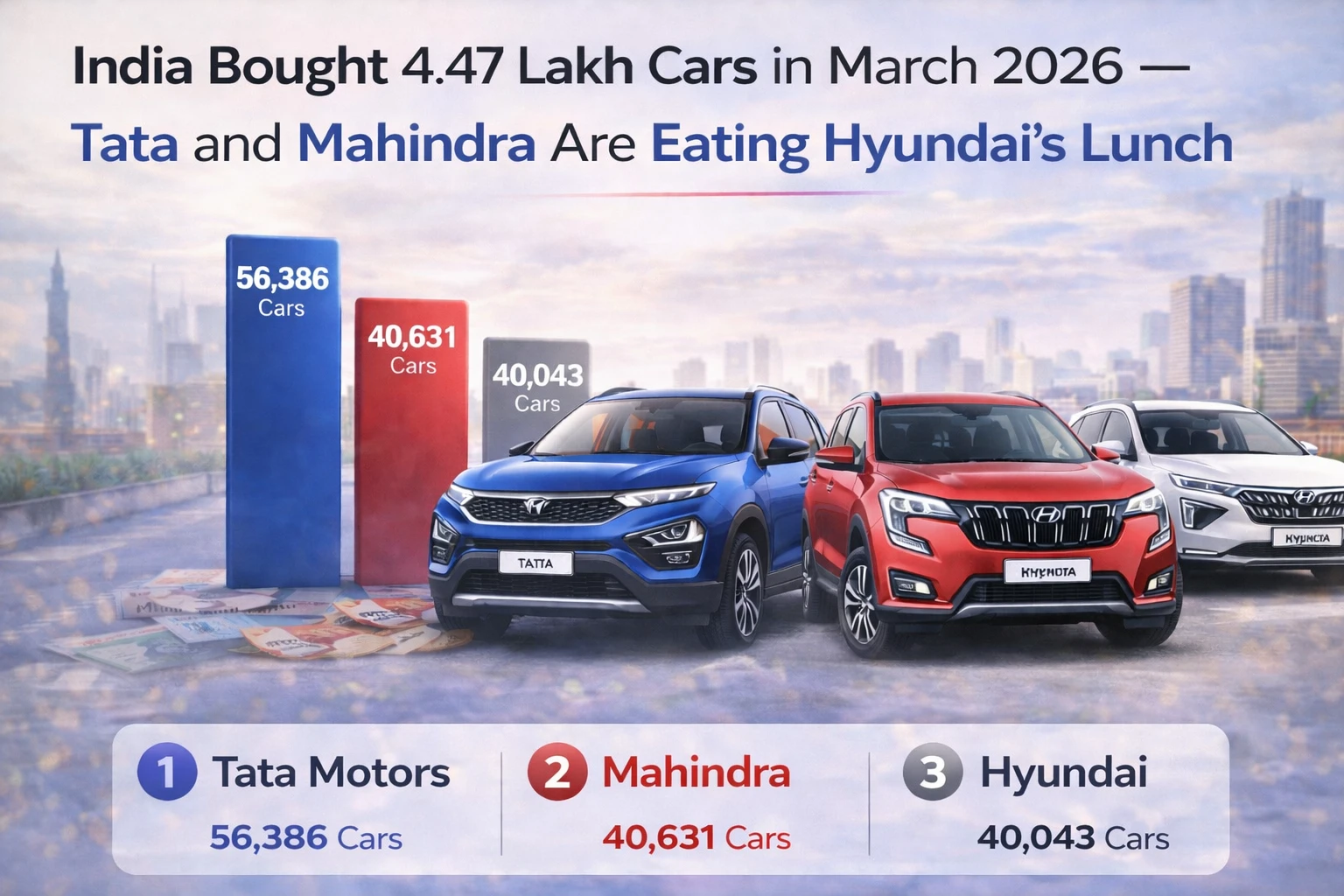
India's car market just closed FY26 with a bang
The numbers are in for March 2026, and they tell a story that every Indian car buyer, auto investor, and weekend showroom browser should read. India dispatched 4,47,702 passenger vehicles in March — that's a 16% jump from the same month last year, and a 6.4% bump over February 2026. FY26 as a whole ended on a record high, with total vehicle dispatches up approximately 10% year-on-year across all categories.
Two things drove this: the SUV boom that just refuses to stop, and the GST 2.0 rate cut that quietly lowered vehicle prices and pushed a lot of fence-sitters into showrooms. If you bought a car in the last three months, you probably felt the impact of that pricing adjustment even if you didn't consciously track it.
Q1 2026 — January through March — added up to 13,20,814 units, a 13% gain over the same quarter last year. That's the strongest Q1 the Indian auto market has seen.
Maruti is still the king, but the gap is narrowing
Maruti Suzuki sold 1,66,219 units in March, holding its number one position comfortably. That's a 10.27% YoY increase — solid, but actually the slowest growth rate among the top five manufacturers. For Q1 2026, Maruti moved 5,01,748 units, growing just 3.42% — significantly below the market average of 13%.
That 3.42% Q1 growth number is worth sitting with. The overall market grew 13%. Maruti grew 3.42%. That means Maruti is losing market share — not dramatically, not in a way that changes its leadership position overnight — but consistently. Its market share in March came in at 37.1%, down 1.9 percentage points from last year. Every percentage point of market share in India's passenger vehicle segment represents thousands of units. Maruti is still dominant, but the challengers are closing in faster than they have in years.
The Brezza, Ertiga, and Swift continue to move in volume. But in the high-growth SUV segment above ₹15 lakh, Maruti's portfolio is thinner than Hyundai, Mahindra, or Tata's, and that's where the industry momentum currently lives.
Tata and Mahindra are the real story of March 2026
Tata Motors sold 66,192 units in March — 28.24% YoY growth. Mahindra sold 60,272 units — 25.44% YoY growth. Both are dramatically outpacing the market average of 16%, and both are eating into Hyundai's traditional position as India's number two car brand.
Tata's EV push is a big part of this. In March alone, Tata sold 9,494 electric passenger vehicles — a 77% jump from the same month last year. The Nexon EV, Tiago EV, and Punch EV continue to dominate India's electric car market at price points from ₹9 lakh to ₹19 lakh, where the charging infrastructure conversation is less intimidating because most buyers use these as city commuters with home charging. For Q1 2026, Tata moved 1,98,653 units with 35.95% growth — the highest growth rate among all major manufacturers.
Mahindra's strength is entirely in the SUV segment, specifically the Scorpio N, XUV700, Thar, and the newer XUV 3XO. The company sold 1,83,800 units in Q1 with 23.25% YoY growth. The Scorpio N continues to be a cult product with waiting periods in several states — Tamil Nadu included, where demand for the 4WD variant has been consistently strong.
Hyundai is growing, but not fast enough
Hyundai sold 55,064 units in March, a 6.26% YoY increase. For a brand that spent years as India's comfortable number two, that growth rate is concerning — not because it's negative, but because the market is growing at 16% and Hyundai is growing at 6.26%. Its market share dropped to 12.3%, down 1.1 percentage points.
The Creta remains Hyundai's bestseller and genuinely one of India's most popular cars at any price point. The Venue holds up in the compact SUV segment. But Hyundai has been slower to add new body styles and new price points than its Korean rival Kia or either of the homegrown brands. With Tata and Mahindra both growing 25-28%, Hyundai needs a product response rather than just refreshes.
Toyota quietly had a great month
Toyota sold 35,168 units in March — 23.95% YoY growth and a sharp 14.42% month-on-month jump. In Q1 2026, Toyota moved 96,535 units, up 19.23%. The Innova HyCross, Urban Cruiser Hyryder, and Rumion are doing real volume, and Toyota's hybrid technology story is resonating with buyers who want better fuel efficiency without committing to a full EV. Fuel prices staying elevated helps Toyota's hybrid pitch significantly.
Kia sold 29,112 units in March (+14.05% YoY). The Seltos continues to be Kia's workhorse — one of the best-selling mid-size SUVs in India consistently. The Syros, Kia's newer compact offering, is showing early demand signals that will be worth watching in Q2 2026.
The brands flying under the radar — Renault and Nissan
The fastest-growing brands in March 2026 weren't the obvious names. Renault grew 77.30% YoY to 5,046 units. Nissan grew 76.39% to 4,408 units. Citroen doubled — technically up 100.25% — to 815 units. These are small base numbers, so the percentage growth looks dramatic. But the direction matters: all three were in decline or stagnation mode for years in India, and they're showing genuine recovery.
Renault's Kiger and the updated Triber are bringing value-focused buyers back. Nissan's Magnite at its price point continues to be one of the best value SUVs on paper in India. If either brand can sustain this momentum through Q2 and Q3, they'll start posing a genuine threat to the bottom of Hyundai's and Kia's lineups.
On the other side: Volkswagen dropped 12.89% to 3,082 units. Jeep slipped 3.74% to just 283 units — at that volume, the Jeep nameplate in India is more brand statement than mass market player.
Skoda and Honda — smaller wins
Skoda sold 7,928 units (+6.82% YoY) but had a strong month-on-month jump of 24.63%. The Kushaq and Slavia continue to find buyers among premium compact segment shoppers who want European build quality at Indian price points. Honda moved 7,585 units (+4.94% YoY) with an even more dramatic 34.75% MoM jump — suggesting a batch delivery pattern rather than consistent underlying demand. MG Motor sold 6,528 units (+18.67% YoY, +31.69% MoM) with the ZS EV and Astor doing most of the work.
What this means for Indian car buyers right now
Three things stand out from these numbers for actual buyers making decisions in April 2026. First, if you're considering a Tata or Mahindra SUV — Nexon, Punch, Scorpio N, XUV700 — waiting times may be longer than the showroom tells you. High demand plus constrained supply means dealers have less incentive to negotiate. Get your booking in early if you're serious.
Second, Hyundai's slower growth may translate into better deals. Brands that are growing below market average typically have more dealer-level flexibility on discounts, exchange bonuses, and finance schemes. If the Creta or Venue is on your list, April and May 2026 may be a good time to push for a better deal than you'd get during peak demand.
Third, Tata's EV numbers — 9,494 units in one month — tell you that the infrastructure conversation around EVs in India has shifted. If you're a city driver in Chennai, Bangalore, Hyderabad, or Pune, the EV case has never been stronger from a total cost of ownership perspective. The Nexon EV Max at around ₹18-19 lakh, or the Punch EV at ₹10-13 lakh, against current petrol prices, works financially for anyone doing 40+ km a day.
TamilTech's take
FY26 closing with a record is genuinely good news for everyone in the Indian auto ecosystem — dealers, manufacturers, component suppliers, and ultimately buyers who benefit from a healthy, competitive market. The structural story is Tata and Mahindra pulling away from the pack while Maruti and Hyundai try to hold position. If that continues through FY27, India's auto market hierarchy could look meaningfully different two years from now. Watch Mahindra's BE 6 EV ramp and Tata's upcoming mid-size SUV — those are the products that could define which brand emerges as the clear FY27 leader.



Comments (0)
Be the first to comment!