


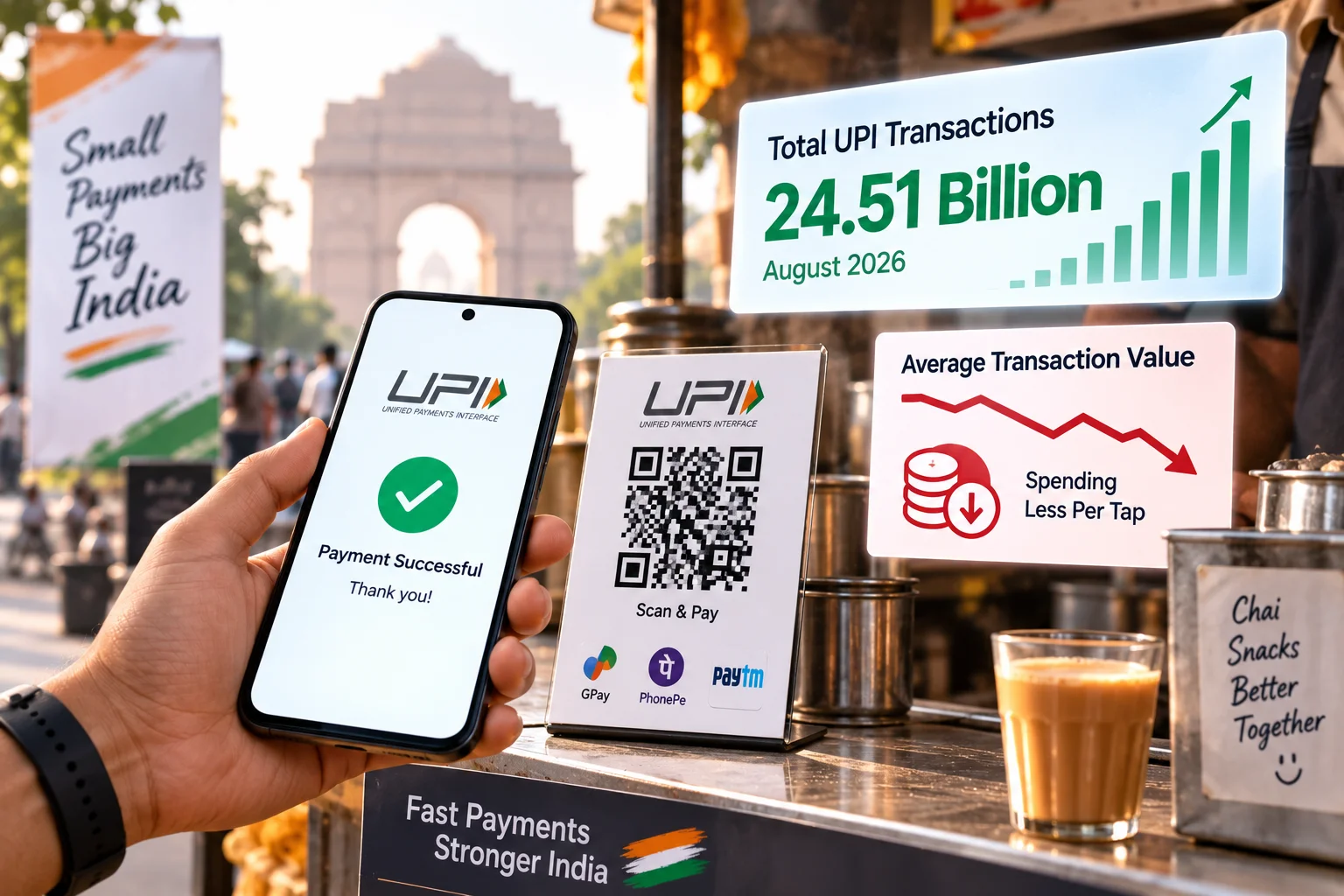
- UPI touched an all-time record of 24.51 billion transactions in August 2026, marking a 3.6% volume jump month-on-month.
- Total transaction value dropped marginally from July, confirming that sub-₹100 micropayments now dominate retail phone payments.
- Growth remains uneven across other payment channels like IMPS, RTGS, and AePS as UPI claims the everyday retail spotlight.
- Server load at commercial banks is accelerating the push toward offline-capable tools like UPI Lite.
What just happened at the billing counter?
Step outside your front door anywhere in Chennai, Bengaluru, or a highway stop in rural Tamil Nadu, and the ground reality is obvious. You buy a ₹12 cup of filter coffee with a quick QR scan. You pay ₹25 for half a kilo of tomatoes at a street pushcart. You scan another QR code on a two-wheeler seat to pay ₹15 for railway station parking.
Those tiny everyday scans added up to a record-shattering milestone in August 2026. UPI clocked 24.51 billion transactions across India in a single month. That represents a 3.6% jump in total volume compared to July.
Look closer at the monthly numbers, and you spot a curious trend. Even as the total count of transactions hit an all-time peak, the overall value of money moving across the network dipped marginally. Indians are picking up their phones and scanning QR codes more times every single day, but they are transferring smaller amounts per scan.
Why did transaction counts go up while total money dipped?
The answer comes down to average ticket size. When UPI launched years ago, people mostly used it for larger peer-to-peer transfers. You split a ₹1,800 dinner bill with friends, paid your monthly house rent, or sent ₹5,000 to a family member in another town. Those were high-value transfers happening once or twice a week.
Today, UPI has killed the need for coins and small currency notes. Features like merchant soundboxes and zero-fee QR displays turned digital payments into muscle memory for buying a ₹5 pack of biscuits or a ₹10 bottle of water. When tens of millions of people do six micro-transactions a day instead of one big transfer, the overall volume counter shoots through the roof while the total rupee sum stays almost flat or slides down a touch.
Seasonal retail patterns also play a role in the August numbers. Big festive sales on platforms like Flipkart and Amazon usually pick up speed heading into autumn. Between major sale windows, consumer spending tilts heavily toward essential daily groceries, local commute tickets, and small roadside purchases rather than big electronics or home appliances.
How are other digital payment systems holding up?
While UPI steals every headline, India's broader digital payment network is seeing split momentum. Different payment rails solve different problems, and they are not growing at the same pace.
High-value channels like RTGS and NEFT continue to handle bulk business transactions, corporate vendor settlements, and property purchases. These corporate rails do not need billions of clicks to move massive wealth. Their volume remains steady because companies rely on them for scheduled treasury operations and payroll processing.
Immediate Payment Service (IMPS) and traditional debit cards, on the other hand, face a noticeable squeeze in the retail consumer space. When you can send money directly from your phone screen to any phone number or bank account without entering an account number, IFSC code, or 16-digit card number, standard card swipes at small retail stores naturally drop.
Aadhaar Enabled Payment System (AePS) tells yet another story. Used primarily across semi-urban and rural areas through business correspondents, AePS volume swings up and down depending on government direct benefit transfer (DBT) schedules, agricultural harvest payouts, and local cash availability. It remains an essential lifeline for doorstep banking, but its trajectory moves to a very different rhythm than urban UPI QR scans.
What does this mean for your daily banking experience?
Processing 24.51 billion transactions in thirty-one days translates to nearly 800 million payment requests handled by Indian banking servers every single day. During peak evening hours between 6:30 PM and 9:00 PM, millions of users initiate transactions simultaneously across supermarkets, metro gates, and food stalls.
That kind of relentless traffic creates real friction on legacy core banking systems. We have all experienced the annoying spinning wheel on our phone screen at a petrol pump or grocery queue, followed by a 'Transaction Pending' status or an unexpected debit without immediate confirmation.
Bank passbooks also take a beating. If you check your statement at the end of the month, scrolling through twenty pages of ₹15 tea payments makes it nearly impossible to audit your actual monthly budget or find important tax-related transfers.
This is precisely why banks and payment apps are heavily pushing UPI Lite. UPI Lite operates as an on-device digital wallet for small-ticket payments under ₹500. It processes payments instantly without pinging your primary bank server in real time, and it keeps your core bank account statement completely clean.
How should you manage your payments to avoid checkout headaches?
With digital transactions becoming the sole way most of us carry money, relying on a single setup is asking for trouble when servers get crowded. A few basic adjustments make your daily checkouts much smoother.
Set up UPI Lite on your primary app for everyday grocery, tea, and parking expenses. Because it does not require entering a PIN for small sums, it takes three seconds at the counter and almost never times out during peak evening hours.
Always maintain a secondary bank account linked to a different UPI app on your phone. If your primary bank runs scheduled maintenance or suffers a network timeout while you are standing at a checkout counter, you can flip to your backup account instantly without holding up the line.
For payments above ₹20,000, plan ahead instead of relying solely on standard merchant QR codes. Check your bank's daily UPI transaction limit, and consider using NetBanking or IMPS for high-value transfers like vehicle servicing or advance rent payments to avoid hitting sudden 24-hour caps.



Comments (0)
Be the first to comment!