


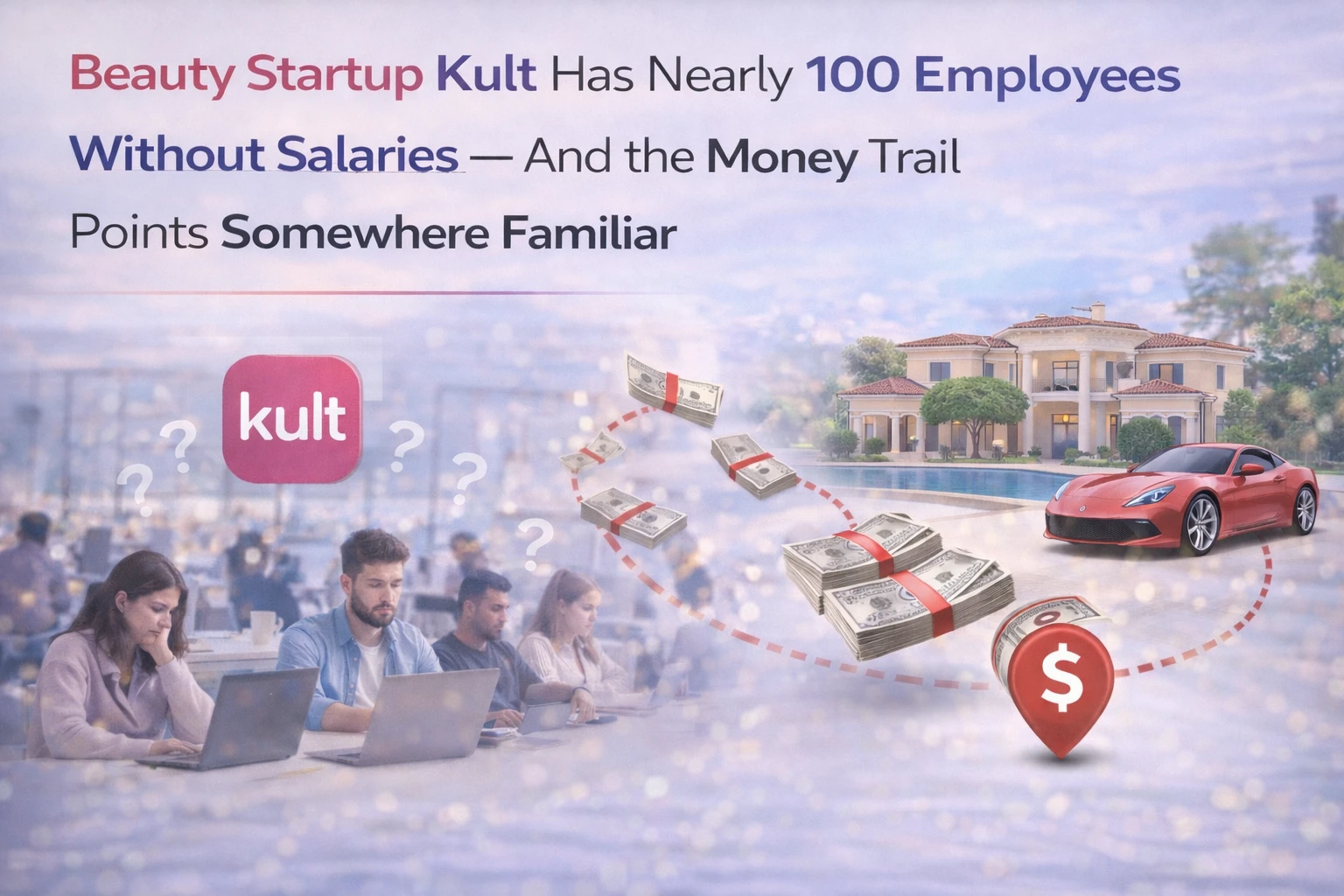
Nearly 100 employees without salaries. The company raised ₹170 crore. Where did the money go?
Kult is an Indian beauty marketplace app — the kind of platform that competes with Nykaa and Purplle for the growing market of Indian consumers buying cosmetics, skincare, and beauty products online. In April 2025, the company announced a $20 million (approximately ₹170 crore) Series A investment round, making headlines in the Indian startup press as a significant vote of confidence for the beauty-tech segment.
It is now April 2026. Close to 100 Kult employees have not received their salaries since November 2025 — some for four months or more. Brands and vendors who listed products on the platform have not been paid either. Employees have publicly described being unable to pay their children's school fees, cover medical expenses for sick family members, or afford rent. Some have had to vacate their homes. The company's FY25 financial results show a revenue of ₹27.5 lakh against a loss of ₹3.2 crore — which is to say, this was a business generating almost no revenue while burning through significant cash.
The $20 million round. ₹27.5 lakh in annual revenue. 100 employees without salaries. Something doesn't add up — and the gap between them is the story.
Who are the people at the centre of this?
Kult is led by Karishma Singh as CEO. Her husband is Rahul Yadav, a name that carries significant baggage in the Indian startup ecosystem. Yadav was previously the founder and CEO of Housing.com, one of India's early real estate tech platforms that raised substantial venture capital, went through a highly public implosion in 2015 involving Yadav's removal by investors after a series of controversial decisions, and ultimately ended up being acquired. Since then, Yadav has been associated with several ventures that have followed similar patterns: raise capital, grow quickly, leave employees and vendors unpaid, rebrand or fold, and resurface in a new avatar.
The most recent venture before Kult was Broker Network — a real estate-adjacent startup — which also left hundreds of employees unpaid when it collapsed. Kult was an entity connected to the Broker Network web of companies, and investigations at the time identified Singh as a key figure in that structure. When Broker Network ended badly, Kult continued — with a new entity, Kult E-Commerce Private Limited, incorporated in 2024 to hold the brand's intellectual property and trademarks.
By this point, over 200 employees across successive Yadav-linked ventures have gone through this experience — joining a company, working, and then going unpaid as the entity implodes. Info Edge, the investor behind Zomato and Policybazaar, was also caught up in the previous cycle of this saga.
The ₹170 crore funding question
The April 2025 funding announcement described a $20 million Series A investment, primarily from M3M India — a major real estate conglomerate. This is the number that circulated in startup media. What appears to have actually been transferred into Kult's operations was significantly less — the widely publicised round appears to have translated into a much smaller capital infusion, creating a gap between the narrative Kult presented to the market and the actual liquidity available to run the business.
M3M India has since publicly distanced itself from Kult's operational situation, stating that management, daily operations, and payroll decisions were the founders' responsibility — not the investor's. M3M has also initiated an independent audit through a firm called Ashwath Partners to review Kult's assets, financial position, and how the invested funds were actually used. M3M describes itself as a "victim" in this situation.
Allegations from employees and those familiar with Kult's finances suggest the following approximate picture of dues when the company effectively stopped functioning: over ₹15 crore in unpaid employee salaries, over ₹15 crore in interest-free loans extended to Rahul Yadav's advisory company RY Advisory, and more than ₹5 crore in unpaid GST and TDS obligations — total dues approaching ₹40 crore or more. Karishma Singh has denied Yadav's connection to Kult E-Commerce, the new entity set up to take control of the app and intellectual property.
The employee experience — what actually happened to the people
The public voice that brought the situation to widespread attention was Adyasha Roy Tomar, Kult's former head of creative and brand communications. She left the company and posted publicly on LinkedIn describing months of unpaid salaries, internal favoritism — specific employees described as "favorites" of the CEO who continued to be paid while the majority went without — and was subsequently offered what she described as hush money to remove her original post. She declined and went on to describe the situation in more detail.
Employees who hadn't been paid took their appeals directly to M3M management via Instagram Stories — a measure of how few conventional channels were working. The fact that employees were posting on Instagram asking investors to release their pending salaries describes a situation with completely broken internal governance.
The cumulative losses at Kult by FY24 had already reached ₹121.3 crore against total revenue of approximately ₹10 crore across three financial years. A business with that loss-to-revenue ratio was not a company in a difficult patch. It was a business model that was fundamentally unsustainable from the beginning.
Why this matters for the Indian startup ecosystem
The Kult situation isn't just a story about one company failing. It's about a pattern that has now repeated multiple times through entities connected to the same individual, each time catching new employees, new investors, and new vendors who were apparently unaware of the preceding chapter.
For Indian professionals considering joining startups, this story serves as a pointed reminder about due diligence. Salary delays at early-stage startups are not uncommon — cash flow management is genuinely difficult. But four months of non-payment, affecting close to 100 employees simultaneously, with evidence of selective payment to "favorites" while others went without, is not a cash flow problem. It's a governance failure of a different order.
Practically, employees should know that unpaid salaries in India are legally recoverable through the Labour Court under the Payment of Wages Act, 1936 and the Industrial Disputes Act. The process is not fast, but employees who document their employment, salary terms, and non-payment have legal recourse. Filing complaints with the Regional Labour Commissioner is the starting point. Employment lawyers offer initial consultations — many free — on salary recovery cases.
For Indian investors, the Kult story raises a question about the due diligence standards applied when investing in founders with documented previous experiences of leaving employees and vendors unpaid. M3M's post-collapse positioning as a victim will face scrutiny — significant investments typically come with governance oversight rights that, if exercised, would have surfaced the financial situation earlier.
TamilTech's take
Every few months, a story like Kult's surfaces in the Indian startup press. The specific details vary — the sector, the investor, the amounts — but the structure is the same: aggressive fundraising narrative, unsustainable unit economics hidden by that narrative, employees and vendors absorbing the cost when the cash runs out, and founders who resurface in new entities to run the cycle again. The Indian startup ecosystem has produced genuine, world-class companies. It has also produced a smaller set of actors who use the startup funding infrastructure as a vehicle for personal enrichment at other people's expense. For professionals evaluating startup jobs, for vendors deciding whether to list on a startup marketplace, and for investors deploying capital — the Kult pattern is a checklist worth knowing about. Check the founders' track record with previous companies. Check what happened to employees and vendors there. The pattern tends to repeat.





Comments (0)
Be the first to comment!