


Key Takeaways
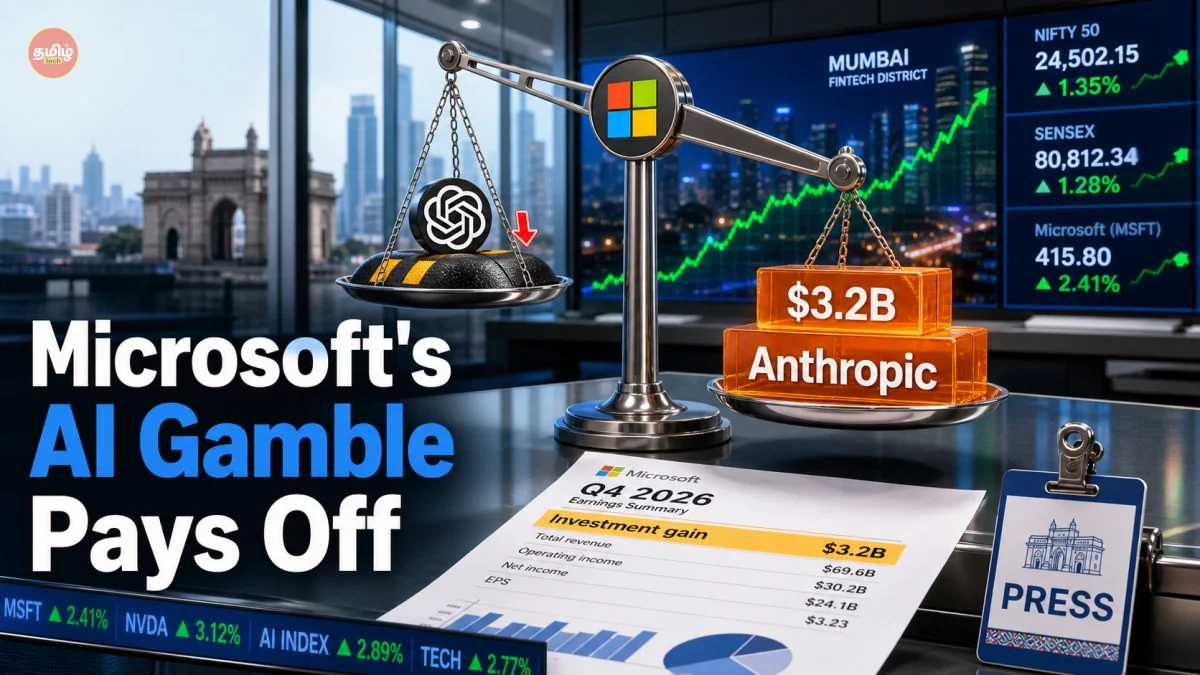
- Microsoft recorded a massive $3.2 billion gain from its investment in Anthropic during Q4 2026.
- The company's OpenAI investment saw a $600 million markdown this quarter, yet remains highly profitable with a $5 billion gain for the full year.
- These numbers reflect a strategic 'dual-bet' approach where Microsoft backs multiple AI frontrunners to dominate the enterprise market.
- For Indian businesses, this means more stable and diverse AI options within the Azure ecosystem, regardless of which individual AI lab leads the race.
The AI Money Game: Microsoft's Masterstroke
So here is the thing—while everyone was busy debating whether the AI bubble would burst in 2026, Microsoft just dropped some numbers that tell a completely different story. We have been tracking their moves for a while now, and it is clear that Satya Nadella isn't just betting on one horse. In their latest Q4 2026 financial report, the numbers are absolutely wild. Microsoft has managed to pull in a staggering $3.2 billion gain from its investment in Anthropic. Yes, you read that right—billion with a 'B'.
But wait, there is a twist. Their most famous partner, OpenAI, actually saw a markdown of about $600 million this quarter. Before you think OpenAI is in trouble, let's look at the bigger picture. On a full-year basis, the OpenAI investment has still generated a massive $5 billion gain. What we are seeing here isn't a failure of OpenAI, but a rebalancing of the scales. Microsoft is playing a high-stakes game of venture capital inside its own corporate balance sheet, and honestly, they are winning big time.
How Did We Get Here? The 2026 AI Landscape
To understand why Anthropic is suddenly the star of Microsoft's portfolio, we have to look at what happened over the last year. Throughout 2025 and early 2026, Anthropic’s Claude series of models became the darlings of the enterprise world. While ChatGPT stayed the king of consumer hype, Claude focused on being the 'safe and reliable' choice for big corporations. This strategy has clearly paid off. As Anthropic's valuation soared in the private markets, Microsoft’s early stake ballooned, leading to that $3.2 billion paper gain we are seeing now.
On the other hand, the $600 million markdown for OpenAI in Q4 is mostly a technical accounting adjustment. In the world of finance, when a company's valuation fluctuates or when the costs of running massive server farms (like the ones powering GPT-5 and beyond) are calculated, these 'mark-to-market' adjustments happen. It doesn't mean OpenAI is losing money in the traditional sense; it just means the estimated value of Microsoft's specific stake was adjusted downward for this specific three-month window. When you look at the $5 billion gain for the whole of 2026, it’s clear that OpenAI is still the crown jewel.
The Multi-Model Strategy: Why Microsoft is Hedging
Look, everyone’s hyped about OpenAI, but let me tell you what they’re NOT telling you: Microsoft is terrified of being too dependent on a single partner. Remember the chaos in late 2023 when Sam Altman was briefly ousted? That was a wake-up call. Since then, Microsoft has been quietly funneling resources and cloud credits into other AI powerhouses like Anthropic and even Mistral. By doing this, they ensure that no matter who wins the 'AGI' (Artificial General Intelligence) race, the winner will be running on Azure servers.
This 'dual-bet' strategy is brilliant because it creates a win-win scenario. If OpenAI launches a revolutionary new model, Microsoft wins. If Anthropic's focus on 'AI Safety' attracts all the big banking and healthcare clients, Microsoft wins again. The $3.2 billion gain from Anthropic proves that there is plenty of room for multiple giants in this space. They aren't just an investor; they are the landlord of the entire AI industry, charging rent in the form of cloud computing fees.
What This Means for India and the Local Tech Scene
Now, why should you care about this in India? Well, the ripple effects are huge. Most Indian startups and IT giants like TCS, Infosys, and Wipro are heavily integrated into the Microsoft Azure ecosystem. When Microsoft’s AI investments flourish, it translates to better, faster, and more affordable AI tools for Indian developers. We are seeing a massive shift in Bengaluru and Hyderabad where companies are moving away from building their own basic models to leveraging these 'Big AI' APIs.
Furthermore, the competition between Anthropic and OpenAI—both funded by Microsoft—is driving down the cost of AI tokens. For an Indian startup operating on tight margins, a 20% drop in API costs because Anthropic and OpenAI are fighting for dominance is a massive win. Whether you are using AI for customer support in Hindi or automating code for a US client, the stability of these investments ensures that the tools you rely on aren't going anywhere. We expect more India-specific localized models to emerge from this well-funded ecosystem by the end of 2026.
TamilTech's Take: The Bottom Line
Honestly, I think Microsoft has played the smartest game in tech history. While other companies are trying to build everything in-house, Microsoft is acting like the ultimate VC. The $600 million markdown on OpenAI is just a tiny blip—a rounding error for a company of this size. The real story is the $5 billion yearly gain from OpenAI and the $3.2 billion surge from Anthropic. They have successfully diversified their risk.
What should you expect next? Expect Azure to become even more 'model agnostic.' You won't just go to Azure for GPT; you'll go there for the best model for your specific task, whether it's from OpenAI, Anthropic, or someone else. The AI war isn't about who has the best chatbot anymore; it's about who owns the infrastructure where all those chatbots live. And right now, that person is Satya Nadella. If you're a developer or a business owner, the message is clear: don't tie yourself to one model, but definitely keep an eye on how these giants are moving their money.




Comments (0)
Be the first to comment!