


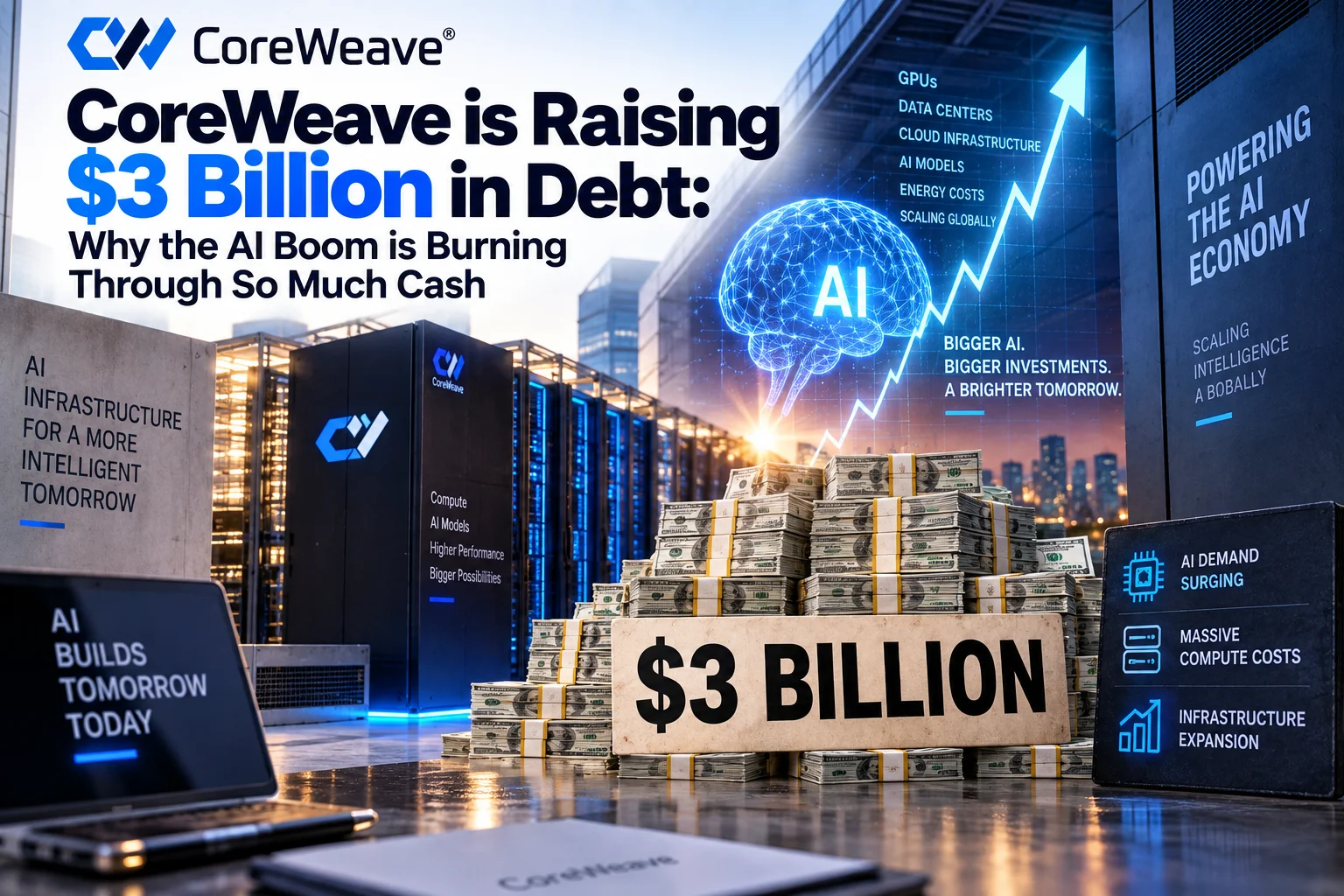
- The Big Raise: CoreWeave is raising $3 billion (around ₹25,000 crore) in convertible debt to fund its expanding AI data center footprint.
- The Backing: Heavy backing and direct chip supply from Nvidia make CoreWeave a top choice for AI labs needing raw compute.
- The Financial Route: Convertible debt lets them grab massive cash today without immediate equity dilution or sky-high bank loan interest rates.
- India Impact: More global compute supply helps ease tight GPU server queues for Indian startups and keeps cloud API costs from spiking further.
What just happened?
Imagine running a rental business where customers are banging on your door day and night, begging to rent your gear. You have the hottest inventory on the planet, but to buy more of it, you need piles of cash that would make a central banker sweat. That is the exact spot CoreWeave finds itself in right now.
CoreWeave, the specialized cloud provider that transformed from an Ethereum mining outfit into Nvidia's favorite AI infrastructure partner, is launching a massive $3 billion convertible debt offering. In Indian currency, that is nearly ₹25,000 crore. That is not petty cash for software patches; it is heavy industrial money meant for one thing: buying thousands of power-hungry AI chips and locking down data center space.
The AI frenzy has not cooled down in 2026. Every foundation model creator, enterprise software maker, and startup wants tens of thousands of GPUs running round the clock. Big tech firms like Microsoft, Google, and Amazon are pouring tens of billions into their own server farms, but specialized cloud providers like CoreWeave have carved out a massive niche by moving faster and securing top-tier Nvidia chips ahead of almost everyone else.
Building these server warehouses is not cheap. A single state-of-the-art server rack stuffed with high-end AI accelerators can run into hundreds of thousands of dollars. Multiply that by thousands of units across multiple global hubs, add liquid cooling systems, power substations, and ultra-fast optical networking, and you see why $3 billion disappears faster than you think.
How does this actually work?
Why choose convertible debt instead of just selling regular company shares or taking a standard bank loan? Think of it like taking a personal loan from a friend with a twist. The friend lends you money today at a relatively low interest rate. If your business takes off and goes public, your friend can turn that loan balance into company shares at a pre-agreed price. If not, you pay back the loan with interest.
For CoreWeave and its existing backers, this structure is a smart shield. If they issued fresh equity right now, existing founders and early venture investors would see their ownership slice get diluted. On the flip side, taking a standard corporate bank loan in today's interest rate climate would saddle them with brutal monthly interest payments that eat away operating profits.
Convertible debt sits right in the sweet spot. Investors eagerly buy these notes because they get downside protection through debt and upside profit if CoreWeave hits a massive public valuation down the road. CoreWeave gets the liquid billions immediately to place massive purchase orders with Nvidia.
Nvidia's close relationship with CoreWeave makes this machinery run. When high-end AI processors are constrained globally, having a direct pipeline to supply guarantees that every data center CoreWeave builds will be filled with paying enterprise clients from day one.
What changes for people in India?
You might wonder why a multibillion-dollar debt sale in North America matters when you are sipping tea in Chennai or coding at a tech park in Bengaluru. The link is direct: cloud compute is the global oil of the software economy right now.
If you build software in India, chances are your product hooks into an AI model somewhere. Whether you are running fine-tuned models for vernacular customer support, processing UPI fraud detection heuristics, or building automated coding agents, your underlying infrastructure bills tie back to global GPU availability. When supply is bottlenecked, rental prices go up, API rate limits drop, and startups in Koramangala or T-Nagar end up burning through their seed funding just to keep their servers alive.
When infrastructure providers like CoreWeave raise billions and bring massive compute capacity online, it prevents a global crunch. More available servers globally means hyperscalers have to stay competitive on pricing. That trickles down to cheaper token costs and more predictable API pricing for Indian software companies.
It also sets a blueprint for Indian data center operators. With massive cloud parks coming up in places like Navi Mumbai, Noida, and Hyderabad, Indian infrastructure players are closely studying how specialized AI cloud providers finance their hardware. The appetite for debt-financed compute expansion is proving that Wall Street and global funds are ready to back hardware-heavy AI bets.
What should you do now?
If you are an engineer, founder, or tech lead building AI-powered features, do not rush into long-term, fixed-price GPU reservations based on fear of missing out. The massive capital pouring into infrastructure means global compute capacity is continuously expanding. Look at dynamic, spot-instance pricing and serverless GPU providers before locking yourself into rigid multi-year server contracts.
Keep your architecture flexible. Avoid hardcoding your entire tech stack to a single closed provider. Build your systems so that if compute rates drop on an alternative specialized cloud, you can switch inference endpoints with minimal friction.
For tech enthusiasts tracking the market, this move is a clear reminder that the AI wave has moved from research labs to pure industrial execution. The companies winning today are not just writing clever algorithms; they are masterfully playing the global finance and hardware supply game.





Comments (0)
Be the first to comment!