


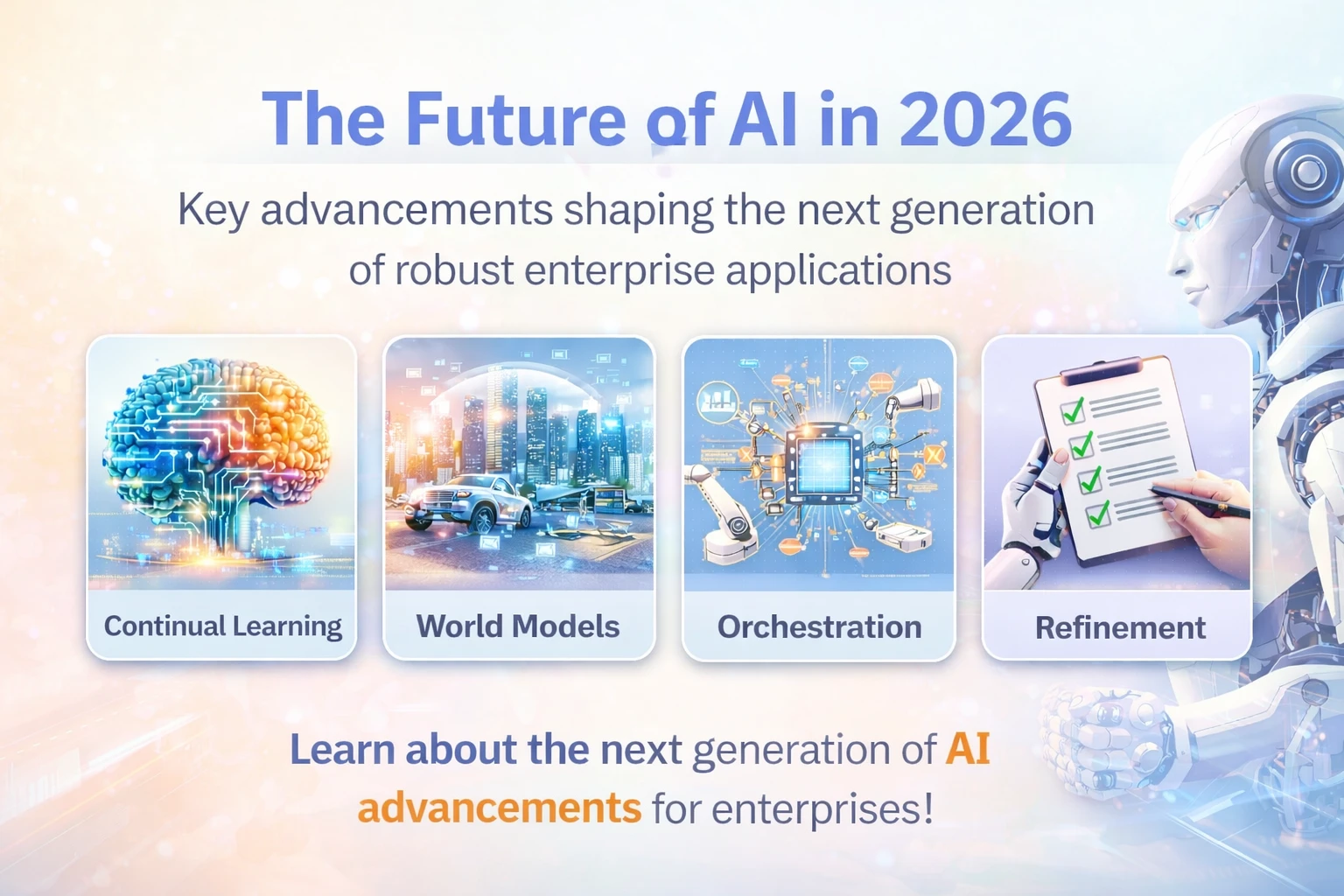
Until now, most conversations about AI have focused on how powerful models are and how well they perform on benchmarks. But as organizations increasingly depend on AI for real business value, the focus is shifting. The real question now is:
How do we turn AI into reliable, scalable production systems?
At VentureBeat, we track research that shows not just how “smart” AI models are, but how the systems around them are evolving. As we look toward 2026, four emerging breakthroughs could define the blueprint for the next generation of enterprise AI.
1️⃣ Continual Learning
One of the biggest challenges in AI today is teaching models new knowledge without erasing what they already know — a problem known as catastrophic forgetting.
Until now, companies only had two options:
- Retrain entire models with old + new data → expensive and complex
- Use external context via RAG → no internal knowledge update + context limitations
Continual learning changes this.
It enables models to:
- Update internal knowledge
- Learn continuously
- Adapt without complete retraining
Google is working on architectures like Titans, which introduce:
- Long-term learned memory
- Online updating during inference
- A more system-like approach similar to caches and logs
In the future, models may intelligently decide:
👉 What knowledge to permanently retain
👉 What to treat as temporary memory
This is a major step toward truly adaptive enterprise AI.
2️⃣ World Models
World Models aim to give AI systems an understanding of the real world, learned directly from experience rather than human-labeled data.
They help AI:
- Handle unpredictable environments
- Make better real-world decisions
- Move beyond text into physical interaction
Current Leading Efforts
✔ DeepMind – Genie
- Simulates environments
- Predicts how actions change the world
- Useful for robotics & autonomous vehicles
✔ World Labs – Marble (Fei-Fei Li)
- Creates realistic 3D interactive worlds
- Uses physics engines
- Supports robot training
✔ Meta – V-JEPA (Yann LeCun)
- Learns world understanding without generating every pixel
- Efficient
- Works on resource-limited devices
- Trained on massive internet video
This opens massive enterprise opportunities in:
👉 Automation
👉 Robotics
👉 Real-time decision systems
3️⃣ Orchestration
Even the most powerful AI models fail in real-world workflows:
- They lose context
- Call wrong tools
- Compound mistakes over steps
The solution?
Treat AI as a system design problem — not just a model problem.
Orchestration builds smart control layers that manage:
- When to use small models
- When to use larger reasoning models
- When to retrieve data
- When to execute tools
Key Examples
✔ Stanford OctoTools
- Tool orchestration framework
- Works without model fine-tuning
- Plans, selects tools, executes tasks
✔ NVIDIA Orchestrator
- 8B parameter controller model
- Decides:
- When to reason
- When to delegate
- When to use tools
- Trained with reinforcement learning
Result?
👉 Higher accuracy
👉 Lower cost
👉 Stronger reliability
4️⃣ Refinement
Refinement transforms AI from:
❌ “Give one answer”
into
✅ “Think → Critique → Improve → Verify”
This structured loop allows AI systems to:
- Reflect on mistakes
- Improve answers
- Validate results
- Operate more intelligently
The 2025 ARC Prize called it:
“The Year of the Refinement Loop”
Poetiq’s refinement system:
- Achieved 54% on ARC-AGI-2
- Outperformed Gemini 3 Deep Think
- Delivered results at half the cost
This shows refinement is not just theory —
It’s a practical breakthrough for real-world AI problem-solving.
How to Read AI Research in 2026
Instead of asking:
“Which model is smartest?”
Enterprises should ask:
“Which systems can scale reliably in the real world?”
Each breakthrough shifts focus:
- Continual Learning → Better knowledge retention
- World Models → Real-world understanding
- Orchestration → Efficient resource management
- Refinement → More accurate decisions
The winners in enterprise AI will not just choose strong models.
They will build the control plane that keeps AI:
✔ Correct
✔ Current
✔ Cost-efficient




Comments (0)
Be the first to comment!