


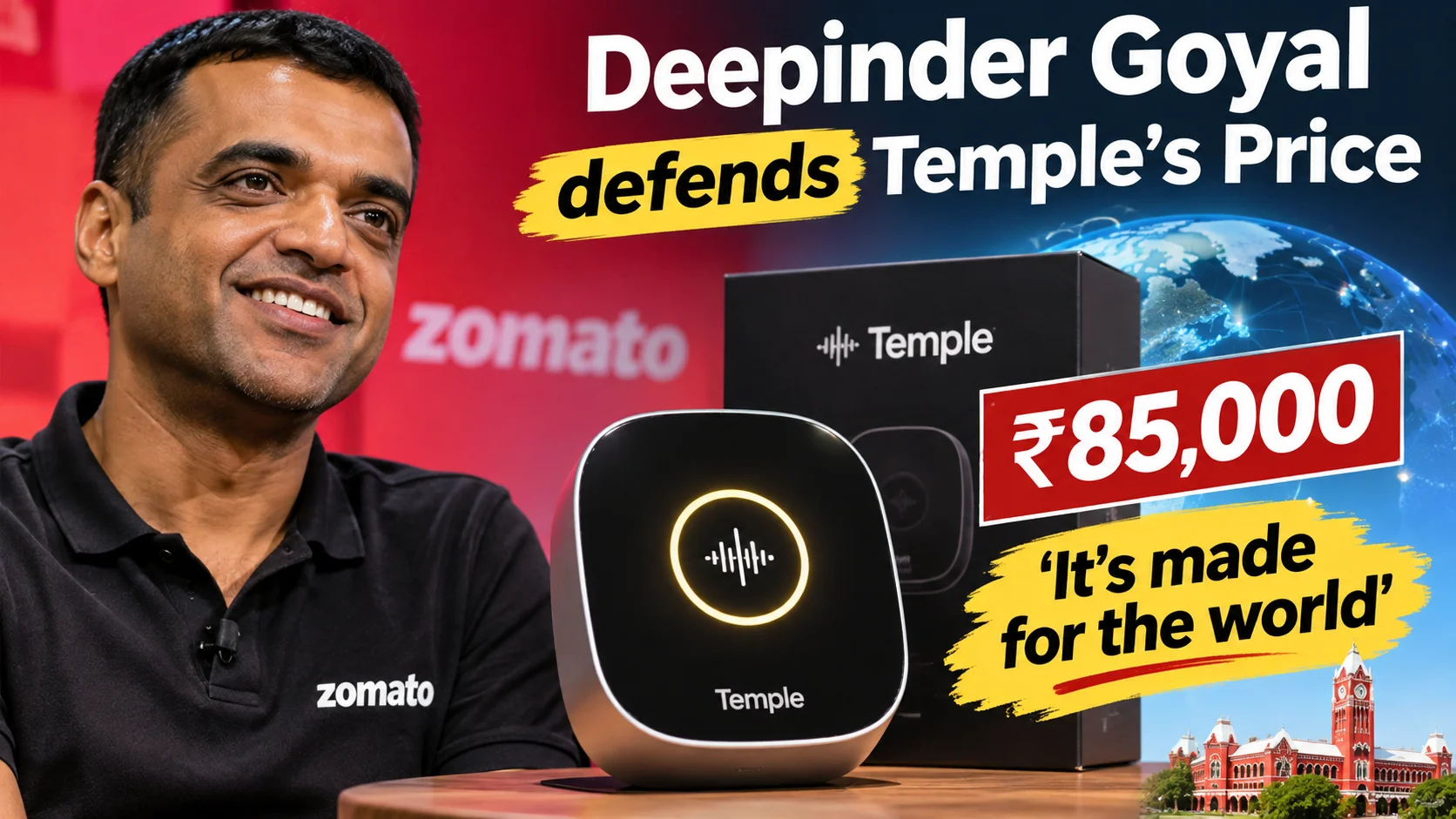
The ₹85,000 price tag on Temple has got people talking—and Deepinder Goyal has now weighed in. The Zomato founder and Temple CEO says the AI wearable is “made for the world”, not specifically for India, and that he does not expect more than 1% of Temple devices to be sold here. His response, reported by Business Today on 8 November 2026, arrives amid questions about the product’s price, its scientific claims and what it is supposed to do.
Goyal’s central message is pretty direct: he says Temple has involved a lot of work, the company priced it at what it believes it is worth, and people who think it is overpriced can wait for user reviews before deciding. He also says buyers shouldn’t support the product simply because it comes from an Indian startup. That’s a confident defence—but it doesn’t settle the question many people are asking: what exactly does an ₹85,000 wearable deliver, and is it worth that amount?
What Deepinder Goyal said about Temple’s price
In a post on X, Goyal said Temple was built for a global market and asked people to check the pricing. He said the company does not expect more than 1% of sales to come from India. Addressing those unhappy with the price, he apologised for the frustration, said significant work had gone into the device, and suggested people wait for user reviews if they believe it is overpriced.
That response makes clear that the company is not positioning Temple as a mass-market Indian gadget. But it doesn’t tell us whether the price is competitive in the markets Temple is targeting, or precisely what customers will get for ₹85,000. Those are separate questions, and buyers will need product details and independent reviews to assess them.
Goyal also rejected the idea that Temple should receive support just because it is an Indian startup. He said the company wants to compete globally and asked people to support early innovation only if they believe it could help improve lives and build scientific evidence over time. That’s a notable stance in a market where “Made in India” can be a strong selling point: Goyal is asking customers to judge Temple on its work and usefulness rather than national pride.
What is Temple?
Temple is a wearable technology startup founded by Goyal in 2024. Business Today’s reporting describes the device as an AI-powered wearable and outlines a vision for a personal companion that could work without a screen. The company has described its approach as “room-deaf voice AI”. Its product description says the device can hear conversations without recording them, with privacy as part of the proposition.
That is an ambitious pitch. A voice-based companion that works without a screen would aim to make interaction feel different from pulling out a phone, opening an app and typing a prompt. But concept descriptions are not the same as a finished product demonstration. Buyers will want to know how the device recognises its owner, when it listens, how it responds, what tasks it can handle, and how reliably it works in real-world settings.
Business Today reported that Temple was expected to begin shipping in 2027, with AI and health monitoring among its planned features. A future shipping timeline means there are still important details customers should look for as development continues. Specs, capabilities, battery life, supported services, regional availability and final terms should be confirmed through official product information when available.
Why the ₹85,000 price has become the focus
At ₹85,000, Temple is competing for attention alongside premium phones, laptops, smartwatches and other high-value purchases in India. It is natural for people to ask what makes a wearable cost that much. For an everyday buyer, the comparison isn’t only with other wearables; it could be with a smartphone upgrade, a laptop purchase or several years of subscriptions and accessories.
Goyal’s answer is essentially about the effort behind the product and the market it is intended to serve. He says Temple has been priced at what the team believes it is worth. That explains the company’s position, but it is not independent evidence of value. The eventual decision will depend on what the device can reliably do, how well it performs, how long it remains useful, and whether those capabilities justify the amount for each customer.
That’s why waiting for user reviews, as Goyal himself suggested, could matter. Reviews after shipping can help answer practical questions that a launch statement cannot: whether the voice interface is genuinely convenient, whether privacy controls are clear, and whether the wearable fits naturally into a user’s day. Until people can test the final product, any verdict on value is necessarily provisional.
Privacy claims need real-world clarity
Temple’s “room-deaf” description is one of the more distinctive claims in the company’s pitch. The product description says the device can hear conversations without recording them. That is intended to address privacy concerns associated with conventional microphones and voice assistants. It’s a significant promise, particularly for a device designed to operate around conversations rather than only when someone is looking at a screen.
For users, the next questions are practical: what does “hear” mean in operation? What information is processed on the device and what, if anything, is sent elsewhere? How does a user know when the device is active? Can it be paused or switched off easily? What controls are available, and how are they explained? The available reporting does not answer all of these questions, so it would be premature to assume exactly how privacy will work in the final product.
Privacy claims are most useful when people can inspect clear product documentation and test the settings for themselves. If Temple’s approach works as described, the company will need to communicate it in terms that ordinary buyers can understand—not just with a memorable label. Independent testing and transparent explanations can help users assess whether the device’s design matches the promise.
AI and health monitoring: promise versus proof
Business Today says AI and health monitoring are among Temple’s intended features. Those categories can mean many different things. “AI” might refer to voice interaction or other assistance, while health monitoring could cover different measurements or insights. The report does not provide a complete feature list, technical specifications or clinical evidence, so we shouldn’t fill in those gaps with assumptions.
This distinction matters especially for health-related functions. A feature that tracks or estimates something should not automatically be treated as a medical diagnosis or a replacement for professional advice. Before relying on health information from any wearable, users should understand what is measured, how accurate it is claimed to be, what the limitations are, and whether the feature has been independently validated. The source material shared here does not establish those details for Temple.
For an AI wearable to earn a place in someone’s routine, the basics will count as much as the headline. It should perform consistently, make its limits clear and provide a reason to use it instead of a phone. A clever idea is a starting point; reliable everyday usefulness is what turns it into a product people keep wearing.
Goyal’s argument about global ambition
Goyal’s statement that Temple is meant for the world, with India expected to account for no more than 1% of sales, shifts the conversation away from whether the product is priced for the average Indian customer. It frames the company’s ambitions internationally and signals that domestic sales are expected to be a small share, according to his post as reported by Business Today.
That position doesn’t mean Indian customers cannot buy or evaluate the product. It means the company is not presenting it as a device whose price or expected sales are centred on India. For Indian buyers, that makes a few questions particularly relevant: what will the final local price be, what support will be available here, and will all announced features work in the Indian market? The available report does not provide those answers.
His comments about avoiding “nationalist support” are also a challenge to a familiar startup narrative. Rather than asking people to buy because a product is Indian, he wants the product to compete internationally on innovation. That is a high bar—and one that makes performance, transparent product claims and after-sales support especially important.
What potential buyers should wait to learn
Before putting down a large sum for Temple, prospective customers should look for concrete answers in the product’s official material and independent coverage. Here are some sensible checkpoints:
- Final product and price: Confirm what the ₹85,000 figure covers, and whether the local price or package changes before shipping.
- Shipping and availability: Business Today reported an expected 2027 start for shipping. Look for a confirmed timeline and regional availability from the company.
- Actual features: Check the final feature list rather than relying only on a broad AI or health-monitoring description.
- Privacy details: Read how listening, processing, storage and user controls work in practice.
- Health limitations: Find out what is measured, how results are presented and what evidence supports those functions.
- Independent reviews: Consider waiting for hands-on testing and user feedback, as Goyal himself suggested.
- Support and warranty: Confirm service arrangements, warranty terms and replacement or repair options in your region.
These aren’t reasons to dismiss the device. They’re the normal checks that make sense for a new product at a premium price, particularly one whose shipment was reported as planned for the future.
So, is Temple worth ₹85,000?
Right now, the honest answer is that the available reporting doesn’t give enough evidence to decide for every buyer. Goyal has defended the price by pointing to the work behind Temple and its global ambition. Business Today has reported the expected shipping timeline and broad product vision. But a product’s value becomes much easier to judge when customers can see the final features, use the device and compare independent test results.
If you’re curious, follow the product’s development and wait for those details rather than treating a bold claim as proof of value. If you’re considering a purchase when it becomes available, compare it with what else ₹85,000 could buy you and decide whether Temple solves a problem you actually have. And if you’re sceptical about the price, Goyal’s own suggestion was to wait for reviews before making up your mind.
The takeaway
Deepinder Goyal has responded to criticism of Temple’s ₹85,000 price by saying the AI wearable is made for a global market and that India is expected to account for no more than 1% of sales. He says the team priced it according to the work involved and wants people to judge it on innovation and usefulness—not because it is an Indian startup.
The pitch is ambitious: a screen-free personal companion, “room-deaf” voice AI, and planned AI and health-monitoring features, with shipping reported as expected in 2027. The important details are still what the product can actually do, how its privacy approach works, what its health features can substantiate, and how it performs in everyday use. For now, the clearest advice is to wait for confirmed specifications and independent reviews before deciding whether ₹85,000 makes sense for you.



Comments (0)
Be the first to comment!