


Key Takeaways
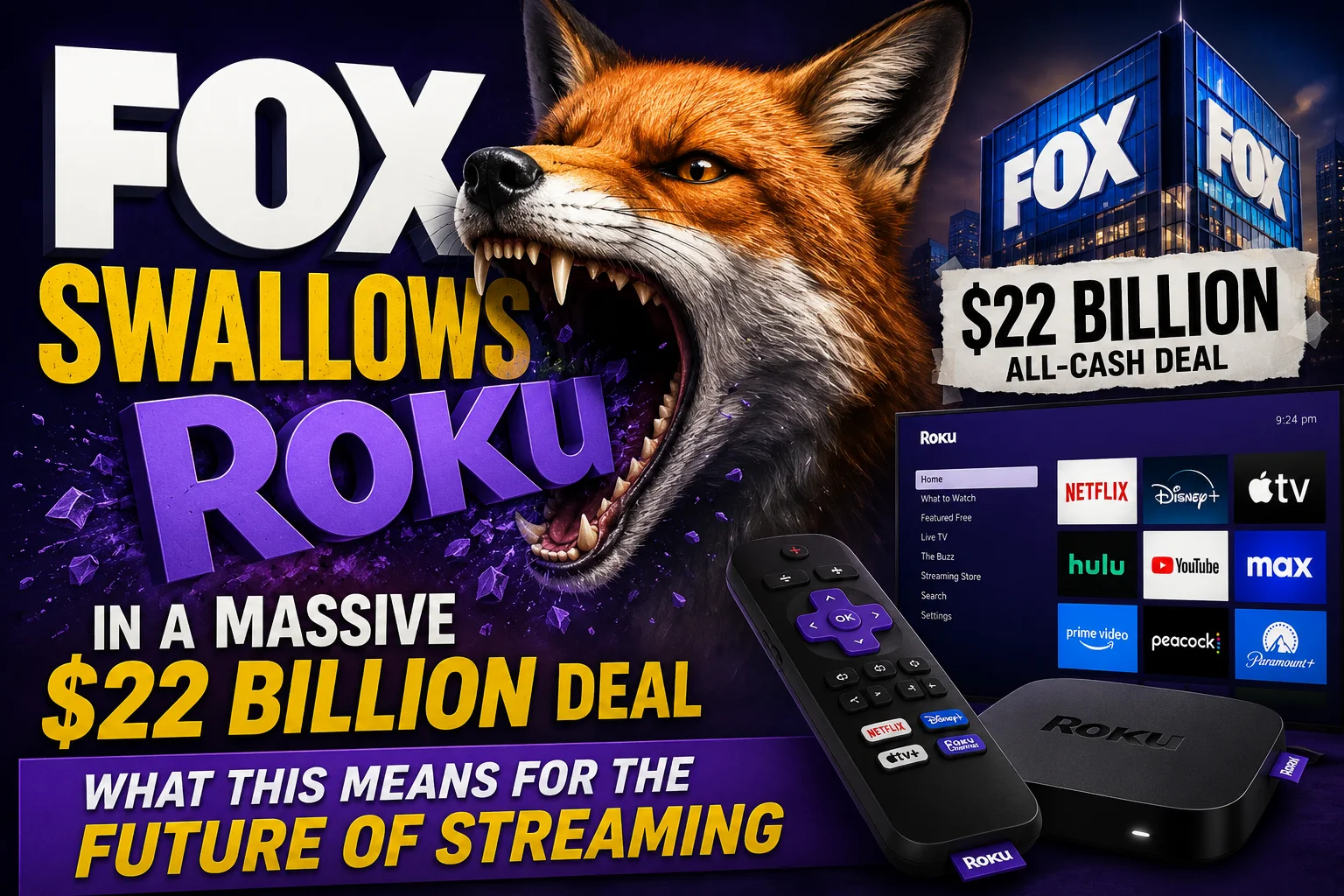
- Fox is acquiring Roku for approximately $22 billion (roughly ₹1.84 lakh crore) in a landmark 2026 deal.
- To finance the acquisition, Fox has secured a massive $12 billion loan, showing high confidence in the streaming hardware market.
- Existing Fox shareholders will dominate the new entity with a 73% stake, while Roku shareholders will hold the remaining 27%.
- For users in India, this could mean a significant push for Roku-powered budget smart TVs and a new rival to JioCinema and Disney+ Hotstar.
- The deal focuses heavily on the FAST (Free Ad-supported Streaming TV) market, where Fox’s content meets Roku’s massive reach.
So, here is the big one for 2026! We have been hearing rumors for months, but it is finally official. Fox is buying Roku. This isn't just another small tech acquisition; this is a massive $22 billion move that is going to reshape how we watch TV. If you have been following the streaming wars, you know that content is king, but the platform is the kingdom. By buying Roku, Fox isn't just getting a company that makes streaming sticks; they are getting the gateway to millions of living rooms. This deal is massive, and honestly, it shows that Fox is tired of playing second fiddle in the digital world.
The Math Behind the Merger: $22 Billion and a Big Loan
Let's talk numbers because they are wild. Fox is valuing Roku at about $22 billion. Now, even for a giant like Fox, that is a lot of cash to have lying around. To make this happen, Fox has gone out and secured a $12 billion loan. In today’s 2026 economy, taking a loan that big means they are betting the entire house on this working out. When the dust settles, the ownership structure is going to look like this: the current Fox shareholders will own 73% of the combined company, and the Roku folks will hold about 27%. It is a clear takeover, not a 'merger of equals' like some corporate PR might try to tell you. Fox is the boss here.
Why would Fox take such a huge financial risk? It is all about the data and the ads. Roku has one of the most sophisticated advertising platforms in the world. They know exactly what you watch, when you pause, and what kind of ads you actually click on. Fox has the content—sports, news, and entertainment—but they have lacked a direct-to-consumer 'pipe' that they fully control. By owning Roku, they control the hardware, the operating system (Roku OS), and the content. It’s a vertical integration play that mirrors what Apple or Google tries to do, but specifically for the television screen.
The 2026 Streaming Landscape: Why Now?
To understand why this is happening now, in June 2026, we have to look at how much the market has changed. Subscription fatigue is real. People are tired of paying ₹999 or ₹1499 every month for five different services. The world has shifted toward FAST—Free Ad-supported Streaming TV. Roku is already a king in this space with the Roku Channel. Fox already owns Tubi, which is another leader in free streaming. By combining Tubi’s content library with Roku’s hardware and OS, Fox is creating a free-streaming monster that could potentially kill off traditional cable TV once and for all.
Think about it. If you buy a TV today, you want it to be simple. You don't want to jump between ten different apps. Fox wants to make the Roku OS the 'Windows of Television.' They want their apps and their ad-tech to be the default experience. With the $12 billion loan, they are also signaling to the market that they have enough liquidity to keep Roku’s hardware business subsidized. We might see even cheaper Roku-powered TVs hitting the market soon because Fox doesn't care about making money on the TV set itself—they want to make money on the ads you see after you turn it on.
What This Means for India: Will Roku Finally Take Over?
Now, let's bring it home to India. For a long time, Roku has been a bit of a ghost in the Indian market. While Amazon Fire TV Stick and Google’s Chromecast (and now Google TV) have dominated our living rooms, Roku has mostly stayed on the sidelines. But with Fox’s backing and their deep pockets, that is likely to change. Fox has a long history with Indian media, and they understand the 'value-conscious' Indian consumer better than almost anyone. We expect a massive push for Roku-enabled budget TVs from brands like TCL, Hisense, and maybe even local players like Vu or Micromax in 2026 and 2027.
Imagine a Roku stick priced at ₹1,999 that comes bundled with a year of free ad-supported sports and movies from Fox’s library. That would be a game-changer in India. Currently, JioCinema is the king of free content here, but a Fox-Roku combo could give them a serious run for their money. If Fox integrates its global sports rights into a free tier on Roku devices in India, the competition with Disney+ Hotstar and SonyLIV is going to get very spicy. We are looking at a potential price war in the streaming hardware space, which is always good for us consumers.
Step-by-Step: How the Transition Will Likely Work
If you are a current Roku user, you are probably wondering if your device is going to stop working or change overnight. Here is how we think the rollout will happen over the next year:
- Phase 1: Branding Integration (Late 2026): You will start seeing 'Fox' branding inside the Roku OS. Tubi will likely become the default 'Free Movies' app on every Roku home screen.
- Phase 2: Account Consolidation: If you have a Fox Sports account or a Tubi account, they will likely merge into one 'Fox-Roku' ID. This will make it easier for them to track your preferences across devices.
- Phase 3: New Hardware: Expect a new line of 'Fox-Roku' smart TVs to be announced by the end of this year. These will probably be even more affordable because they will be heavily subsidized by ad revenue.
- Phase 4: Content Bundles: Fox will likely introduce 'Premium' bundles where you get ad-free content if you use their hardware, or discounted subscriptions to other services through the Roku interface.
Comparison: Fox-Roku vs. The Competition
How does this new giant stack up against the others? Let's look at the pros and cons compared to Amazon and Google. The biggest 'Pro' for Fox-Roku is that they are a 'Media-First' company. Amazon is a 'Retail-First' company and Google is a 'Search-First' company. Fox understands how to make TV shows and live sports that people actually want to watch. Their interface is likely to be much more 'TV-centric' rather than 'App-centric.'
However, the 'Con' is the massive debt. That $12 billion loan isn't free. Fox will be under huge pressure to show profits quickly. This could mean we see more ads than ever before on Roku devices. If the user experience becomes too cluttered with ads, people might jump ship to Google TV or Apple TV. It’s a delicate balance. If they get it right, it’s a goldmine. If they get it wrong, they’ve just spent $22 billion on a sinking ship.
TamilTech’s Honest Take: Is This Good for You?
Here is what we think at TamilTech. Honestly, this is a bold move that was long overdue. Roku was starting to look a bit stagnant compared to the fast updates we see on Fire OS or Google TV. Fox brings the 'masala'—the content—that Roku desperately needed to stay relevant. For the average Indian user, this is great news because more competition means lower prices for streaming sticks and smart TVs. We are finally going to see a real alternative to the Google/Amazon duopoly in India.
However, keep an eye on your privacy. This deal is 100% about data. When a company takes a $12 billion loan to buy a platform, they are going to squeeze every bit of value out of your viewing habits. Expect more targeted ads and more 'suggested' content that you didn't ask for. But if you are okay with that in exchange for high-quality free content, then the Fox-Roku era is going to be a fun ride. Watch out for those 2026 festive season sales—we bet Roku is going to be the star of the show!

Comments (0)
Be the first to comment!