


Key Takeaways
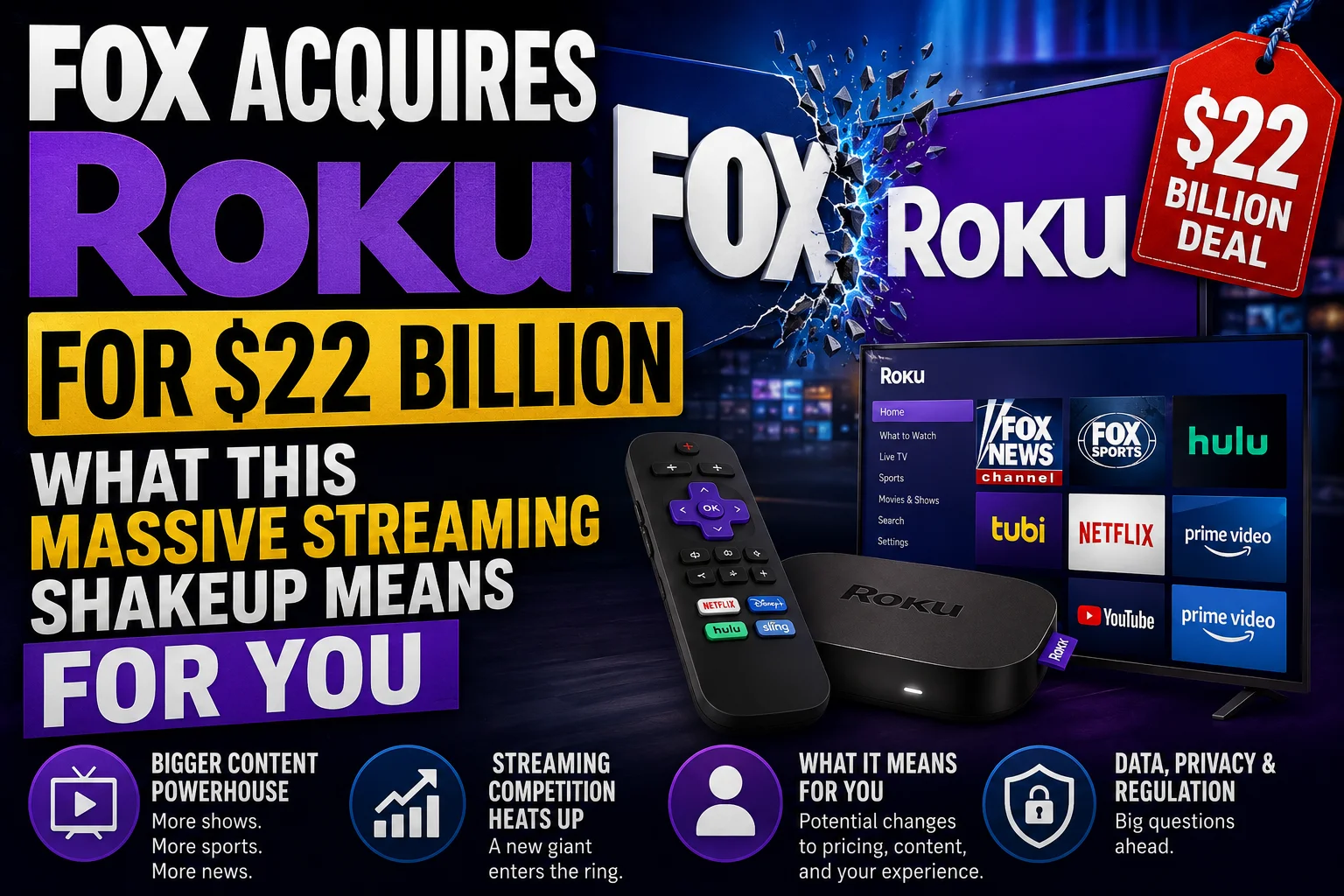
- Fox is acquiring Roku in a massive deal valued at approximately $22 billion, which includes taking on Roku's existing debt.
- The acquisition grants Fox direct access to Roku’s massive user base of over 100 million streaming households worldwide.
- For users in India, while Roku hardware isn't as dominant as Fire TV, this deal could influence how Fox-owned content and sports are distributed on smart TV platforms.
- The bottom line: This is a massive play for first-party data and advertising revenue, moving Fox from just a content provider to a platform owner.
The Streaming Wars Just Got a Massive Plot Twist
Stop what you're doing because the streaming landscape just changed forever. In a move that very few saw coming this early in 2026, Fox has officially announced it is acquiring Roku. We are talking about a deal worth roughly $22 billion. If you've been following the tech space, you know Roku isn't just a company that makes those little sticks you plug into your TV; they are a platform giant. By bringing Roku into the fold, Fox isn't just buying a hardware company; they are buying a direct pipeline into more than 100 million households. That is a massive number that even the biggest players like Netflix and Disney have to respect.
Think about it this way: Fox has always been great at making content—think live sports, news, and their massive success with Tubi. But they always had to rely on someone else's platform to get that content to you. Whether it was a cable provider or a smart TV OS like Google TV or Fire OS, Fox was a guest in someone else's house. With this Roku deal, Fox finally owns the house, the front door, and the living room. This is a strategic pivot that shows Fox is no longer content just being a broadcaster; they want to be the gatekeeper of the entire streaming experience.
How We Got Here: The Rise of the Platform King
To understand why Fox is dropping $22 billion, you have to look at what Roku has built over the last decade. Originally a spin-off from Netflix in its very early days, Roku became the 'Switzerland' of streaming. They didn't care if you watched Netflix, Prime Video, or YouTube; they just wanted to be the interface you used to find them. This neutral stance allowed them to grow rapidly, especially in the US and parts of Europe. By 2026, having 100 million active households is essentially holding the keys to the kingdom of digital advertising. Roku knows what you watch, when you watch it, and what ads you actually click on. For a company like Fox, that data is worth its weight in gold.
Fox, on the other hand, has been undergoing a massive transformation since it sold its entertainment assets to Disney years ago. The 'New Fox' focused heavily on live events—the stuff people still watch in real-time. They realized that the future of TV isn't just about subscriptions; it's about FAST (Free Ad-supported Streaming TV). Their acquisition of Tubi was a masterstroke, and now, combining Tubi's massive library with Roku’s operating system creates a vertical powerhouse. They now control the content, the ad-tech, and the hardware. It’s a closed-loop system that is designed to squeeze every bit of value out of the streaming shift.
The Numbers: $22 Billion and 100 Million Homes
Let's talk about the cold, hard cash. $22 billion is a premium price, especially when you consider that it includes Roku's debt. But when you break down the math, Fox is paying roughly $220 per household. In the world of tech acquisitions, that’s actually a very calculated bet. Each of those households represents years of potential ad revenue and data. Roku’s stock has had its ups and downs, but its platform revenue—the money they make from ads and taking a cut of other people's subscriptions—has always been the real star of the show. Fox is betting that they can supercharge this revenue by integrating their own massive sales team and exclusive content.
What's even more interesting is the 100 million household milestone. In 2026, reaching 100 million homes puts you in the elite tier of tech platforms. Fox now has a seat at the table with the likes of Amazon, Google, and Apple when it comes to the 'Smart Home' and 'Connected TV' space. This isn't just about movies and TV shows anymore. It's about who owns the OS of the biggest screen in your house. If Fox can successfully integrate Roku OS into more budget TVs and expand internationally, that 100 million could easily double in the next few years. This deal is as much about global scaling as it is about domestic dominance.
What This Means for Users in India
Now, let's bring it home to India. If you walk into a Croma or Reliance Digital today, you'll see plenty of Amazon Fire TV Sticks, Google Chromecasts, and Xiaomi Mi Boxes. Roku has always been a bit of a niche player in the Indian market, mostly available through imports or a few specific TV brands. However, this Fox deal could change that. Fox has significant interests in how content is distributed globally. With Roku now under their wing, we might see a more aggressive push to bring Roku-powered smart TVs and streaming sticks to India at very aggressive price points—perhaps even under ₹2,500 to compete with the Fire Stick Lite.
There's also the content angle. While Fox sold Star India to Disney (which became Disney+ Hotstar), the 'New Fox' still controls massive global sports rights and news syndication. If Fox decides to launch a dedicated global sports streaming app, you can bet it will be 'Roku First.' For Indian consumers, more competition in the OS space is always a good thing. If Roku becomes a major player here, it forces Google and Amazon to improve their interfaces and maybe even lower their hardware prices. We’ll be watching closely to see if Roku finally sets up a proper headquarters in Bengaluru or Mumbai to localize the experience for us.
Step-by-Step: What Existing Roku Users Should Do Now
If you already own a Roku device or a TV with Roku OS built-in, don't panic. Here is what you can expect in the coming months:
- Check for Updates: You don't need to do anything manually, but keep your device connected to Wi-Fi. Fox will likely push a series of firmware updates to integrate their services more deeply.
- Watch the Ad Load: One of the first things Fox will likely do is optimize the ad placements on the Roku home screen. You might see more 'Suggested Content' from Fox-owned properties like Tubi or Fox Sports.
- Subscription Changes: Keep an eye on your billing. While your existing Netflix or Prime subscriptions won't change, there might be new 'Fox-Roku' bundles introduced that offer premium content at a discount.
- Privacy Settings: Since Fox is big on data, it’s a good time to dive into your Roku settings. Go to Settings > Privacy > Advertising and make sure you've toggled 'Limit Ad Tracking' if you're not comfortable with the new ownership having all your data.
Comparison: Roku vs. The Competition in 2026
How does the 'Fox-Roku' combo stack up against the giants? Let's look at the pros and cons:
- Roku (Fox): Pros - Extremely simple UI, massive free content via Tubi, now backed by a media giant. Cons - Hardware can feel a bit dated compared to Apple, privacy concerns under new management.
- Amazon Fire TV: Pros - Deeply integrated with Alexa and Prime, very cheap hardware. Cons - Very cluttered interface, pushes Amazon content too aggressively.
- Google TV: Pros - Best search and recommendation engine, integrates with your Google account. Cons - Can be buggy on cheaper hardware, tracks everything you do.
- Apple TV: Pros - Best performance, no ads, high privacy. Cons - Extremely expensive (₹15,000+), locked into the Apple ecosystem.
Honestly, Roku’s biggest strength has always been its simplicity. My grandmother can use a Roku. If Fox keeps that simplicity while adding better content, they have a winning formula. If they clutter it with too many ads and Fox News pop-ups, they risk driving users away to Google or Amazon.
TamilTech's Honest Take: A Bold but Risky Move
At TamilTech, we think this is one of the most significant tech acquisitions of the decade. Fox is essentially admitting that 'Content is King, but the Platform is the Kingdom.' By spending $22 billion, they are buying a direct relationship with the customer. No more middlemen. For Fox, this is a survival move. In a world where traditional cable TV is dying, owning the OS is the only way to stay relevant. They want that 100 million household data to sell high-value ads, and Roku is the perfect vehicle for that.
However, the risk is huge. Roku users loved the platform because it felt independent. If Fox turns it into a giant billboard for their own agenda, the '100 million households' will quickly start looking for alternatives. For us in India, the impact might be slow, but it’s definitely coming. We expect to see more Roku-powered TVs hitting the Indian market by the end of 2026. If you're looking for a simple, no-nonsense streaming experience, Roku is still a great choice, but just be aware that your viewing habits are now part of a much larger corporate machine. What do you think? Would you buy a Roku stick if it launched officially in India for ₹1,999? Let us know!



Comments (0)
Be the first to comment!