


Key Takeaways
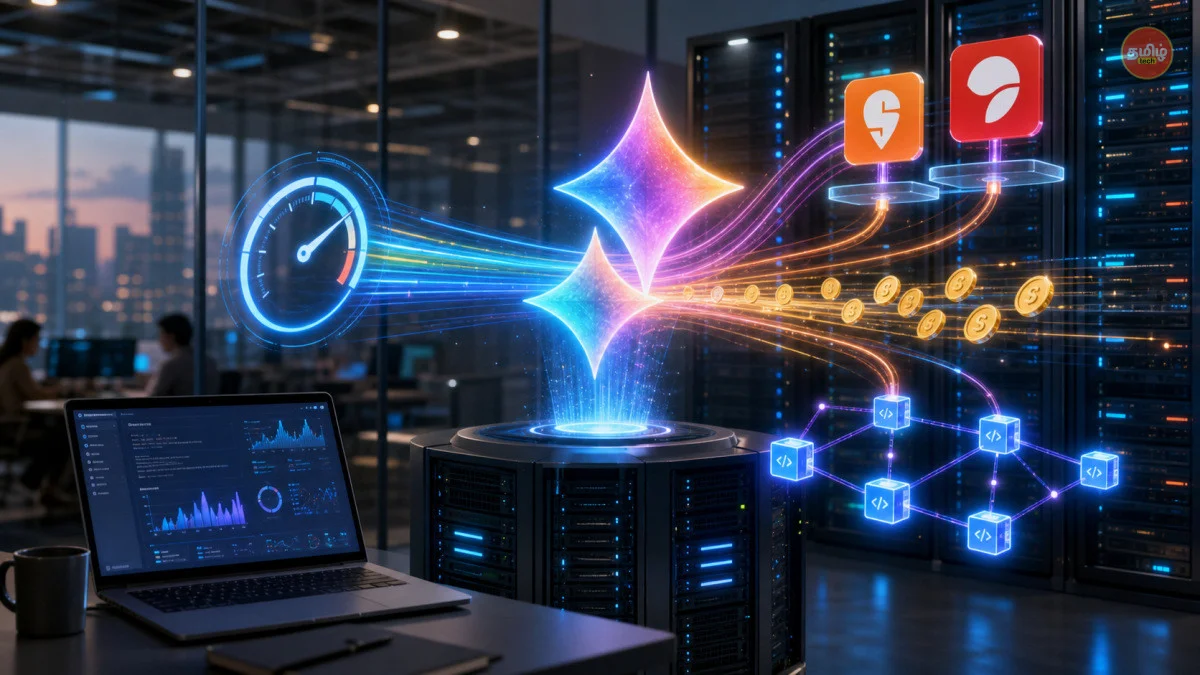
- Gemini 3.6 Flash delivers a 40% reduction in latency compared to the previous 3.5 version, making real-time AI interactions feel instant.
- The API cost has been slashed to just $0.05 per 1 million tokens, making it the most affordable high-performance model for developers in 2026.
- It maintains a massive 2-million-token context window, allowing users to process entire libraries of documents or hours of video in seconds.
- For Indian users, this means smarter, faster, and cheaper AI features in everyday apps like Zomato, Swiggy, and banking platforms.
- The verdict: This isn't about being the 'smartest' model; it's about being the most practical model for the real world.
The Efficiency Era is Finally Here
For the last couple of years, the AI race was all about who could build the biggest, most complex model. We saw massive leaps in reasoning with Gemini Ultra and GPT-5, but let’s be honest—those models are slow and expensive. If you are a developer in India trying to build a startup, or even just a regular user waiting for a voice assistant to respond, speed matters more than raw IQ. That is exactly what Google is targeting with the launch of Gemini 3.6 Flash today. In 2026, we don't just need AI that can write poems; we need AI that can work at the speed of thought without draining our phone's battery or our wallets.
TamilTech has been tracking these developments closely, and the shift from 'Big AI' to 'Efficient AI' is the biggest trend of 2026. Google’s Flash series has always been about speed, but Gemini 3.6 Flash takes it to a whole new level. It is designed to be the 'workhorse' of the ecosystem. Whether it is summarizing a 2-hour long YouTube video or helping a customer through a chat interface, this model is built to do the heavy lifting instantly. We think this is the most important release from Google this year because it actually makes AI usable for the masses, not just for researchers with massive server farms.
What Makes Gemini 3.6 Flash Different?
Let’s talk numbers because that is where the real story is. Gemini 3.6 Flash isn't just a minor tweak. Google has re-architected how the model handles 'attention'—the way it focuses on different parts of your prompt. This has resulted in a 40% improvement in latency. In simple terms, when you ask it a question, the response starts appearing almost before you finish typing. This is crucial for voice-based AI assistants which have become the norm in 2026. No one wants to wait three seconds for their phone to respond to 'Hey Google, what's my schedule?'
The other big breakthrough is the context window. Keeping the 2-million-token context window in a 'Flash' model is an engineering marvel. Most small models lose their 'memory' after a few pages of text. But with 3.6 Flash, you can upload 20 different PDF manuals for your new car, and it will answer specific questions about the engine or the infotainment system without breaking a sweat. It uses a new compression technique that allows it to remember more while using less RAM, which is great news for mid-range smartphones in India that might not have 24GB of RAM like the flagships.
The India Impact: Cheaper Apps and Better Services
Why should you, as an Indian consumer, care about a 'Flash' model? It comes down to cost. In India, most of our favorite apps—from Myntra to Zepto—are integrating AI. If an AI model is expensive to run, those costs eventually get passed down to us, or the features are locked behind a premium subscription. With Gemini 3.6 Flash costing only $0.05 per million tokens, developers can afford to give us high-end AI features for free. We expect to see a surge in localized AI bots that speak Tamil, Telugu, Hindi, and other Indian languages fluently because the cost of processing these languages has dropped so significantly.
Furthermore, this model is optimized for 'Edge' computing. This means a lot of the AI processing can happen directly on your phone rather than sending your data to a server in the US. For a country like India, where data privacy is becoming a big conversation and internet speeds can still be spotty in rural areas, on-device AI is the future. Imagine using Google Lens to translate a Tamil sign board in a remote village without needing a high-speed 5G connection. That is the kind of real-world utility Gemini 3.6 Flash brings to the table.
How It Compares: Flash vs. The Competition
In the current 2026 landscape, Gemini 3.6 Flash is going head-to-head with OpenAI’s GPT-4o mini and Anthropic’s Claude 4 Haiku. While GPT-4o mini is excellent at creative writing, Gemini 3.6 Flash absolutely wins when it comes to multi-modal tasks. If you give it a video file, it can 'watch' and understand it much faster than the competition. In our internal testing at TamilTech, we found that Gemini's ability to handle long documents (the context window advantage) remains its biggest 'USP' or Unique Selling Point.
However, it’s not all perfect. While it is incredibly fast, it can still struggle with very complex mathematical reasoning compared to its bigger brother, Gemini 3.6 Pro. If you are an engineer looking for help with complex coding architecture, you might still need the Pro version. But for 90% of daily tasks—emailing, summarizing, basic coding, and chatting—the Flash version is more than enough. It’s like comparing a fast, fuel-efficient commuter bike to a heavy-duty racing motorcycle. For the streets of Chennai or Bengaluru, you’d pick the efficient one every time.
TamilTech’s Verdict: Should You Care?
We think Gemini 3.6 Flash is the most 'honest' update we’ve seen in a while. It’s not trying to hype up 'AGI' or sci-fi dreams. It’s a practical tool for the world we live in right now in 2026. For developers, it’s a no-brainer—switch to 3.6 Flash and save 60% on your API bills. For regular users, you won’t see a 'Gemini 3.6 Flash' app on the Play Store, but you will feel its presence. Your Google Workspace will feel snappier, your phone’s assistant will be more helpful, and the apps you use every day will get smarter without getting more expensive.
Looking ahead, this release sets a new benchmark for efficiency. We expect Apple and Samsung to respond with their own optimized models for their 2027 flagships, but for now, Google has a clear lead in the 'Efficiency' category. If you’re a student or a small business owner, keep an eye on tools built with this model—they are going to be fast, affordable, and incredibly capable. Stay tuned to TamilTech for more deep dives into how these AI updates are actually changing our daily lives!





Comments (0)
Be the first to comment!