


Key Takeaways
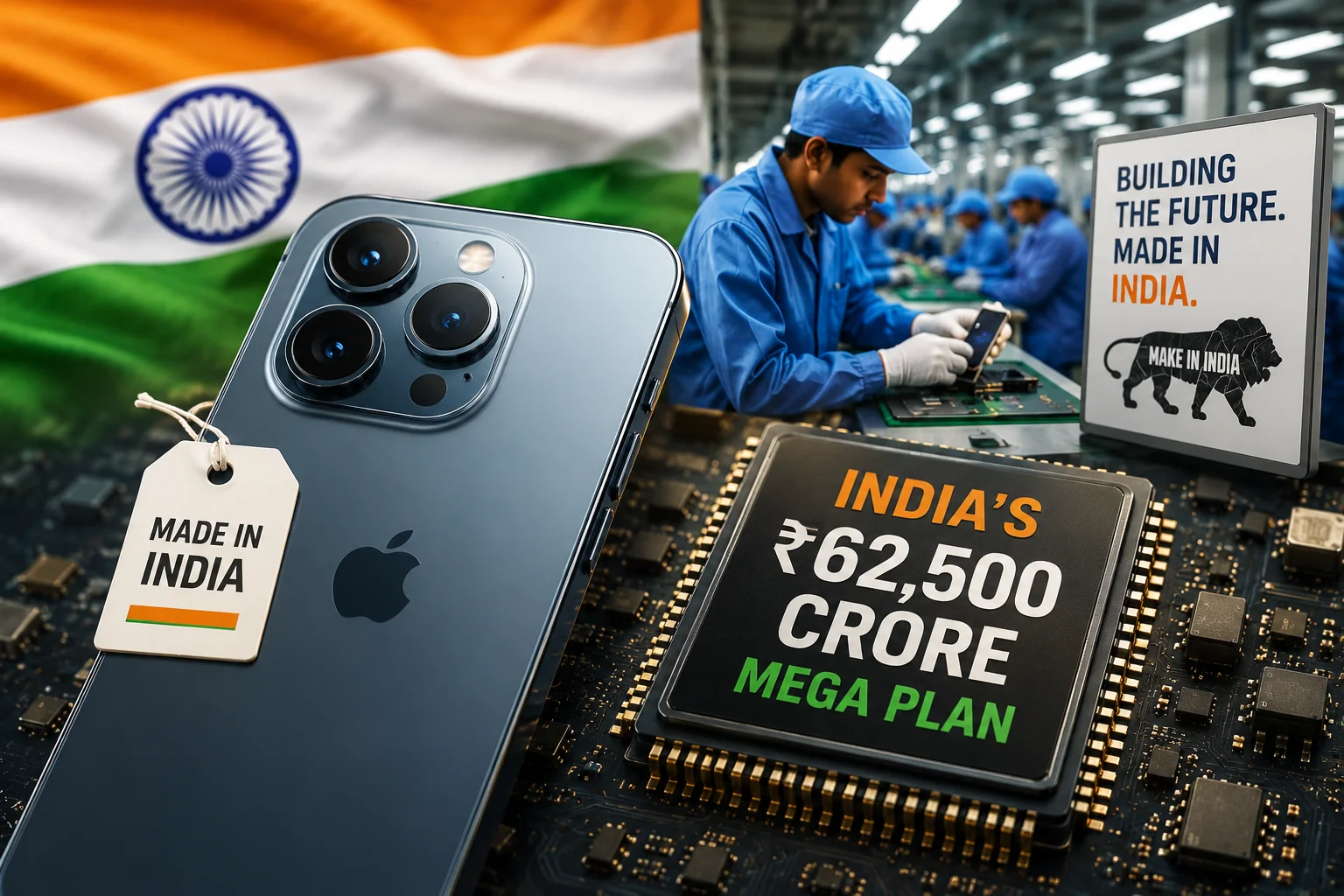
- The Indian government has approved a new ₹62,500 crore incentive scheme focused on high-end mobile component manufacturing and assembly.
- The goal is to increase domestic value addition from the current 20% to nearly 45% by 2028, reducing reliance on imported parts from China.
- This scheme will likely lead to price drops for flagship devices from Apple, Samsung, and Google as more 'Pro' and 'Ultra' models get manufactured locally.
- The initiative is expected to generate over 2.5 lakh direct jobs and nearly 6 lakh indirect jobs in the electronics sector over the next three years.
The Big Move: ₹62,500 Crore to Change the Game
So, here is the news that everyone in the tech industry is buzzing about today. The Indian government has just doubled down on its 'Make in India' vision by greenlighting a massive ₹62,500 crore scheme specifically for mobile manufacturing. Now, you might be thinking, "Wait, aren't we already making phones in India?" Well, yes and no. While we have been assembling millions of phones over the last few years, most of the expensive parts inside those phones—the screens, the camera sensors, and the complex circuit boards—are still coming from abroad, mostly from China or Taiwan. This new 2026 scheme is designed to fix exactly that. It is not just about putting the pieces together anymore; it is about making the pieces themselves right here on our soil.
I have been tracking this space for a while, and let me tell you, the scale of this is unprecedented. This isn't just a small top-up to the previous PLI (Production Linked Incentive) schemes. This is a complete overhaul. The government wants India to be the factory of the world, and they are putting their money where their mouth is. By 2026, we have seen India become the second-largest mobile manufacturer globally, but we were still lagging in 'value addition.' Most of the value was still being captured by foreign component makers. With this ₹62,500 crore push, the government is telling global giants like Apple, Samsung, and even the likes of Google and Xiaomi, "Hey, build your high-tech components here, and we will give you massive cash incentives."
How We Got Here: From Assembly to Deep Manufacturing
To understand why this is such a big deal, we need to look back at how far we have come. Back in 2020-21, when the first PLI scheme was launched, India was mostly just a destination for low-end and mid-range phone assembly. We saw brands like Redmi and Realme setting up shops, but the high-end stuff was still being imported. Fast forward to 2026, and the landscape has shifted dramatically. We already have the iPhone 17 and iPhone 18 series being produced in India simultaneously with global launches. But even now, the 'Pro' models often carry a heavy import duty because many of their premium components aren't sourced locally. This new scheme targets that specific gap.
The government's strategy has evolved. They realized that to truly compete with manufacturing hubs like Shenzhen or Vietnam, India needs a 'Component Ecosystem.' You can't just have one factory making the phone; you need a hundred smaller factories around it making the screws, the vibration motors, the glass back, and the battery cells. This ₹62,500 crore fund is specifically earmarked to subsidize the setup of these component units. It is about creating a massive industrial cluster where everything a smartphone needs is available within a 50-kilometer radius. This is how you bring down costs and increase efficiency.
What's Inside the ₹62,500 Crore Package?
Let's break down the numbers because they are quite staggering. Out of the total corpus, a significant chunk is going towards 'Sub-Assembly' units. We are talking about Printed Circuit Board Assembly (PCBA), which is essentially the brain of the phone where all the chips sit. Currently, while some PCBA happens in India, the most advanced boards for flagship phones are still imported. The new scheme offers a 4% to 6% incentive on incremental sales of these components. This might sound like a small percentage, but when you are dealing with billions of dollars in sales, it is a massive amount of money that goes straight to the company's bottom line.
Another major focus area is the Display and Camera Module segment. These are the two most expensive parts of any modern smartphone. If you have ever broken your phone screen, you know how much it costs to replace! By incentivizing companies to set up display fabrication units in India, the government is looking to slash the Bill of Materials (BoM) for manufacturers. There is also a special provision for 'Design-led Manufacturing.' This means the government isn't just rewarding companies for building things; they are rewarding them for designing the hardware in India. This is a huge win for Indian engineers and startups who want to create indigenous tech rather than just copying global designs.
The India Impact: Will Prices Actually Drop?
This is what you really want to know, right? Will your next iPhone or Samsung Galaxy cost less? The short answer is: Yes, but it will take a little time. Currently, India imposes high import duties on fully built phones and certain components to encourage local making. When a phone is 'Made in India' with 40% local parts, the manufacturer saves a ton on these duties. They also save on logistics and shipping costs from China. In 2026, we are already seeing the price gap between Indian and US pricing for iPhones narrowing. This new scheme will accelerate that trend.
For the average Indian consumer, this means better availability of 'Pro' and 'Ultra' models. Earlier, these premium variants were often in short supply because they were imported in limited batches. Now, with local manufacturing of high-end components, we can expect these flagship devices to be readily available at more competitive prices. Moreover, this isn't just about the big brands. Local Indian players like Lava and Micromax (who are making a comeback in 2026 with 5G and 6G-ready budget phones) can also tap into this component ecosystem to make their phones better and cheaper. This creates a healthy competition that ultimately benefits us, the buyers.
Real-World Use Cases: Beyond Just Phones
While the headlines say "Mobile Manufacturing," the ripple effect of this ₹62,500 crore scheme goes much further. The same factories making mobile batteries can be pivoted to make batteries for Electric Vehicles (EVs). The units making PCBAs for smartphones can easily make boards for laptops, tablets, and even smart home devices like Alexa or Google Home. We are essentially building a foundation for the entire electronics industry in India. Imagine a future where your laptop, your smartwatch, your earbuds, and even your smart fridge are all made in India using parts manufactured in Tamil Nadu, Karnataka, or Uttar Pradesh.
Take the example of the growing 'Wearables' market in India. Brands like Boat and Noise have already started making products here, but they still rely heavily on imported chips. This new scheme encourages the local production of the tiny sensors and Bluetooth modules used in these devices. So, it's not just about the ₹1,50,000 phone in your pocket; it's also about the ₹2,000 smartwatch on your wrist and the ₹1,500 TWS earbuds in your bag. Everything is going to get a 'Made in India' boost, making the entire ecosystem more robust and self-reliant.
TamilTech's Honest Take: Is This Enough?
Look, we think this is a massive step in the right direction, but let's be real—money alone won't solve everything. While ₹62,500 crore is a huge incentive, the government also needs to focus on the 'Ease of Doing Business.' We have seen in the past that red tape and bureaucratic delays can kill even the best-funded projects. Manufacturers need consistent power supply, world-class logistics, and a highly skilled workforce. If we can't provide the infrastructure, these companies might still prefer Vietnam or Thailand despite the incentives.
Another point we want to highlight is the 'Jobs' aspect. While the government claims 2.5 lakh jobs will be created, we need to ensure these are high-quality engineering and design jobs, not just low-wage assembly line work. We want to see Indians designing the next big processor or the next revolutionary display technology. This scheme has a 'Design-led' component, which is great, but the implementation needs to be aggressive. Overall, we are optimistic. India is no longer just a 'market' for global tech companies; we are becoming their 'workshop.' And that is a shift every Indian tech enthusiast should be proud of. Expect more 'Made in India' labels on premium tech by the end of 2026 and early 2027!





Comments (0)
Be the first to comment!