


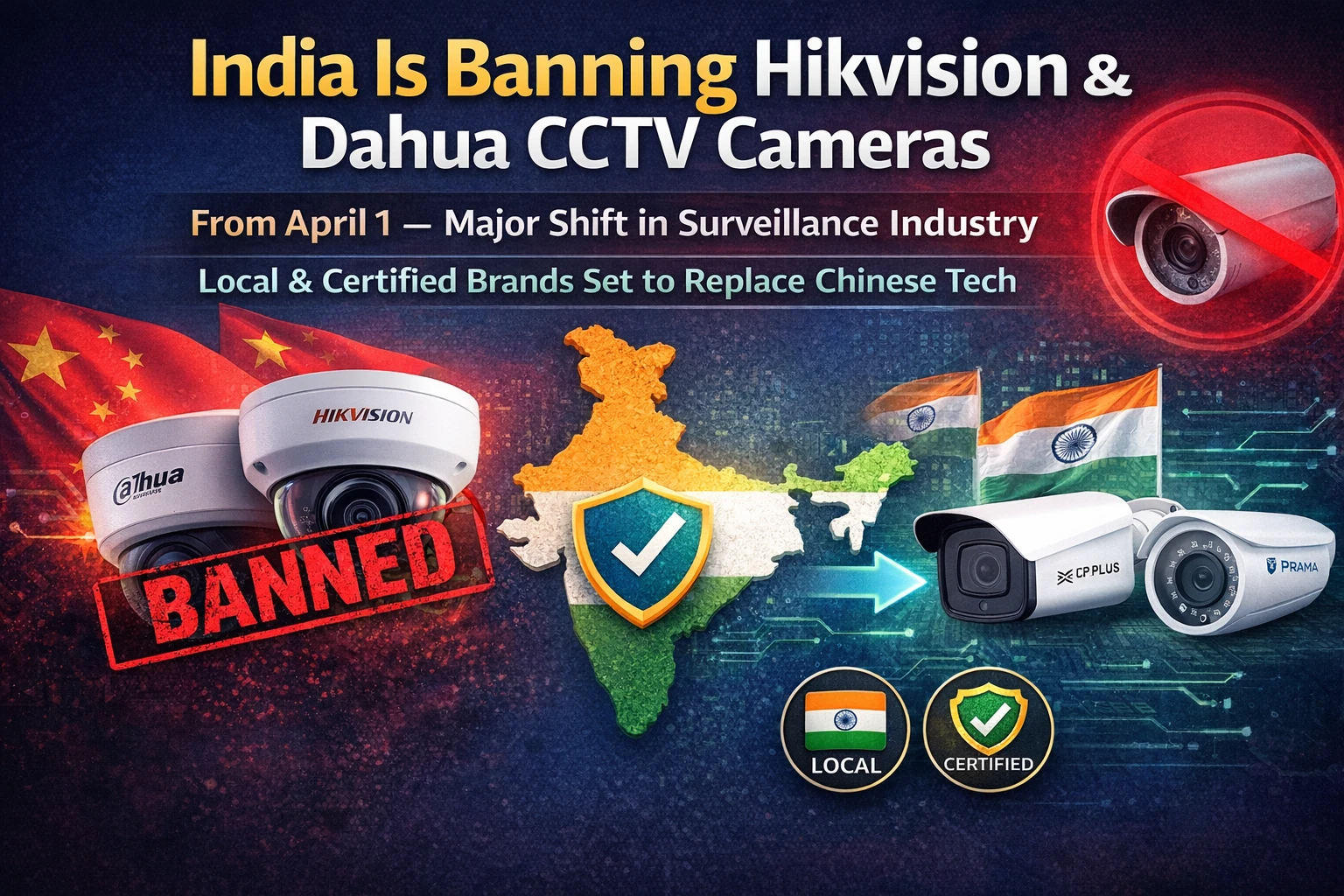
April 1 is the deadline — and this one isn't a joke
Starting April 1, 2026, two of the world's biggest surveillance camera brands — Hikvision and Dahua — can no longer sell internet-connected CCTV cameras in India. The Indian government is refusing to certify their products, and without certification, they can't legally be sold.
This has been coming for two years. The Ministry of Electronics and Information Technology (MeitY) introduced new Essential Requirements norms for CCTV cameras in April 2024 and gave the industry a two-year window to comply. That window closes tomorrow. For Chinese manufacturers, the rules have effectively become an exit notice.
Why is the government doing this?
The core issue is national security and data sovereignty. Internet-connected CCTV cameras are surveillance infrastructure — they sit in homes, offices, factories, hospitals, airports, and government buildings, recording continuously and sending data over the internet. If those cameras use chipsets from a country with which India has strategic tensions, the risk is real: unauthorised remote access, data interception, potential surveillance by foreign actors.
The new STQC (Standardisation Testing and Quality Certification) rules address this directly. Manufacturers must now:
Declare the country of origin for critical components — specifically the System-on-Chip (SoC), which is the brain of any connected camera. Devices must be tested at certified labs for vulnerabilities that could allow unauthorised remote access. Products using Chinese chipsets will not receive government certification.
That last point is the kill shot for Chinese brands. Hikvision and Dahua don't just manufacture in China — their entire chip supply chain runs through Chinese semiconductor companies. Switching that out isn't a minor adjustment; it requires rebuilding the product from the ground up.
What happened to Hikvision and Dahua specifically?
Hikvision was once the dominant player in India's CCTV market. It's the world's largest surveillance camera manufacturer by volume. In India, the company was denied certification for a large factory and is now reportedly exploring joint ventures with Indian partners — essentially trying to restructure its India operations to survive under the new rules.
Dahua, which was the second-largest player in the Indian CCTV segment, has seen its India business contract by approximately 80%. It's currently limited to selling analogue cameras — the old-school cameras that don't connect to the internet and therefore don't fall under the same certification requirements. But analogue cameras are a dying product category. Nobody building a new security system in 2026 is going with non-networked cameras.
The collateral damage extends further: Xiaomi and Realme — both popular smartphone brands in India — have reportedly exited the smart home camera segment entirely after failing to secure certification for their products. If you were using a Xiaomi Mi Home Security Camera or a similar product, replacements won't be available from the same brand going forward.
Who's winning: Indian brands are surging
The shift in market dynamics is dramatic. As recently as 2024, Chinese brands held roughly one-third of all CCTV sales in India. By February 2026, Indian companies control over 80% of the market, according to Counterpoint Research data.
The brands leading this shift: CP Plus (which now commands 45-50% of the Indian CCTV market, up from 20-25% previously), Qubo (Honeywell's India-focused brand, now owned by Hero Group), Prama, Matrix, and Sparsh. These companies have adapted their supply chains to use Taiwanese chipsets and developed localised firmware that meets STQC certification requirements.
The tradeoff: Indian manufacturers estimate that switching from Chinese to Taiwanese and US chipsets has increased their bill of materials by 15-20%, particularly for mid- and high-end camera models. That cost will likely be passed on to consumers over time, meaning CCTV cameras in India may get modestly more expensive as the market fully transitions.
What this means if you're buying a security camera right now
If you're shopping for a home security camera, a dashcam-style indoor camera, or a business CCTV system in India right now, the practical impact is immediate.
Existing Hikvision and Dahua cameras you already own will continue to work — this ban is about new sales, not requiring people to dismantle existing installations. But getting warranty service, replacement parts, or technical support for those brands is going to become progressively harder as their India operations shrink.
For new purchases, the reliable options are now Indian-brand cameras. CP Plus has the widest distribution and product range — available on Amazon India, Flipkart, and through thousands of offline dealers. Qubo has become a strong option specifically for home security cameras, with good app integration. Prama and Matrix are more enterprise-focused but have residential product lines too.
Price-wise, a decent Indian-brand IP camera starts around ₹1,500-2,000 for basic models, going up to ₹5,000-8,000 for feature-rich options with colour night vision, AI motion detection, and two-way audio. These price ranges are broadly similar to what Chinese brands were selling at before the ban.
Only 507 models cleared certification — out of how many?
Here's the number that puts the scale in perspective: as of the certification deadline, only 507 CCTV camera models across all brands have successfully obtained STQC certification. The Indian CCTV market had thousands of models available from dozens of brands. The certification process has effectively compressed the market to a much smaller set of compliant products, at least temporarily.
As Indian manufacturers move more products through the certification pipeline, that number will grow. But for now, if you're buying a connected CCTV camera in India, checking whether the specific model has STQC certification is a meaningful step before purchase.
TamilTech's take
This is one of the more significant tech policy changes in India's recent history, and it's been largely under the radar for most consumers. The security rationale is sound — internet-connected cameras with Chinese chipsets in sensitive locations is a genuine vulnerability. The two-year transition window gave the industry time to adapt, and Indian brands have moved quickly. CP Plus's rise from 20-25% to 45-50% market share in two years is remarkable. The downside is that short-term product availability will be narrower and prices may edge up slightly. But if you're buying a security camera for your home or business, you're now buying Indian — and the products are genuinely competitive. That's not a bad outcome.





Comments (0)
Be the first to comment!