


Something is off in India's phone market — and your wallet already knows it
Walk into any mobile shop in Chennai, Coimbatore, or Bengaluru right now and ask about a mid-range Android phone. Chances are the shopkeeper will tell you prices have gone up "because of components." They're not wrong. What's happening is real, it's significant, and it's going to affect every phone buyer in India over the next few months.
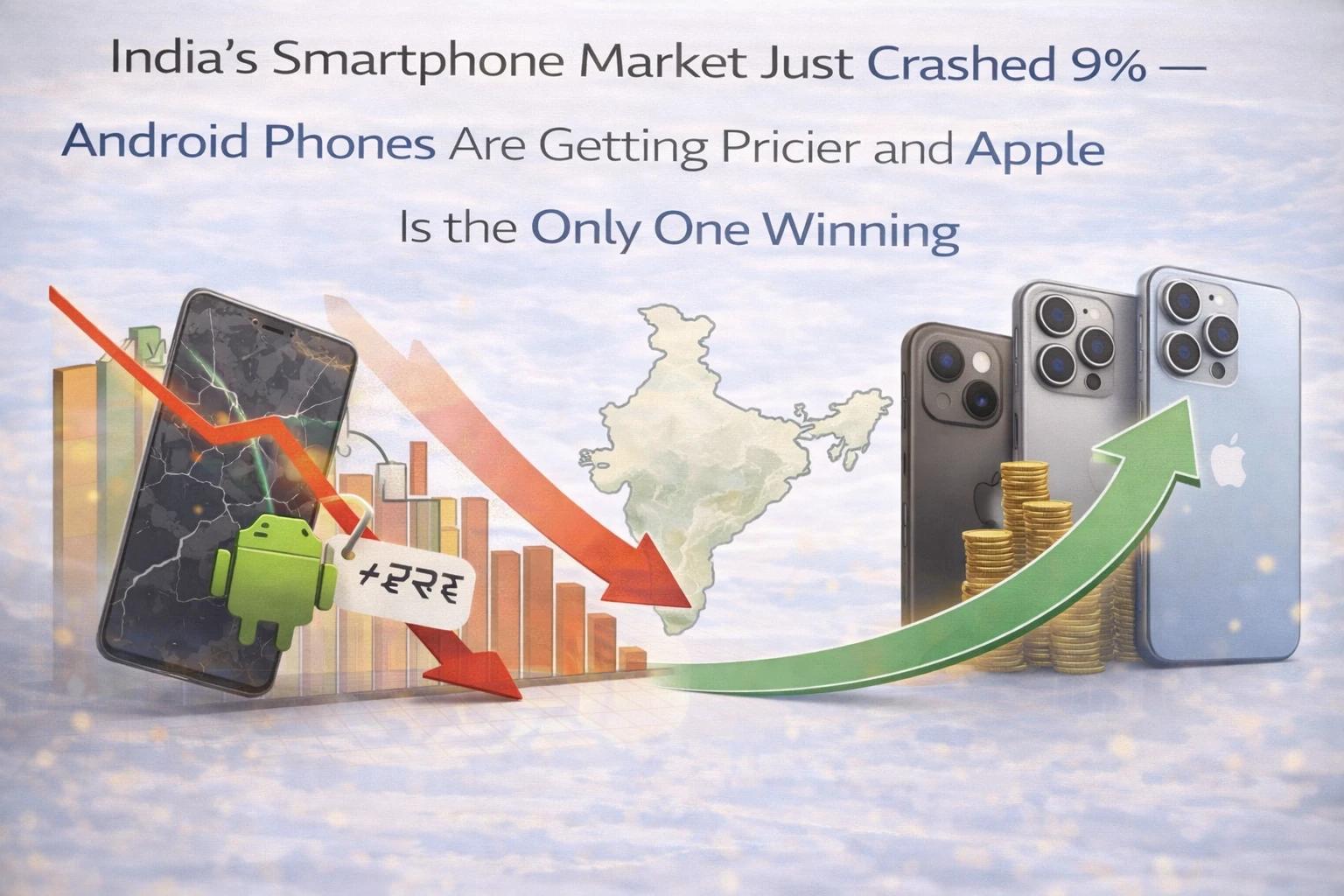
India's smartphone sales fell 9% year-on-year in the first nine weeks of 2026. That data comes from Counterpoint Research, which tracks actual sell-through at retail — not shipped units, not production numbers, but phones that actually left shelves and went into customers' hands. A 9% drop in nine weeks is not a seasonal blip. It's a market under pressure.
What's causing this — the memory chip story
The root cause is memory chip pricing. DRAM and NAND flash — the components that make your phone's RAM and storage — have seen significant cost increases over the past several months. When chip manufacturers raise prices, smartphone makers have two choices: absorb the cost (which kills margins) or pass it on to consumers (which hurts sales). Almost every Android brand chose option two.
By the first week of March 2026, over eight Android brands had already hiked prices on existing models in India by an average of ₹1,500. Some models saw bigger jumps. More hikes are expected. This means the phone you were considering buying at ₹18,000 last October might now be tagged at ₹19,500 or more — for the exact same hardware.
The brands that have implemented hikes include Samsung, Xiaomi, Realme, Motorola, and Vivo. That's essentially the entire mid-range Android market that Indian buyers depend on. The ₹10,000 to ₹25,000 segment — where the majority of India's volume sales happen — is feeling the squeeze most acutely.
Apple is somehow growing — and here's why
Here's the counterintuitive part. While the overall market fell 9%, Apple grew 12% year-on-year in the same period. That seems impossible when iPhones cost ₹79,900 to ₹1,59,900. How does the premium brand grow when the market is contracting?
Two reasons. First, Apple didn't raise prices on its existing Indian inventory. When every Android brand was hiking prices, Apple held its price points — the iPhone 15 and iPhone 16 series stayed where they were, and the iPhone 17 series launched at competitive prices relative to its predecessors. In a market where consumers are suddenly facing ₹1,500 to ₹3,000 unexplained price increases on brands they thought they knew, Apple's price stability looks attractive by comparison.
Second, India's smartphone market is premiumizing even as it shrinks in volume. Total units sold are down, but buyers who are spending are spending more. Consumers who were sitting on the fence between a ₹22,000 Android and spending more for an iPhone are increasingly choosing the iPhone — especially when the ₹22,000 Android has now become ₹24,000 without getting any better.
Apple's 28% value share in India's smartphone market is a record — it overtook Samsung and everyone else in revenue terms even while selling far fewer units in volume.
What this means if you're buying a phone in the next few months
Practically speaking, here's what Indian buyers should know right now.
If you're in the market for an Android phone under ₹20,000 — act sooner rather than later. More price hikes are expected through mid-2026, and the phones available today are likely cheaper than they'll be in June or July. The Redmi 13 series, Realme Narzo line, and Samsung Galaxy A series in this range have already seen price adjustments, and analysts expect another round.
If you're considering a mid-range ₹20,000 to ₹35,000 phone — compare carefully. The OnePlus Nord 6 just launched with Snapdragon 8s Gen 4, a 9000mAh battery, and a strong camera system at a competitive price point. It came in before the next round of memory-driven hikes, making it worth evaluating seriously against whatever the Xiaomi or Samsung equivalent is offering at the same price.
If you're considering an iPhone — right now is an unusual window. Apple's price stability while competitors hike means the iPhone 16 Plus and even iPhone 17 are effectively relatively cheaper compared to Android alternatives than they were six months ago. If an iPhone was always on your mind but the price gap seemed too large, recheck the current numbers on Flipkart and Amazon India.
The full-year forecast is worse — this isn't over
The 9% decline in the first nine weeks is bad. The full-year projection is more concerning. Analysts expect India's smartphone market to decline approximately 10% for all of 2026 compared to 2025. Memory prices are not expected to normalise quickly. Global uncertainties — Iran conflict effects on supply chains, ongoing US-China trade tension, rising commodity prices — continue to create headwinds for the electronics sector.
Indian consumers are also being more cautious with discretionary spending. EMI purchases of phones through Flipkart and Amazon India haven't slowed dramatically, but cash purchases and upgrade cycles are stretching. People who might have changed phones every 18 months are now waiting 2 to 2.5 years.
The export side of the story
India's smartphone market trouble doesn't stop at domestic sales. The country has been on a tear with smartphone exports — approximately $11 billion worth of phones exported in just the first six months of FY2025-26, up 55% year-on-year. But the Iran conflict is now threatening that momentum too, with analysts warning of 22-25% declines in export channels that run through Middle East trade hubs.
Apple is better positioned to handle the export disruption due to its scale and logistics flexibility. Smaller Android traders who route shipments through Dubai and Doha are more vulnerable. The combined pressure of domestic sales decline and export disruption makes 2026 a genuinely challenging year for India's smartphone industry — even as the long-term manufacturing story remains strong.
TamilTech's take
If you were waiting for a good time to buy, that time is right now — not three months from now. Prices are only going one direction in the short term. The ₹1,500 average hike that's already happened is likely just the beginning. For most Indian buyers in the ₹15,000 to ₹25,000 range, the best value is currently in phones that launched just before this round of hikes — the OnePlus Nord 6, Realme GT 7 Pro, and select Samsung Galaxy A models. Check Flipkart's current pricing against what these launched at — if the gap is still reasonable, grab it now before the next round lands.




Comments (0)
Be the first to comment!