


India's smartphone export story was going really well
Let's set the scene. Over the last two years, India quietly became one of the world's most important smartphone manufacturing hubs. The government's PLI (Production-Linked Incentive) scheme — essentially cash incentives for companies that manufacture and export electronics locally — pulled in Apple, Samsung, and a host of their contract manufacturers. Foxconn, Tata Electronics, and others expanded aggressively in Tamil Nadu and other states.
The results were striking. India exported approximately $11 billion worth of mobile phones in just the first six months of the fiscal year that started in April 2025. That's a 55% jump compared to the same period the previous year. For context, iPhones became India's single largest export item in value terms during 2025 — overtaking gems, jewellery, petroleum products, and everything else that has traditionally dominated the country's export basket.
Apple alone assembled around 55 million iPhones in India in 2025, up from 36 million the year before. That's roughly one in four iPhones sold globally now built in Tamil Nadu and other Indian states. For a country that was importing almost everything from China five years ago, this is a genuine manufacturing transformation.
Then Iran's war changed the logistics map
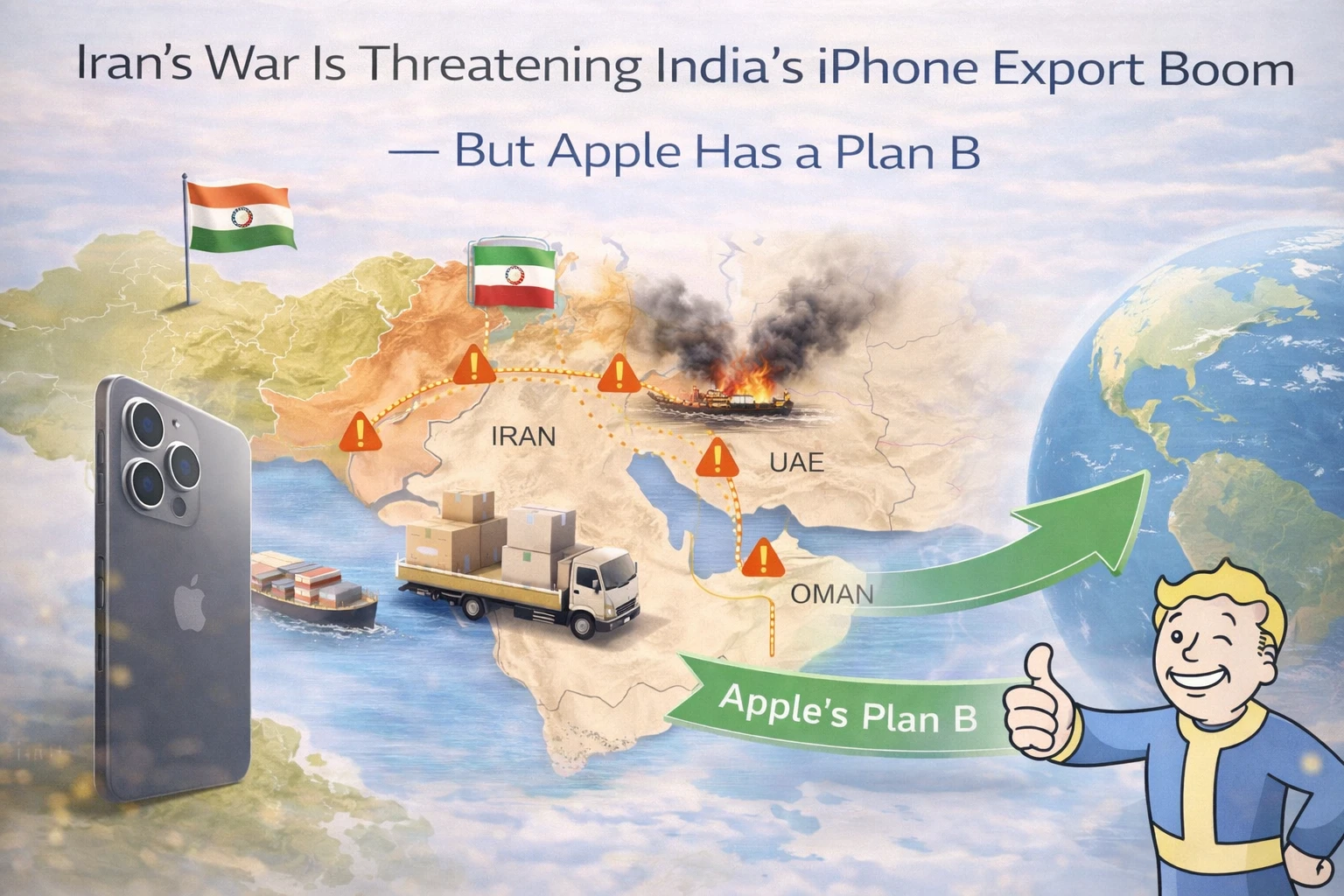
A significant chunk of India's smartphone exports flow through Middle East trade hubs — particularly Dubai in the UAE and Doha in Qatar. These aren't just destinations; they're redistribution centres. Goods shipped from India land in Dubai, get sorted and re-exported to Europe, Africa, Central Asia, and regional markets across the Gulf. It's how global supply chains work — hub-and-spoke logistics, with Middle Eastern ports as critical connecting points.
The ongoing conflict involving Iran has thrown this routing into chaos. Shipping through the Persian Gulf region has become riskier and more expensive. Insurance costs for cargo passing through affected zones have spiked. Airlines and shipping companies are rerouting, adding days and cost to journeys. The result: a bottleneck that's hitting India's smartphone export pipeline at exactly the worst time — right when the country had built momentum.
Analysts are warning that if the situation escalates further, smartphone exports from India could fall by 22% to 25% over the coming weeks. On a baseline of $11 billion in six months, a 25% drop translates to roughly $2-3 billion in lost export value. That's not a rounding error — that's real economic impact.
Why Apple is better placed than most
Here's where it gets interesting. Not all exporters are equally exposed to this disruption, and Apple is specifically cited as one of the large brands better positioned to absorb the impact.
The reason is scale and logistics sophistication. Apple's iPhone exports from India are large-scale, organised, and run through dedicated supply chain infrastructure built specifically for global distribution. When a trade route gets disrupted, Apple and its contract manufacturers can reroute shipments — moving cargo through alternative ports, direct routes, or different transit hubs — faster and more effectively than smaller operators.
Small and mid-sized smartphone traders — the ones who ship through informal channels, rely on regional brokers, and depend on Dubai or Doha as their primary redistribution points — don't have the same flexibility. They're more exposed because their entire logistics setup is built around those hubs. When the hubs get disrupted, they have fewer alternatives and less leverage with shipping companies.
So while the overall India smartphone export number may take a hit, Apple's share of that decline is expected to be smaller than the market average. The brand's global scale essentially acts as a buffer against regional disruptions.
What this means for Indian manufacturing — and Indian jobs
This situation matters beyond just Apple's quarterly numbers. India's smartphone manufacturing push has created real employment — Foxconn and Tata's Tamil Nadu plants employ tens of thousands of workers, many of them women from rural areas who've found formal sector jobs for the first time. When export volumes drop, production schedules get adjusted, and that has downstream effects on factory shifts and employment.
Tamil Nadu specifically has become the epicentre of India's iPhone production. The Foxconn plant in Sriperumbudur near Chennai is one of the largest iPhone assembly facilities outside China. The Tata Electronics plant in Hosur (where the former Wistron facility was acquired) adds to that concentration. A sustained export disruption would be felt most acutely in this region.
The silver lining, analysts note, is that demand for smartphones hasn't dropped. People still want to buy phones. The disruption is logistical — getting products from factories to end consumers through the affected trade routes — not a collapse in buying interest. That means once the routing situation stabilises, export volumes should recover. The question is how long the disruption lasts and how much inventory accumulates in warehouses while alternative routes get established.
The US tariff angle that makes this more complicated
India's manufacturing surge didn't happen in isolation. A big part of the push came from Apple's deliberate strategy to reduce its dependence on China, accelerated by the US-China trade war and American tariffs on Chinese-made goods. Moving iPhone production to India made sense as a hedge: if US-China tensions escalated further, Apple's India-made iPhones wouldn't face the same tariff exposure.
That logic still holds. But it also means India's iPhone exports are heavily weighted toward the US market — reportedly around 97% of India-made iPhones were shipped to the US between March and May 2025. The Iran conflict disrupts the Middle East routing more than the India-to-US direct routing. So ironically, Apple's heavy US export focus might actually insulate it somewhat from the Middle East disruption compared to brands that distribute more through Gulf hubs.
What Indian consumers should watch for
Right now, the disruption is primarily an export story — it's about India-manufactured phones going to other countries, not about iPhones available for sale within India. Indian consumers buying iPhones through Flipkart, Amazon India, or Apple's own stores are not directly affected by this export logistics situation.
Where Indian consumers might feel a longer-term effect: if sustained disruptions make India a less attractive manufacturing hub for global brands, the investment pipeline that's been driving job creation and PLI-incentivised expansion could slow. That's a multi-year concern, not an immediate one. In the near term, the iPhone 18 series is on track for production in India, and that timeline hasn't been reported as affected.
TamilTech's take
India's smartphone manufacturing story is real and genuinely impressive — $11 billion in exports in six months is not hype, it's a structural shift. The Iran conflict disruption is a stress test, and the fact that Apple is among the better-prepared companies reflects the advantage of scale and supply chain sophistication. The concern is for India's smaller smartphone traders and exporters who built their businesses around Middle East routes and don't have Apple's rerouting muscle. For them, the next few weeks are genuinely difficult. The bigger picture remains: India is now a serious manufacturing player in the global smartphone industry, and one regional conflict, while disruptive, is unlikely to reverse that trajectory permanently.





Comments (0)
Be the first to comment!