


Key Takeaways
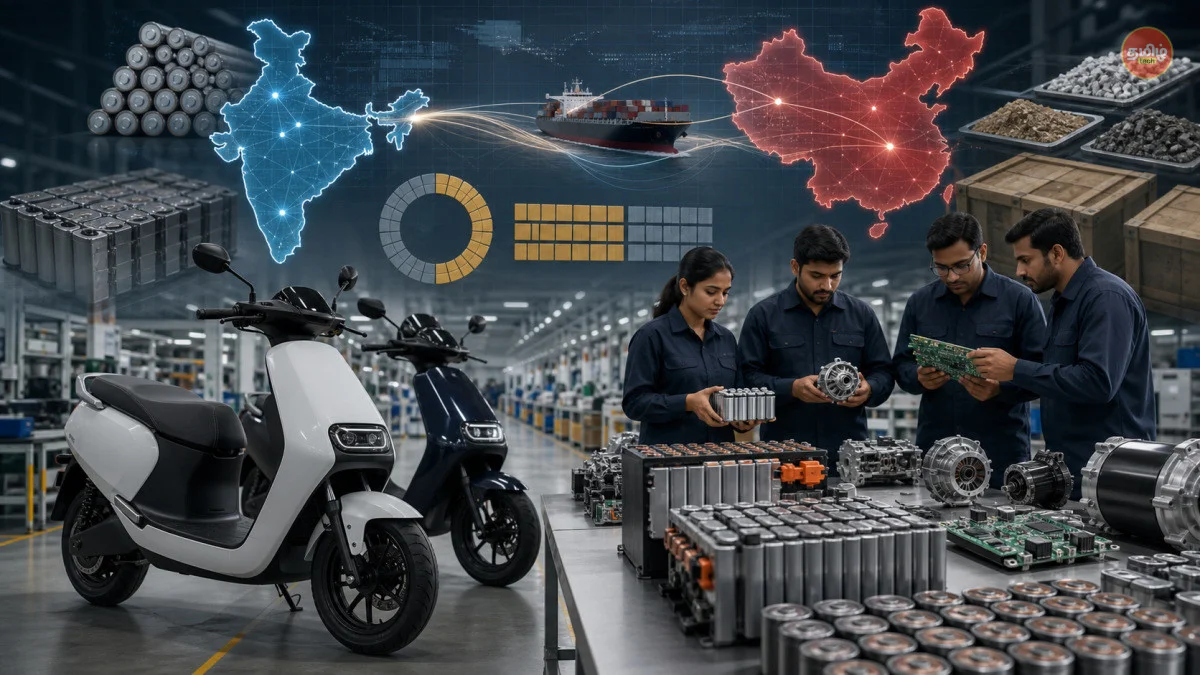
- India imports 70% of EV components from China, creating supply chain vulnerability
- Chinese EV giants like BYD and NIO control critical battery technology and rare earth minerals
- Government's FAME-II scheme worth ₹10,000 crore faces potential disruption
- Indian startups like Ola Electric and Ather Energy heavily dependent on Chinese parts
- Strategic alternatives include domestic manufacturing and partnerships with Japan/South Korea
What's the news
India's electric vehicle revolution is hitting a geopolitical roadblock. While the country aims for 30% EV sales by 2030, a staggering 70% of critical components still come from China. The recent border tensions have Indian automotive companies scrambling as Beijing tightens export controls on rare earth minerals and battery components.
The situation has escalated from trade concerns to strategic vulnerability. When Chinese companies like CATL and BYD control the battery supply chain, India's EV ambitions become hostage to Beijing's political whims. The FAME-II scheme, with its ₹10,000 crore subsidy fund, could face serious implementation challenges if component shipments get delayed or priced exorbitantly.
Details
India's EV ecosystem is heavily tilted toward Chinese imports. Battery cells, controllers, and even software platforms often originate from Chinese manufacturers. Companies like Ola Electric, Ather Energy, and TVS have built their entire product lines around Chinese component suppliers.
The dependency goes beyond just parts. Chinese companies control 60% of global rare earth processing, essential for high-performance EV motors. With China recently restricting rare earth exports to Japan, Indian companies face similar threats. The situation becomes critical as India's domestic manufacturing capabilities remain limited to assembly rather than component production.
India impact
The economic implications are staggering. India's EV market, currently valued at ₹1.5 lakh crore, could see growth stall if Chinese barriers persist. Job creation in the EV sector, projected at 10 lakh by 2030, faces uncertainty. Consumer prices might surge by 15-20% if companies absorb the higher component costs or pass them to buyers.
The government's push for Atmanirbhar Bharat in EVs faces its toughest test yet. While initiatives like PLI schemes aim to boost domestic manufacturing, the transition from assembly to full component production will take years. In the meantime, India's EV adoption rate, which has been growing at 40% annually, could decelerate significantly.
Use cases
For Indian startups, the situation creates both crisis and opportunity. Companies like Ola Electric might need to diversify their supply chains, potentially partnering with Japanese or South Korean battery manufacturers. The two-wheeler segment, which accounts for 70% of India's EV sales, faces the most immediate impact.
For consumers, the immediate concern is price stability and availability. The government might need to intervene with strategic reserves of critical components or fast-track domestic manufacturing approvals. Long-term, this could accelerate India's push for battery gigafactories in partnership with countries like South Korea and Japan.
Honest take
Let's be real - India's EV roadmap needs a serious reality check. While we celebrate the growth of companies like Ather and Ola, we're building houses on borrowed foundations. The dependence on China isn't just a trade issue; it's a strategic vulnerability that could derail India's clean energy goals.
The government needs to move beyond announcements and actually create incentives for domestic component manufacturing. We can't keep celebrating assembly units as if they're manufacturing powerhouses. The time for strategic partnerships with non-Chinese countries and aggressive domestic capability building is now, not when the barricades are already up.
India's EV future shouldn't be held hostage by geopolitical games. We need a comprehensive strategy that addresses immediate supply chain concerns while building long-term domestic capabilities. The road to electric mobility might pass through Beijing today, but we need to build alternative routes before Beijing decides to close the highway entirely.


Comments (0)
Be the first to comment!